
Key Players by Sector and India Marketing Market Stats FY26
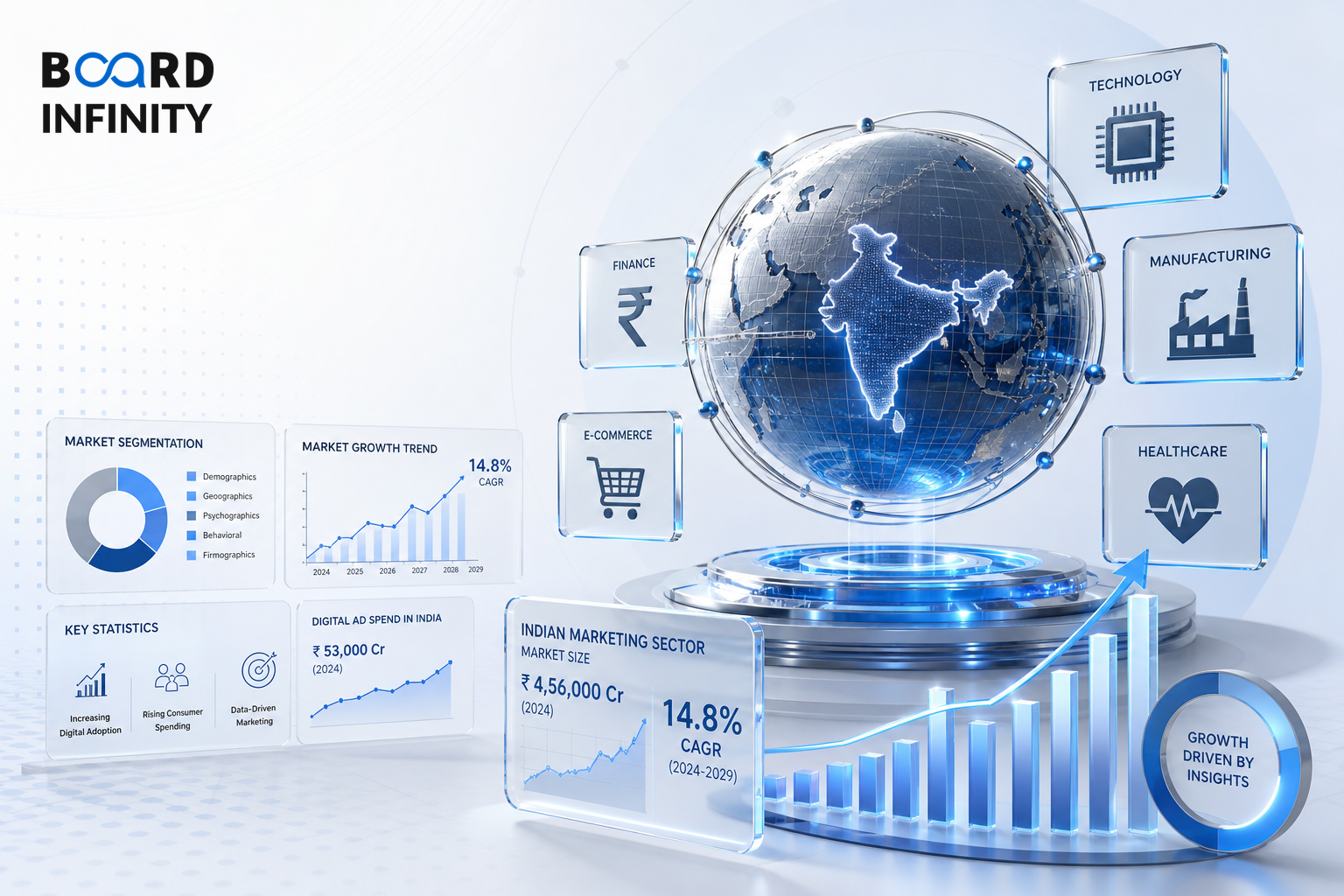
India marketing cases are stronger when they are anchored in current market size, consumer behaviour, and named sector examples rather than generic strategy language. This FY26 cheat sheet gives you the numbers, trends, and company anchors needed to discuss fast-moving consumer goods, direct-to-consumer brands, digital advertising, quick commerce, Bharat growth, and premiumisation in India. Use it as a reference when you need to size an opportunity, choose a channel, or justify a go-to-market decision in a case answer.
- India's FMCG market is estimated at ~$220-288B in 2025 and is projected to cross $1T+ by 2033-34 at 14-17% CAGR.
- D2C in India is already an $80B+ market in 2024, projected to cross $100B+, with 800+ D2C-first brands across beauty, personal care, food, and electronics.
- The digital ad market is $13.6B in 2024 and is projected to reach $32.3B by 2030 at 15.3% CAGR, making digital media central to most marketing plans.
- Bharat is not a side market: 65% of India's population is rural, rural FMCG volume growth is 8.4% versus urban 2.6%, and the next 500M consumers are expected from Tier 3-5 towns and villages.
- Quick commerce players Blinkit, Zepto, and Swiggy Instamart are reshaping FMCG distribution, with the category at $5B in FY25 and projected at $9.9B by FY29.
- UPI processed ₹23.48 Lakh Cr in Jan 2025, and with PhonePe at 48% share and Google Pay at 37%, payments data is becoming a marketing intelligence layer.
- IPL, vernacular content, social commerce, AI-driven MarTech, premiumisation, and sustainability are the most useful trend anchors for FY26 India marketing cases.
Think of India marketing in FY26 as a stack: market size gives the opportunity, consumer shifts explain where growth is coming from, channels decide how brands reach users, and named sector examples make your answer believable.
India Marketing Market Stats for FY26
The first job in a marketing case is to place the opportunity in context. FMCG, or fast-moving consumer goods, refers to frequently purchased categories such as packaged food, personal care, and household products. India’s FMCG market is estimated at ~$220-288B in 2025 and is projected to cross $1T+ by 2033-34 at 14-17% CAGR, or compound annual growth rate, which means the annualised growth rate over a period.
D2C, or direct-to-consumer, means brands selling directly to consumers through their own websites, marketplaces, social platforms, or commerce tools instead of depending only on traditional retail. The D2C market is $80B+ in 2024, projected to cross $100B+, with 800+ D2C-first brands. YoY, or year-on-year growth, compares a metric with the same period in the previous year; total ad spend is ₹1.11 Lakh Cr, up +11% YoY.
The nuance is that these numbers should not be used mechanically. A rural sachet-pricing case, a premiumisation case, and a quick commerce impulse-purchase case may all sit inside FMCG, but the growth driver, channel, and consumer expectation can be very different.
Key Players by Sector
Named examples help interviewers see that you understand the Indian market rather than only textbook marketing. In FY26-style answers, the useful move is to connect each company to a sector pattern: beauty and personal care D2C, food and health-led brands, electronics-led D2C, and fast delivery-led distribution.
Do not treat these as interchangeable logos. Nykaa and Sugar are useful when the question is about beauty-led D2C. Blinkit, Zepto, and Swiggy Instamart are more relevant when the question is about distribution speed, impulse baskets, or channel conflict with traditional FMCG retail.
Ten Defining Trends in India Marketing
The most reusable way to remember the FY26 India market is to group the trends into demand, distribution, media, data, and brand trust. IPL, or the Indian Premier League, is a cricket league and marketing property with ₹5,000+ Cr ad revenue per season and 400M+ viewers. UPI, or Unified Payments Interface, is India’s instant digital payments system and is now also a source of behavioural signals for marketers.
AI means artificial intelligence, and GenAI means generative artificial intelligence, which can create text, images, recommendations, or decision support. MarTech means marketing technology, such as tools for targeting, personalisation, pricing, and content automation. ESG means environmental, social, and governance factors, used to evaluate a company’s sustainability and responsibility commitments.
Bharat vs India: The Most Important Consumer Split
The phrase Bharat vs India is a shorthand for the difference between rural and smaller-town consumers on one side and more urban, metro-led consumers on the other. It matters because 65% of India’s population is rural, and rural FMCG volume growth at 8.4% is ahead of urban growth at 2.6%. For many mass brands, the next 500M consumers will come from Tier 3-5 towns and villages.
The marketing implication is not just wider distribution. Brands typically need vernacular content, smaller packs, and affordability-led choices such as sachet pricing. Since 70% of India’s next internet users will be non-English speakers, language strategy can directly affect reach, trust, and conversion.
The common nuance is that Bharat is not automatically low-value. Premiumisation can still appear in smaller markets depending on category and income segment, but a candidate should first prove that reach, language, and pricing barriers have been addressed.
Digital Demand Stack: Ads, UPI, Social Commerce, and AI
India’s digital demand stack is now broader than social media ads alone. The digital ad market is $13.6B in 2024 and is projected to reach $32.3B by 2030 at 15.3% CAGR. With 950M+ internet users and ~55% penetration, marketers have massive digital reach while still having room for new internet users to enter.
UPI adds a payments and behaviour layer. In Jan 2025, UPI processed ₹23.48 Lakh Cr, with PhonePe at 48% share and Google Pay at 37%. In marketing terms, this means transactions can reveal spending patterns, purchase frequency, and category behaviour, though the exact use depends on the business model and data access.
For interviews, avoid saying digital is the answer to every problem. Digital helps most when the target consumer is reachable, the category can be explained or demonstrated online, the transaction path is simple, and the brand can measure conversion or repeat behaviour.
IPL, Premiumisation, and Purpose as Brand Builders
Not every marketing case is solved through performance media. IPL is India’s biggest marketing event, with ₹5,000+ Cr ad revenue per season and 400M+ viewers. Since it runs for 2 months, major brands plan campaign calendars around it, similar to the role of a large national advertising property.
Premiumisation is another major brand-building trend. India has a 400M+ middle class trading up across categories, and the premium segment is growing 2-3× faster than mass. Consumers are willing to pay more for quality, health, and experience, which makes examples like Yogabar useful in food and health-led positioning cases.
Sustainability and purpose are also moving from optional brand polish to a stronger purchase factor. 73% of Indian millennials are willing to pay a premium for sustainable brands, and ITC’s sustainability story and Tata’s brand trust are benchmarks. The nuance is that purpose claims must be credible; otherwise, they can weaken trust rather than strengthen it.
Worked Example: Quick Commerce Changes an FMCG Launch
Consider a packaged consumer brand planning an FY26 India launch. The old default might be to focus mainly on traditional retail distribution and broad advertising. But with Blinkit, Zepto, and Swiggy Instamart building a $5B FY25 quick commerce market projected at $9.9B by FY29, 10-minute delivery can change the launch logic.
The decision is not that every FMCG product must prioritise quick commerce. The better answer is that quick commerce is especially useful when speed, replenishment, convenience, or impulse buying changes the consumer’s likelihood of purchase.
Reusable FY26 India Marketing Answer Framework
When you face a market-entry, growth, or media-mix case, use a simple sequence: size the market, identify the growth pocket, select the channel, name examples, and state the risk. This keeps the answer structured while letting you plug in the right FY26 India facts.
Conclusion
The core idea is simple: FY26 India marketing cases reward candidates who connect market size with consumer shifts, channels, and named examples. If you remember the big anchors - FMCG scale, D2C growth, digital ads, Bharat, UPI, IPL, quick commerce, premiumisation, social commerce, AI, and sustainability - your answers will sound current, practical, and India-specific.
The most frequent error is quoting a big India number without linking it to the case decision. A ₹1.11 Lakh Cr ad market or a $80B+ D2C market only earns points when you explain what it changes - target consumer, channel choice, pricing, language, or distribution.