
Nykaa's Content-Led D2C Growth
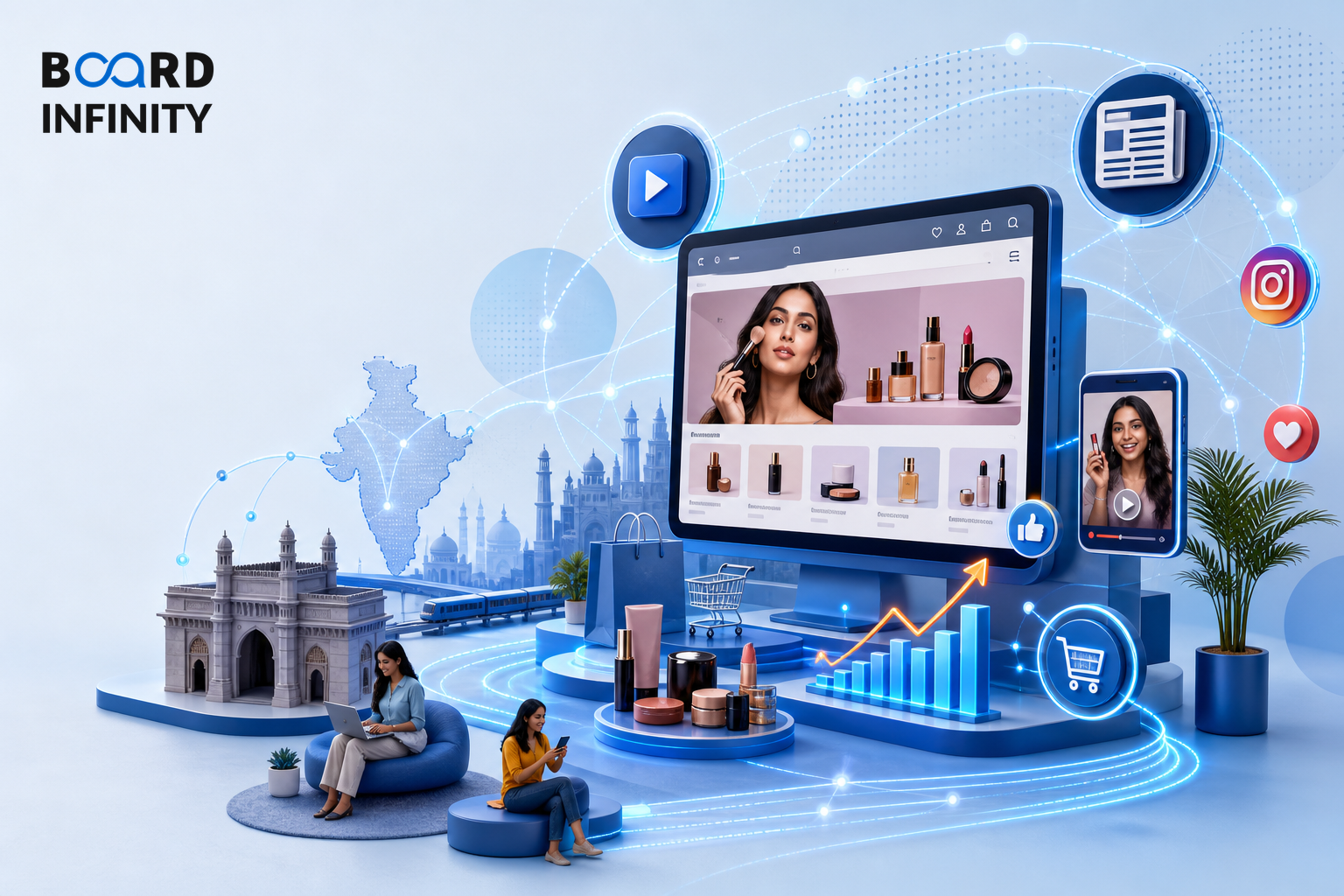
In the previous case on Jio's penetration pricing disruption, the core idea was how pricing can rapidly expand adoption. Nykaa answers a different but equally interview-relevant question: what happens when price alone is not enough because consumers need education, trust and confidence before buying? This case matters because beauty is a high-consideration category, and Nykaa shows how content-led commerce can outperform a purely performance-marketing-led direct-to-consumer funnel.
- Nykaa launched in 2012 as an online beauty retailer and IPO'd in 2021 at a ~₹53,000 Cr valuation.
- Its key differentiator in a market dominated by offline beauty counters was content plus curation, not just online availability.
- Nykaa's funnel can be understood as Educate - Trust - Transact - Retain, instead of Advertise - Transact.
- Its content engine included YouTube tutorials, blog posts and beauty guides, with the content team producing 1,000+ pieces per month.
- The influencer ecosystem combined beauty mega-influencers, micro-influencers and employee creators to create a content - discovery - purchase - review - more content flywheel.
- Private labels such as Nykaa Cosmetics and Kay Beauty contributed 10%+ of revenue and gave Nykaa higher-margin, exclusive reasons to shop on the platform.
- Nykaa scaled trust through 150+ retail stores, Nykaa Network, reviews on every product page, ₹6,385 Cr revenue in FY24, 32M+ annual transacting customers and a repeat rate where >40% of orders came from repeat customers.
Big Picture: Why Nykaa Is a Trust-Led Commerce Case
Nykaa is best understood as a marketplace and brand-building case where the purchase decision starts much before checkout. In beauty, consumers typically want to know what a product does, whether it suits them, how to use it and whether other users trust it. Nykaa built its growth strategy around solving that trust gap.
Nykaa: The Full Framework in One Business
Nykaa demonstrates the full content-led D2C growth framework because it did not rely on only one lever. The company combined education, influencer credibility, owned brands, offline trust-building and user-generated community signals into one connected system.
A shallow answer says Nykaa grew because it sold beauty online. A complete answer explains how content, community, private labels and omnichannel trust worked together to convert a high-consideration category into repeat commerce.
For high-consideration categories, the stronger funnel is Educate - Trust - Transact - Retain, not Advertise - Transact.
What Content-Led D2C Growth Means
D2C means direct-to-consumer, where a brand or platform sells directly to end customers instead of depending only on traditional distribution. In Nykaa's case, the important idea is not just online selling, but using content to guide the consumer before the purchase decision.
Content-led growth means customers discover, understand and trust products through useful content before they transact. For Nykaa, this included YouTube tutorials, blog posts and beauty guides. The source makes the strategic point clearly: in categories where consumers need education before purchase, such as beauty, health, financial products and technology, content-led commerce beats performance-only strategies.
Performance marketing refers to paid marketing where brands spend to drive measurable actions such as clicks, app installs or purchases. It can be useful, but a performance-only approach assumes the buyer is already ready to transact. Nykaa's case shows that in beauty, the bigger constraint was often confidence, not only awareness.
Why Beauty Needed More Than Online Distribution
Nykaa entered a market dominated by offline beauty counters. Offline counters had an advantage because beauty often needs touch-and-try, personal reassurance and product explanation. A customer choosing a lipstick, skincare product or makeup item may hesitate if the product feels unfamiliar or if usage is unclear.
Nykaa's differentiator was content plus curation. Curation means selecting, organising and presenting products in a way that makes customer choice easier. For an online beauty retailer, curation matters because more assortment can create more confusion unless the platform also helps the customer decide.
This is why Nykaa's strategy should not be interpreted as a simple e-commerce story. The deeper case is about reducing purchase anxiety. Tutorials educated users, influencers made products feel more relatable, reviews gave social proof, private labels created exclusivity and stores gave offline validation.
Content-Led Discovery: Educating Before Selling
Nykaa's content-led discovery engine included YouTube tutorials, blog posts and beauty guides. The source states that Nykaa's content team produced 1,000+ pieces per month. That scale matters because content in beauty is not a one-time campaign - it has to cover products, use cases, routines, skin concerns, looks and purchase doubts.
The interview insight is that content does two jobs at once. First, it creates discovery by bringing consumers into the Nykaa ecosystem. Second, it builds confidence by explaining how products work. In a high-consideration category, this can be more valuable than simply showing an advertisement and asking for immediate purchase.
Nykaa's content impact was visible through its YouTube channel with 2M+ subscribers and its blog with 10M+ monthly visits. These metrics show that content was not a side activity; it was part of the consumer acquisition and trust-building system.
Influencer Ecosystem: Awareness Plus Authenticity
Nykaa did not use only one type of creator. Its influencer ecosystem was tiered: beauty mega-influencers for awareness, micro-influencers for authenticity and employee creators. This matters because each creator type plays a different role in the funnel.
Mega-influencers typically help with reach and visibility. Micro-influencers can feel more authentic because their audiences may see them as closer to everyday users. Employee creators can add an internal, brand-owned layer of explanation. Together, these roles supported the flywheel described in the source: content - discovery - purchase - review - more content.
The nuance for interviews is that influencer marketing should not be treated as only a top-of-funnel awareness tool. In Nykaa's case, it worked with tutorials, reviews and community signals to reduce purchase hesitation across the journey.
Private Labels: Margin, Exclusivity and Brand Control
Nykaa's private labels included Nykaa Cosmetics and Kay Beauty, with Kay Beauty linked to a Katrina Kaif partnership. The source states that these private labels contributed 10%+ of revenue. That is strategically important because private labels can give a platform more margin than third-party brands.
Private label means a product brand owned or controlled by the retailer or platform itself. For example, Nykaa Cosmetics is not just another listed brand; it is a Nykaa-owned brand that gives customers an exclusive reason to shop there. Kay Beauty similarly created differentiation through a named partnership.
The strategic benefit is two-sided. On the customer side, exclusivity can improve brand recall and platform loyalty. On the business side, higher margins than third-party brands improve the economics of the model. However, private labels work best when the platform has already built trust; otherwise, customers may hesitate to buy an unfamiliar owned brand.
Omnichannel Expansion: Offline Stores as Trust Builders
Omnichannel means serving customers through multiple connected channels, such as online platforms and physical stores. Nykaa opened 150+ retail stores in malls across India. This was not a contradiction of its online identity; it was a way to solve the physical trust gap in beauty.
Beauty often needs touch-and-try. Customers may want to see shades, test textures or simply feel more confident that the brand is credible. Nykaa's offline stores helped build trust and also served as marketing for the online platform.
The nuance is that omnichannel expansion is not only about distribution. In Nykaa's case, stores also had a brand-building role. They made the online platform feel more tangible in a category where offline beauty counters had historically shaped buying behaviour.
Community Building: Reviews, Nykaa Network and Loyalty
Nykaa built community through Nykaa Network, a beauty community forum, and user reviews on every product page. User-generated content means content created by users, such as reviews, posts or recommendations. In commerce, user-generated reviews can reduce purchase anxiety because they show real customer experiences.
The community layer strengthened retention. The source states that Nykaa had 32M+ annual transacting customers and that >40% of orders came from repeat customers. Repeat behaviour matters because it suggests the customer relationship was not limited to one-time acquisition.
Community also completed the content flywheel. A customer discovers content, buys a product, leaves a review or participates in discussion, and that user signal helps the next customer decide. This is why Nykaa's strategy is stronger than a simple paid-ad funnel.
Worked Example: How Nykaa Turned Purchase Anxiety Into Repeat Commerce
Consider the central business problem Nykaa had to solve: Indian consumers were used to offline beauty counters, while online beauty buying required trust without physical trial. Nykaa's response can be broken into a full case-interview structure.
The key learning is not that every D2C brand should copy every Nykaa tactic. The reusable insight is to identify the customer's purchase anxiety first, then design content, community and channel choices around reducing that anxiety.
Where This Case Applies Beyond Beauty
The source explicitly extends Nykaa's lesson to categories where consumers need education before purchase: beauty, health, financial products and technology. These are high-consideration categories because customers often compare options, worry about suitability and need confidence before spending.
For interviews, this is where the case becomes broadly useful. If asked about a D2C brand, a marketplace, a fintech product or a health product, you can ask whether the customer needs education before purchase. If yes, a content-led funnel may be more persuasive than a performance-only funnel.
The nuance is that content does not replace commerce fundamentals. The business still needs the right assortment, trust signals, product availability and retention loop. Nykaa worked because content was connected to curation, private labels, stores and community rather than operating as an isolated brand activity.
Structuring a Case Study Interview Answer
"Nykaa grew in a category where offline beauty counters were dominant. How would you explain its growth strategy, and what can other D2C brands learn from it?"
The best answers do not say "Nykaa used content" and stop there. They show how content connected to trust, private labels, offline stores, reviews and repeat behaviour.
The most frequent error is treating Nykaa as a generic e-commerce success story. That misses why the case is valuable: Nykaa solved the trust problem in a high-consideration category before pushing for transaction, which is exactly the strategic insight interviewers are testing.
Conclusion
Nykaa's content-led D2C growth shows that in categories where customers need education before purchase, trust can be the real acquisition engine. Its success came from connecting content, influencers, private labels, stores and community into one funnel: Educate - Trust - Transact - Retain.