
Indian Market Nuances in Consumer Goods & Retail
“India is price-sensitive” is the lazy answer. Walk into a kirana, a quick-commerce cart, a mall fashion store and a wedding-shopping lane on the same day, and you will see something sharper: Indian consumers are value-sensitive, context-sensitive and highly local.
The same household may buy a small shampoo sachet, a premium phone, branded atta, discount apparel and express-delivered ice cream. That is the nuance recruiters want you to understand.
- India is not one market; it is a set of micro-markets shaped by region, income, language, climate, food habits and retail access.
- The core consumer tension is not “cheap versus premium”; it is value, trust, convenience and aspiration in different combinations.
- Winning consumer goods players adapt the 4Ps: product format, pack size, price ladder, channel mix and communication language.
- General trade still matters because kiranas influence availability, trust, credit, visibility and last-mile reach.
- Modern trade, e-commerce, quick commerce and D2C add data and speed, but they do not replace local execution discipline.
- Use metrics like numeric distribution, weighted distribution, repeat rate, gross margin and inventory turns to prove your argument.
- The biggest interview mistake is treating India as “poor and price-sensitive” instead of explaining its layered consumption behaviour.
Big Picture: India Is a Micro-Market Machine
The best way to understand Indian consumer goods and retail is to think in loops, not straight lines. A brand learns local behaviour, adapts the offer, executes through the right channel, reads demand signals, and then improves again. If you want the overall industry structure before this nuance layer, revise Consumer Goods & Retail at a Glance: Size, Growth & Structure first.
The Core Explanation: The 6 Nuances That Actually Matter
In interviews, do not list random facts about India. Organise the answer around the six forces that change how a consumer goods or retail business must operate.
1. Regional India Beats Average India
Food habits, festivals, climate, language, shopping frequency and family structures vary sharply across states and cities. A snack, apparel format, personal care pack or grocery assortment that works in one region may need a different flavour, size, fabric, shade, shelf placement or communication style elsewhere.
Interview-ready line: “India is better read as a cluster of regional demand systems than as a single national consumer profile.”
2. Price Sensitivity Is Really Value Sensitivity
Indian consumers may bargain hard in one category and pay a premium in another. The same buyer can be frugal on staples but aspirational in beauty, electronics, fashion or children’s products. That is why smart companies build price ladders: entry packs, core packs, family packs, premium variants and festive bundles.
3. Pack Size Is Strategy, Not Packaging
Small packs reduce trial risk and cash outflow. Large packs reward monthly stock-up behaviour. Single-serve formats fit convenience consumption. Refill packs suit repeat categories. In India, pack architecture often decides whether a product can enter a household at all.
So what: When asked about launch strategy, talk about “pack-price architecture,” not just “low price.”
4. Channel Mix Is Fragmented by Design
India has kiranas, wholesalers, modern trade, chemists, beauty stores, marketplaces, D2C websites, quick commerce, social commerce and local specialists. Each channel performs a different job.
If you want to connect these channels to sourcing, manufacturing, distribution and retail margins, revise How the Consumer Goods & Retail Value Chain Works.
5. Trust Is a Commercial Asset
Trust in India is built through many signals: known brand name, retailer recommendation, family usage, visible quality, hygiene cues, reviews, return policy, influencer credibility and after-sales service. In food, baby care, beauty, appliances and health-linked categories, trust can outweigh a small price difference.
6. Execution Beats PowerPoint Strategy
A brilliant consumer insight fails if the distributor does not replenish, the kirana does not stock, the store associate cannot explain the product, the app image is poor, or the product is unavailable during a festival demand spike. In Indian retail, strategy lives in the last mile.
Definitions You Can Say Cleanly
- Consumer goods: Products bought by end consumers for personal or household use, usually classified as durable, semi-durable or non-durable.
- Retailing: Selling goods or services directly to final consumers for personal, non-business use.
- General trade: Traditional retail channels such as kiranas, local stores, wholesalers and distributors.
- Modern trade: Organised retail formats such as supermarkets, hypermarkets, department stores and chain outlets.
- Route-to-market: The path a product takes from manufacturer to consumer through distributors, retailers, platforms or direct channels.
- Pack-price architecture: Designing pack sizes and price points to serve different usage occasions, budgets and channels.
How to Diagnose Indian Market Nuance Using Metrics
Nuance is not just storytelling. In a good interview answer, you support your logic with operating metrics. Benchmarks differ by category, so compare against direct peers, the same channel and the same time period rather than quoting fake universal standards.
Mini worked example: Suppose a snack brand is stocked in 2,000 of 10,000 relevant stores. Its numeric distribution is 20%. But if those 2,000 stores account for 45% of the category’s sales in that city, weighted distribution is 45%. That means the brand has chosen fewer but more valuable outlets - a better launch signal than outlet count alone.
Case Study: iD Fresh Food and the Indian Freshness Code
iD Fresh Food turned a deeply local Indian kitchen habit - fresh batter and ready-to-cook staples - into a modern chilled retail proposition.
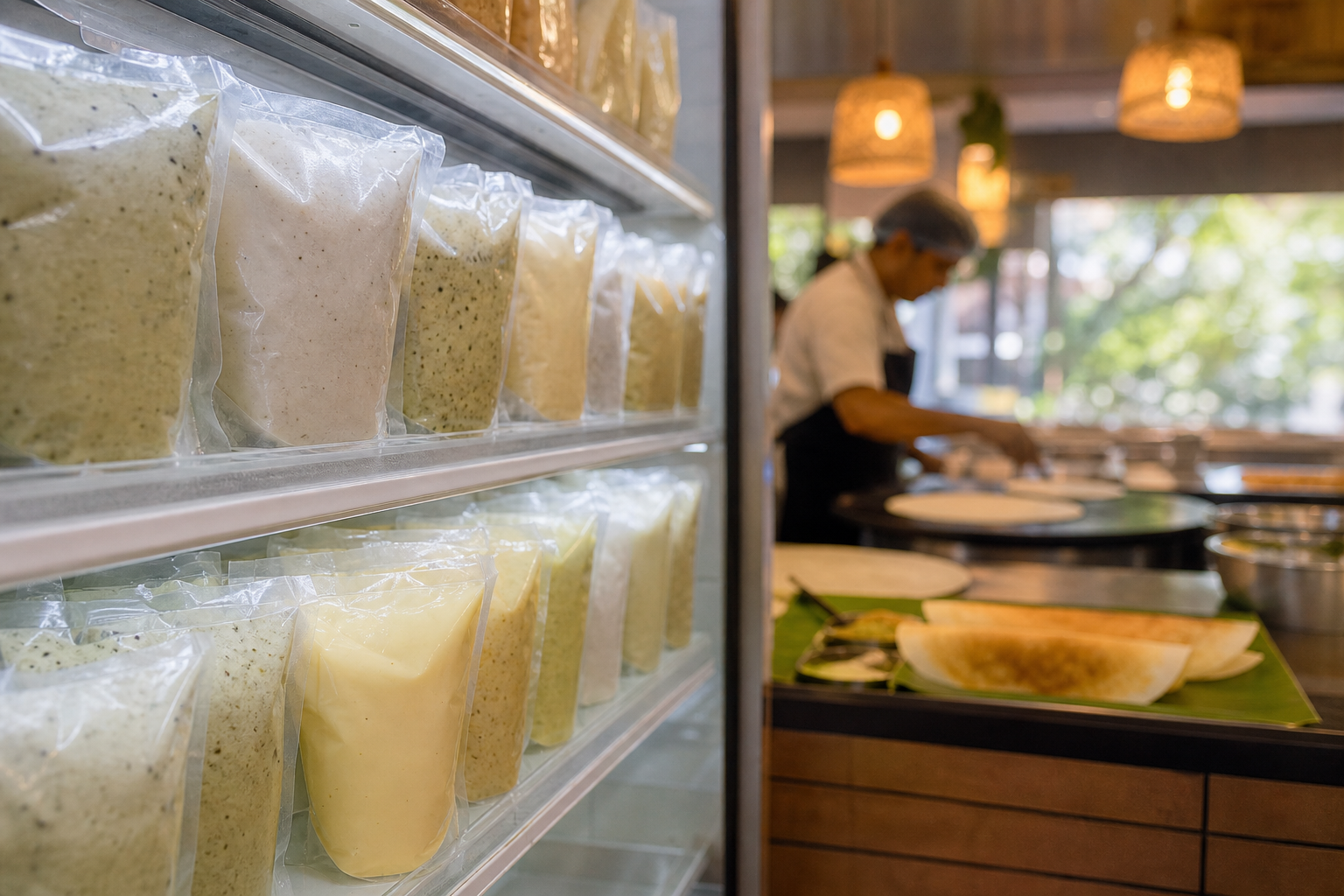
Situation: Many Indian households want traditional foods like idli, dosa, parota and chapati, but urban routines make preparation time, consistency and hygiene harder. The consumer need was not “new cuisine”; it was familiar food with lower effort and higher reliability.
The move: iD Fresh focused on ready-to-cook fresh foods rather than shelf-stable packaged food. That choice made the business harder operationally because chilled supply, short shelf life, daily replenishment and retailer discipline matter. But it also created a strong trust signal: freshness, convenience and authenticity in categories where households are cautious.
Why it worked strategically: The primary driver was deep fit with Indian food habits. Supporting drivers included urban time pressure, modern retail and grocery availability, clear product visibility, chilled distribution discipline, and a brand promise built around freshness rather than only price.
Lesson: The best India strategies do not blindly “premiumise” or “discount.” They translate a local habit into a scalable product, price, channel and operating model.
How AI Changes Indian Market Nuances in Consumer Goods & Retail
AI does not remove Indian complexity; it helps companies detect and act on it faster.
- Hyperlocal demand sensing: AI models can combine store sales, search behaviour, weather, festivals, local events and stock-outs to recommend assortment by pin code or store cluster. This matters because Indian demand changes sharply by locality and occasion.
- Vernacular and cultural content testing: Brands can create and test product descriptions, ad copy, WhatsApp scripts and marketplace content in multiple Indian languages. The risk is stereotyping; the safeguard is human review by people who understand the region.
- Retail execution intelligence: Computer vision and field-force analytics can track shelf availability, planogram compliance, promoter productivity and competitor visibility. This makes the last mile more measurable.
Use NotebookLM or ChatGPT with three inputs: a company annual report, marketplace reviews and this lesson. Ask: “Identify five India-specific market nuances affecting this company, classify each under product, price, channel or execution, and generate likely interview questions.” For safe prompting habits, revise Using AI to Research a Sector Without Importing Its Errors.
Interview Relevance
“Suppose you are launching a new packaged food or personal care brand in India. What Indian market nuances would shape your go-to-market strategy?”
Use one Indian example in your answer. Even a short line like “iD Fresh shows how a familiar Indian habit can become a modern chilled retail category” makes your answer sound grounded.
Common Mistake
The mistake that costs candidates is saying “India is price-sensitive” and stopping there. It sounds shallow because it ignores aspiration, trust, regional habits, channel fragmentation and execution. Fix: say “India is value-sensitive, but value means different things by category, channel and occasion.”