
Where AI Is Landing in Consumer Goods & Retail
Five years ago, a category manager often began Monday by reconciling last week’s sales in spreadsheets and arguing with the sales team about what to replenish. Now the same decision can start with an AI forecast that sees weather, promotions, stockouts, search behaviour and store-level demand before the human meeting begins.
That is the real shift: AI in consumer goods and retail is not “robots replacing shops.” It is decision intelligence being inserted into the messy places where demand is uncertain, margins are thin, and speed matters.
- AI lands where retail has repeated decisions: demand forecasting, assortment, pricing, promotions, recommendations, replenishment, store operations and customer service.
- The core mental model: AI converts data into better predictions, and better predictions into faster commercial decisions.
- Front-end AI improves discovery and conversion through search, recommendations, chat assistants and personalisation.
- Middle-office AI improves category, price and promotion choices by simulating demand, margin and inventory impact.
- Back-end AI improves supply chain execution through demand sensing, replenishment, route planning, shrink detection and labour scheduling.
- The business test is not “AI accuracy.” The test is incremental profit, lower stockouts, better inventory turns, higher conversion or lower operating cost.
- Best interview line: “AI creates value only when it is embedded into a decision workflow, not when it sits as a dashboard nobody acts on.”
Big Picture - AI Is Moving Retail from Reactive to Predictive
Consumer goods and retail companies win by matching the right product, at the right price, in the right channel, at the right moment. AI helps because every one of those words - product, price, channel, moment - is a prediction problem. If you need the base business flow first, revise how the consumer goods and retail value chain works before going deeper.
Where AI Actually Lands Across the Consumer Goods and Retail Value Chain
The easiest way to understand AI in this sector is to follow the flow of decisions. It starts with understanding demand, then shaping demand, then fulfilling demand profitably.
The important interview insight: AI does not “sit in technology.” It sits inside merchandising, sales, supply chain, marketing and store operations. That is why consumer goods and retail recruiters like candidates who can connect AI to commercial levers, not just tools.
The Four-Quadrant Map - Which AI Use Cases Matter First?
Not every AI idea deserves funding. The best way to prioritise is to compare business value with implementation feasibility. A high-value, high-feasibility use case should be piloted before a glamorous but operationally hard one.
The Core Idea - AI Creates Value Only When Prediction Changes Action
AI in consumer goods and retail follows a simple commercial chain:
This is why “we have an AI dashboard” is weak. A dashboard informs. A decision system changes the next replenishment order, the next offer, the next shelf allocation or the next customer response.
How to Measure Whether Retail AI Is Working
There is no universal “good” number across grocery, fashion, beauty, electronics and FMCG. A strong result is one that beats the retailer’s own baseline or a clean control group without damaging another key metric.
Notice the pattern: the best AI metrics are business metrics with a model attached. Do not stop at model accuracy unless you can explain what commercial decision it improves.
Definitions You Should Be Able to Say Cleanly
AI in retail is the use of learning systems to improve demand, pricing, assortment, fulfilment and customer decisions.
Machine learning means algorithms learn patterns from data and improve predictions or decisions without being explicitly programmed for every rule.
Generative AI creates new text, images, code or recommendations from learned patterns, usually through large foundation models.
Demand sensing uses near-real-time signals to update short-term demand forecasts faster than traditional planning cycles.
Case Study - Lenskart: AI Where Online Choice Meets Offline Trust
Lenskart shows how AI-led retail works best when it reduces purchase uncertainty and is supported by stores, product data and fulfilment capability.
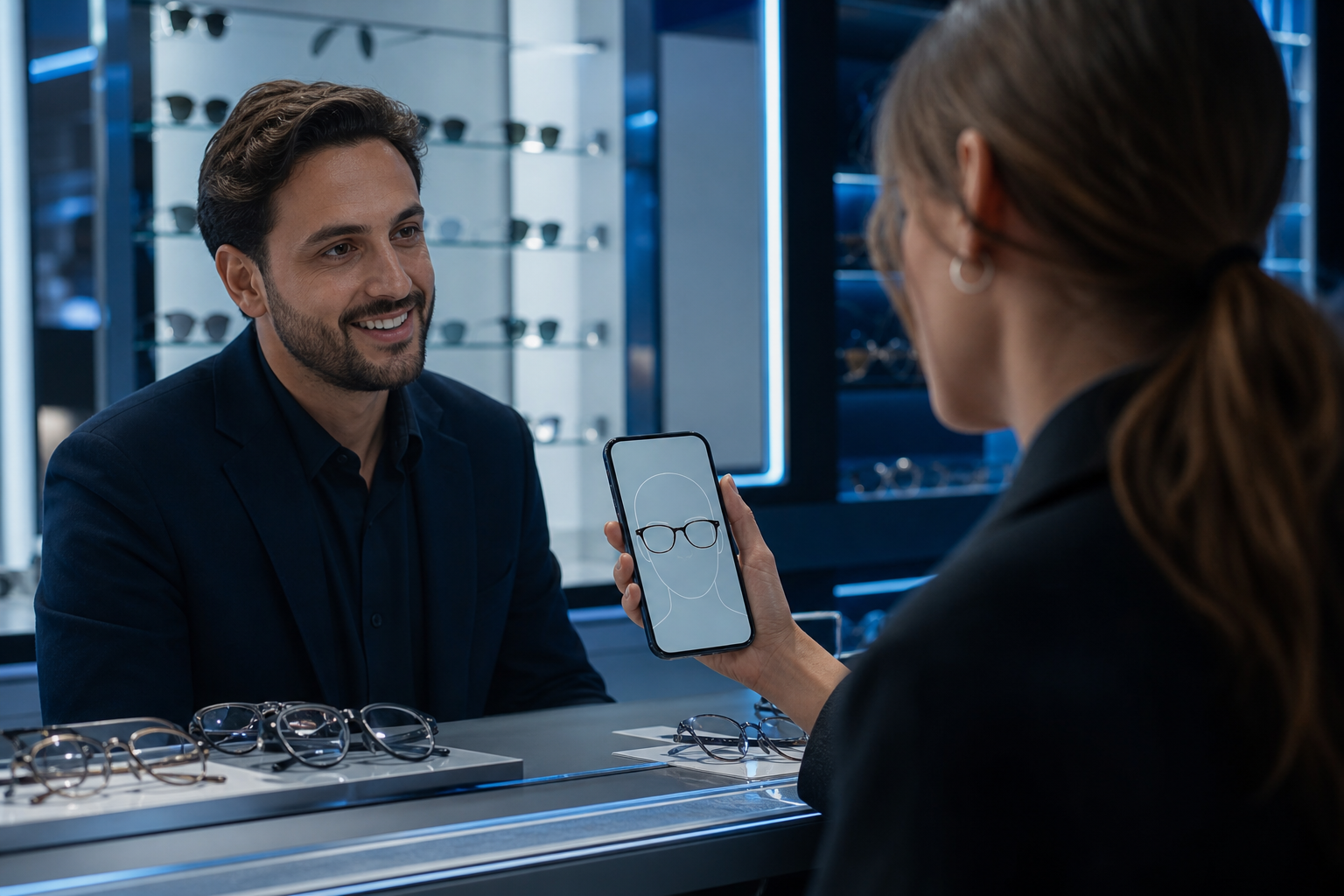
Eyewear is a difficult retail category because customers worry about fit, face shape, lens quality, prescription accuracy and after-sales service. Pure online convenience is attractive, but the product is personal and functional, so trust matters.
Lenskart’s strategic move was not simply “use AI.” It built an omnichannel experience where digital discovery and offline assurance support each other. Virtual try-on and recommendation-led browsing reduce fit uncertainty; stores and eye-testing services build trust; structured frame and lens data make digital journeys easier; fulfilment integration helps convert interest into purchase.
The lesson for interviews: Lenskart’s primary driver is reducing purchase uncertainty in eyewear. Supporting drivers are omnichannel stores, structured product data, service trust and fulfilment integration. That complete answer is much stronger than saying “Lenskart uses virtual try-on.”
How AI Changes Consumer Goods and Retail in 2026
AI is no longer a side experiment in this sector. It is becoming part of how brands and retailers plan, sell and operate.
Generative AI adds a second layer: faster catalogue content, product descriptions, service-agent assistance, sales scripts, synthetic research summaries and internal knowledge search. But the same rule applies - the output must improve a decision or save measurable effort.
Use NotebookLM or Claude with a company annual report, investor presentation and product pages. Ask: “List where AI could improve demand, pricing, supply chain, stores and customer experience. For each, name the business metric it should affect.” Then verify every claim using the company document. For a safer workflow, revise using AI to research a sector without importing its errors.
Interview Relevance
“Where do you think AI will create the most value in consumer goods and retail, and how would you prioritise use cases for a company like a supermarket chain or D2C brand?”
If the interviewer names a company, do not give a generic AI answer. Anchor it in that company’s channel mix, category economics and value chain. For company prep, use reading an annual report for sector insight to identify where margin, inventory or growth pressure sits.
Common Mistake
The mistake is treating AI as a technology feature instead of a commercial operating lever. Candidates say “chatbots, recommendations, automation” but never explain which decision changes or which metric improves. The fix: always answer in the chain use case - decision - metric - risk.