
Liquidity Risk, ALM & Fatal Mismatches: Interview-Ready Framework
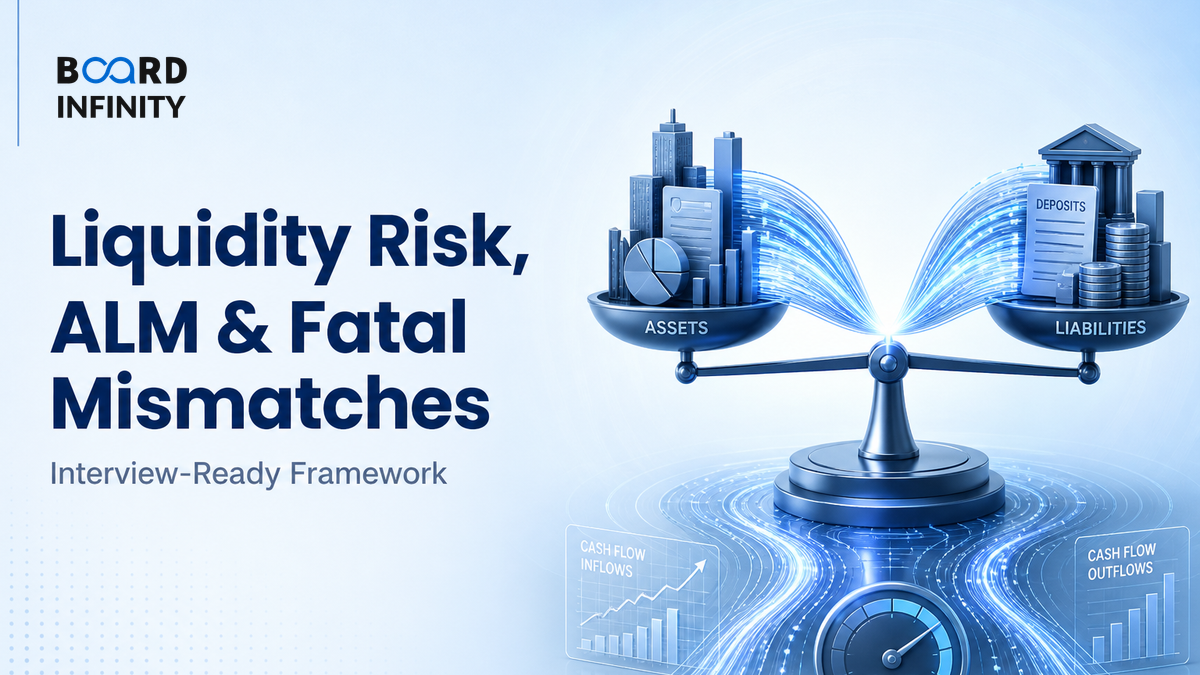
At 9:00 a.m., a bank can look solvent on paper. By 4:00 p.m., if enough depositors want their money back and the bank's assets cannot be sold without a loss, the same bank can be fighting for survival.
That is the brutal lesson of liquidity risk: companies do not fail only because they are loss-making. They often fail because cash leaves faster than assets can be converted into cash.
- Liquidity risk is the risk of being unable to meet cash obligations when due without unacceptable losses.
- Asset-liability management matches the timing, currency, rate sensitivity and behaviour of assets and liabilities.
- The fatal pattern is simple: long-term, illiquid assets funded by short-term, flighty liabilities.
- Key metrics: LCR, NSFR, liquidity gap, loan-to-deposit ratio, CASA ratio and duration gap.
- A firm may be solvent but illiquid: assets exceed liabilities, but cash is not available when needed.
- ALM is not a treasury back-office activity. It is a board-level survival system covering growth, funding, stress tests and risk appetite.
- The strongest interview answer links maturity mismatch + funding concentration + confidence shock + forced asset sale.
Big Picture
Think of liquidity risk as a ladder of survival. At the bottom is daily cash discipline; at the top is strategic resilience. Asset-liability management, or ALM, is the system that keeps every layer aligned so that a temporary cash squeeze does not become an existential crisis.
Core Explanation
Liquidity risk is not just “running out of money.” It is the risk that cash obligations arrive before cash resources do. The damage becomes fatal when the firm has to sell illiquid assets quickly, often at distressed prices, which can convert a liquidity problem into a solvency problem.
Asset-liability management is the discipline of managing the balance sheet so that assets and liabilities do not create dangerous mismatches in timing, interest rate sensitivity, currency or liquidity behaviour.
The Four Fatal Mismatches
Most liquidity failures are not mysterious. They usually come from one or more of these mismatches:
The most dangerous combination is short-term confidence-sensitive funding + long-term illiquid assets + rising rates. This is why banks, NBFCs, mutual funds and even large corporates spend so much time on ALM.
Key Metrics Interviewers Expect You to Know
Use metrics carefully. A “good” number depends on business model, regulation and market conditions, but these are the standard signals to mention for banks and NBFCs.
A Small Worked Example: Spot the Mismatch
Suppose a lender has ₹1,000 crore of assets and ₹900 crore of liabilities. Its average asset duration is 3.8 years and liability duration is 1.2 years.
Duration gap = 3.8 - (900 / 1,000 × 1.2) = 3.8 - 1.08 = 2.72 years.
This means assets are much more rate-sensitive than liabilities. If market rates rise, the economic value of long-duration assets can fall meaningfully before liabilities reprice enough to offset the hit.
Now add a liquidity view: in the next 30 days, expected inflows are ₹120 crore and outflows are ₹180 crore. The 30-day liquidity gap = ₹120 crore - ₹180 crore = -₹60 crore. If the lender has ₹90 crore of immediately usable liquid assets, it survives the month, but its buffer falls to ₹30 crore. If depositors or lenders panic and outflows rise further, the same balance sheet becomes dangerous.
After IL&FS defaulted in 2018, Indian NBFCs faced a sharp funding confidence shock. The deeper lesson was not just “one company defaulted”; it was that parts of the sector had long-tenor loans funded through shorter-tenor market borrowings, supported by assumptions that refinancing would remain available. The so what: ALM risk is quiet during easy liquidity and brutal when confidence disappears.
Definitions
- Liquidity risk: The risk of being unable to meet cash obligations when due without unacceptable loss.
- Funding liquidity risk: The risk that a firm cannot obtain cash or funding at reasonable cost when needed.
- Market liquidity risk: The risk that an asset cannot be sold quickly without materially affecting its price.
- Asset-liability management: The coordinated management of assets, liabilities and off-balance-sheet exposures to control liquidity and interest-rate risk.
- Maturity mismatch: A gap between when assets generate cash and when liabilities must be paid.
First Republic Bank: When Good Assets Could Not Save Bad Funding
First Republic Bank showed how a respected lender can collapse when long-duration assets meet concentrated, confidence-sensitive deposits.
Situation: First Republic Bank was known for serving affluent clients and had built a relationship-led banking franchise. But its balance sheet carried a dangerous ALM weakness: a large base of uninsured, confidence-sensitive deposits funded longer-duration assets such as mortgages and securities.
The move that created pressure: As interest rates rose sharply in 2022-2023, the market value of long-duration assets came under pressure. At the same time, the failures of other US regional banks made large depositors more alert to bank-specific risk. Once confidence weakened, deposit outflows accelerated.
Outcome and lesson: In 2023, First Republic was seized by regulators and sold to JPMorgan Chase. The primary driver was a funding-confidence shock hitting a balance sheet with asset-liability mismatch. Supporting drivers included a high share of large uninsured deposits, long-duration assets affected by rising rates, and contagion from wider regional-bank stress. The lesson is precise: a bank can have high-quality customers and still fail if the liability side is too unstable for the asset side.

Do not narrate this case as “depositors panicked.” A better answer says: depositor panic was the trigger; the underlying vulnerability was an ALM structure with long-duration assets and flighty funding.
How AI Changes Liquidity Risk, Asset-Liability Management & Fatal Mismatches
AI does not remove liquidity risk. It changes how quickly institutions can detect it, simulate it and accidentally amplify it.
- Faster cash-flow forecasting: ML models can forecast deposit withdrawals, loan prepayments, merchant settlement flows and seasonal cash needs using transaction behaviour rather than only static maturity buckets.
- Better stress testing: Banks can run richer scenarios - rate shocks, rating downgrades, social-media panic, wholesale funding freeze, deposit concentration outflows - and estimate which buffers fail first.
- New model and conduct risks: If AI-driven treasury models rely on calm-period data, they may underestimate panic behaviour. If automated pricing pushes customers away during stress, the model can worsen funding instability.
Use NotebookLM or Claude before a finance interview: upload a bank's annual report, its Basel III Pillar 3 disclosure and recent investor presentation, then ask, “Summarise this bank's liquidity risk using LCR, NSFR, deposit mix, ALM gaps and stress-test language. Generate five interview questions with model answers.”
Interview Relevance
“A bank has profitable long-term loans but is facing sudden deposit withdrawals. Is this a solvency problem, a liquidity problem, or both? How would you analyse it?”
Use the phrase “solvent but illiquid” carefully. It is a temporary condition. If the firm must sell assets at deep discounts, liquidity stress can quickly become insolvency.
Common Mistake
The single biggest mistake is treating liquidity risk as a cash-balance problem only. That costs candidates because it ignores timing, asset saleability, depositor behaviour and confidence. The fix: always answer using the chain cash flows - maturity gaps - funding stability - stress scenario - management action.
What to Revise Next
Now move from balance-sheet survival to the other risks that can quietly break financial institutions. Revise Operational Risk, Model Risk & Conduct Risk Explained to understand non-market failures, then study The Indian Derivatives Market: Structure, Regulation & Retail Reality to connect ALM, hedging and risk transfer in India.