
Option Pricing Intuition Without the Mathematics - Interview-Ready Mental Model
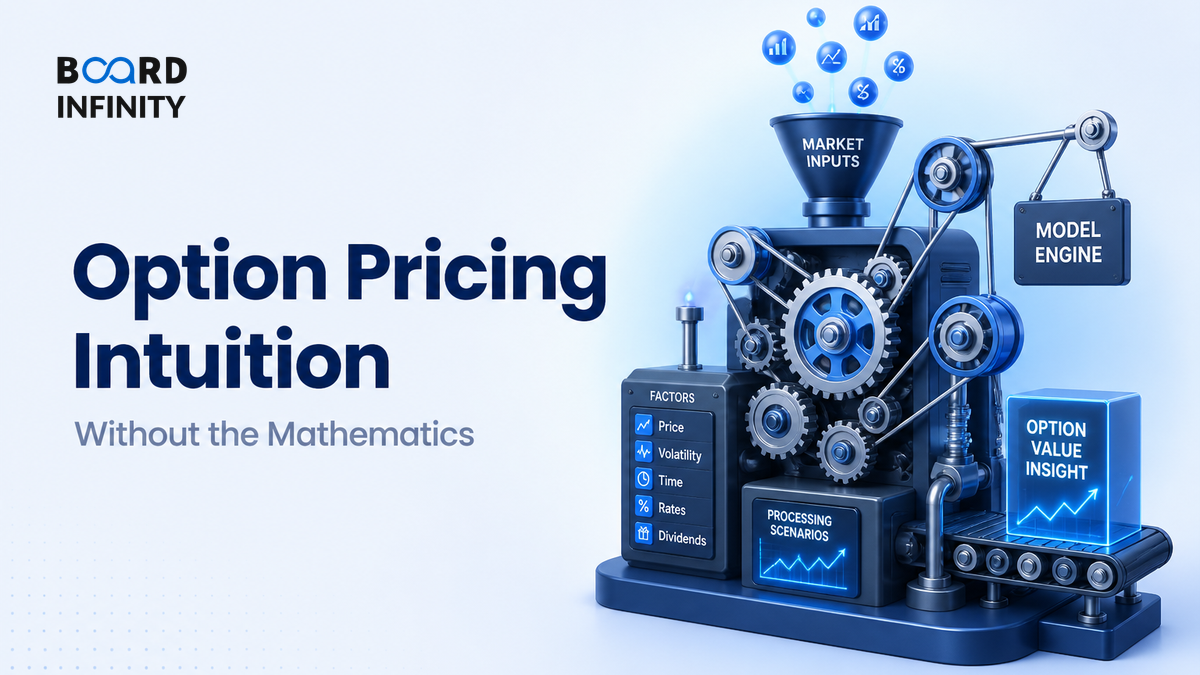
A cheap option is not necessarily a bargain - just like cheap insurance is not always good insurance. The premium may be low because the market thinks the event is unlikely, time is running out, or volatility has collapsed. Option pricing is not about predicting the stock price; it is about pricing the right to benefit from uncertainty.
- An option premium is the price paid for a right, not an obligation.
- Every option price has two intuitive parts: intrinsic value and time value.
- A call becomes more valuable when the underlying price rises; a put becomes more valuable when the underlying price falls.
- Higher expected volatility usually increases both call and put premiums because the upside of large moves belongs to the option buyer.
- More time generally increases option value because there is more opportunity for a favourable move.
- Option pricing is driven mainly by five inputs: spot price, strike price, time to expiry, volatility, and interest rates or dividends.
- The biggest interview trap is treating the option premium as a simple directional stock forecast.
Big Picture: An Option Premium Is the Price of Flexibility
Think of an option as a paid reservation. You pay a premium today to keep a future choice open. If the future is favourable, you exercise or sell the option; if it is unfavourable, you can walk away and lose only the premium.
Core Explanation: What You Are Really Paying For
An option buyer pays for asymmetry. If the move is favourable, the buyer can participate. If the move is unfavourable, the buyer can walk away. That one-sided payoff is why uncertainty itself has value.
For a call option, the buyer wants the underlying asset to go above the strike price. For a put option, the buyer wants the underlying asset to go below the strike price. The seller receives the premium but takes the obligation if the buyer exercises.
The Two Layers of an Option Premium
The premium is best understood in two layers:
- Intrinsic value - the value if the option were exercised immediately.
- Time value - the extra value from the possibility that things may improve before expiry.
The Five Inputs That Move Option Prices
You do not need to write Black-Scholes mathematics in most MBA interviews. You do need to explain the direction of impact correctly.
Option buyers have limited downside and open-ended or meaningful upside. Bigger possible moves increase the chance of a favourable payoff, whether the buyer owns a call or a put.
The Market Loop: Why Option Prices Keep Changing
Options are not priced once and left alone. Prices update continuously as news changes the market's expectation of future movement. This is why premiums can jump even before the underlying price moves much.
A Small Worked Example: Intuition Without Black-Scholes
Assume a stock trades at ₹110. You buy a call option with a strike price of ₹100 for a premium of ₹14.
This distinction is powerful. An option can be in the money and still be unprofitable for the buyer if the premium paid was too high.
Definitions You Must Be Able to Say Cleanly
- Option: A contract giving the buyer the right, not obligation, to buy or sell an underlying asset.
- Call option: A right to buy the underlying asset at a specified strike price.
- Put option: A right to sell the underlying asset at a specified strike price.
- Premium: The price paid by the option buyer to the option seller.
- Intrinsic value: The value obtained if the option were exercised immediately.
- Time value: The premium beyond intrinsic value, reflecting remaining uncertainty before expiry.
Case Study: Bajaj Finance and Regulatory Uncertainty in Options
Bajaj Finance shows why option premiums can rise around uncertainty even before a clean directional outcome is known.
In November 2023, the Reserve Bank of India directed Bajaj Finance to stop sanctioning and disbursing loans under two lending products, eCOM and Insta EMI Card. The restriction was later lifted in May 2024. For equity markets, this was not merely a normal earnings question; it was a regulatory uncertainty question.

How would option pricing intuition read this? A trader did not need to know the final outcome to understand why option premiums could become sensitive. The primary driver was uncertainty around regulatory impact. Supporting drivers included possible effects on loan growth, customer acquisition, investor sentiment, analyst revisions, and hedging demand around the stock.
The lesson is interview-useful: when an event can materially change the range of future outcomes, option value can rise because uncertainty rises. The premium is not saying “the stock must go up” or “the stock must go down.” It is saying “the right to participate in a large move has become more valuable.”
How AI Changes Option Pricing Intuition Without the Mathematics
AI does not remove option pricing logic. It makes the information feeding that logic faster, broader and more real-time.
- Event-risk scanning: LLMs can summarize earnings calls, RBI or SEBI announcements, court updates and management commentary to identify events likely to affect volatility.
- Sentiment and news velocity: AI systems can detect whether news flow is accelerating, cooling or becoming contradictory, which matters because option premiums respond to uncertainty.
- Scenario generation: AI can help convert a vague event into structured scenarios - favourable, base and adverse - so a student can explain why time value exists.
Use NotebookLM or Perplexity to load a company announcement, latest annual report and recent news articles. Ask: “List events that could increase uncertainty in this stock and map each to spot price, volatility and time-to-expiry effects on call and put premiums.” Then verify important facts from original filings or exchange disclosures.
Interview Relevance
“Explain option pricing intuitively without using the Black-Scholes formula. Why does higher volatility increase both call and put prices?”
If you forget everything else, say this: “An option premium prices the right to benefit from uncertainty, not just the expected direction of the stock.”
Common Mistake
The mistake: saying “call price rises because the stock will rise” or “put price rises because the stock will fall.” This costs candidates because it ignores time value and volatility - the heart of option pricing. One-line fix: always separate direction from uncertainty: spot affects direction, volatility affects the value of possible movement.
What to Revise Next
You now have the pricing intuition. Next, revise the language traders use to describe how premiums move, and then learn which strategy fits which market view.