
Option Sensitivities for Interviews: Delta, Gamma, Theta, Vega & Rho in Plain English
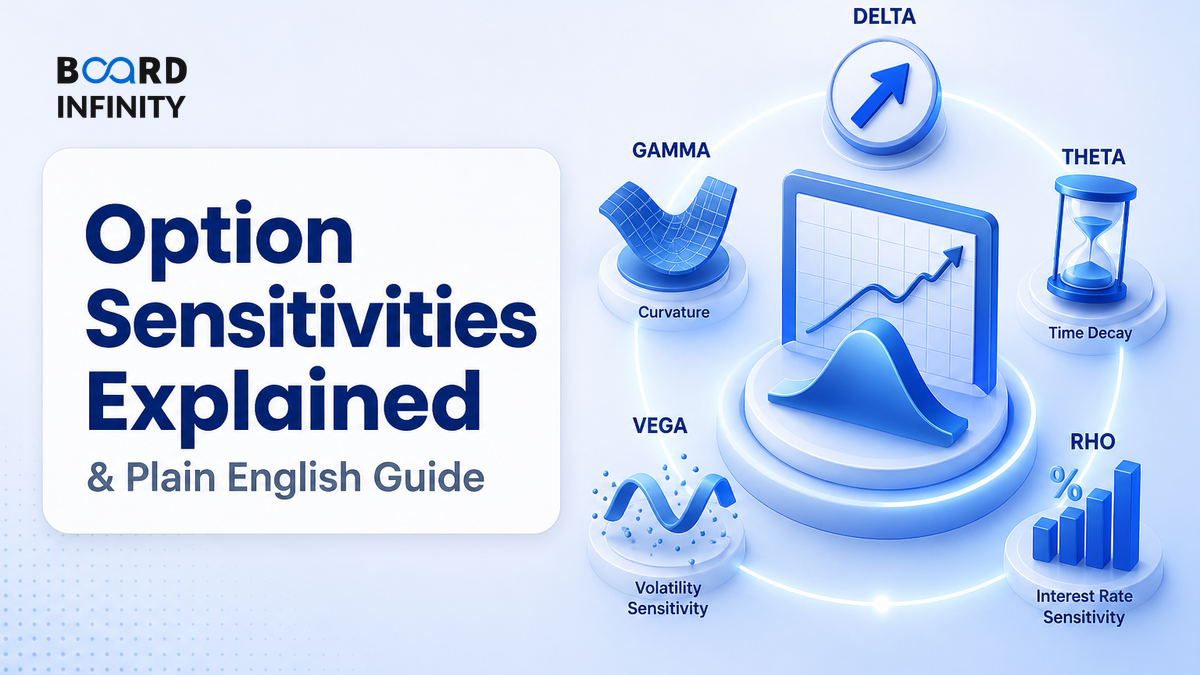
A trader buys a Nifty call before a big market event, the index rises, and yet the option premium barely moves. The missing piece is not luck - it is the Greeks: Delta, Gamma, Theta, Vega and Rho quietly pulling the price in different directions.
- Option Greeks are sensitivities: they estimate how an option price changes when one input changes, holding others constant.
- Delta shows directional exposure: how much the option price moves for a ₹1 move in the underlying.
- Gamma shows how unstable Delta is: it is highest near-the-money and close to expiry.
- Theta is time decay: long options usually lose value as expiry approaches, all else equal.
- Vega is sensitivity to implied volatility: it matters most before events like earnings, RBI policy or election results.
- Rho is interest-rate sensitivity: often small for short-term equity options, more relevant for long-dated options.
- The best answer never explains Greeks one by one only - it explains which Greek dominates in the situation.
Big Picture
Think of an option price as a live dashboard, not a fixed tag. The underlying price, time left, volatility and interest rate keep changing - the Greeks tell you how sensitive the option is to each force.
Core Explanation: Read Greeks as a Risk Dashboard
An option gives the buyer the right, not the obligation, to buy or sell an underlying asset at a specified price before or on expiry. A call benefits when the underlying rises; a put benefits when the underlying falls.
The option price depends mainly on five inputs: underlying price, strike price, time to expiry, implied volatility and risk-free interest rate. Greeks convert those inputs into usable risk numbers.
Delta: the direction dial
Delta answers: “If the stock or index moves by ₹1, how much should the option premium move?” A call with Delta 0.60 should gain roughly ₹0.60 for a ₹1 rise in the underlying, before considering other changes.
Plain English: Delta is your directional exposure. A Delta of 0.60 behaves like owning 60% of the underlying for small moves. A put Delta of -0.40 gains when the underlying falls.
Gamma: the acceleration risk
Gamma answers: “How quickly will Delta itself change?” This matters because Delta is not fixed. Near expiry, an at-the-money option can flip from low Delta to high Delta very quickly.
Plain English: Gamma is the speedometer of your Delta. High Gamma can create sharp gains if the move goes your way, but it can hurt badly when the move reverses.
Theta: the clock tax
Theta answers: “How much value does the option lose just because one day passes?” Long calls and long puts usually have negative Theta because optionality becomes less valuable as expiry approaches.
Plain English: Theta is the rent you pay for keeping the option alive. Option buyers pay it; option sellers try to earn it.
Vega: the volatility lever
Vega answers: “How much will the option price change if implied volatility moves by one percentage point?” Implied volatility is the market’s expectation of future movement embedded in the option price.
Plain English: Vega is the event-risk lever. Before earnings, RBI policy announcements or election results, options can become expensive because implied volatility rises.
Rho: the interest-rate background force
Rho answers: “How much will the option price change if the risk-free interest rate changes?” For short-dated equity options, Rho is often less important than Delta, Gamma, Theta and Vega. For long-dated options, currency options and rate-linked structures, it becomes more relevant.
Worked Example: How the Greeks Move a Premium
Assume a hypothetical Nifty call option has a premium of ₹100. Its Greeks are: Delta 0.50, Gamma 0.02, Theta -1.20 per day, Vega 3.00 per 1 percentage point IV move and Rho 0.40 per 1 percentage point rate move.
Now suppose, over one day, the underlying rises by ₹40, implied volatility rises by 2 percentage points, and interest rates are unchanged.
This is only an approximation because Greeks themselves change after the move. But it shows the interview-level logic: premium movement = directional move + acceleration + time decay + volatility change + rate effect.
Definitions
- Delta: Change in option price for a one-unit change in underlying price, holding other factors constant.
- Gamma: Change in Delta for a one-unit change in underlying price, holding other factors constant.
- Theta: Change in option price as one calendar day passes, holding other factors constant.
- Vega: Change in option price for a one-percentage-point change in implied volatility.
- Rho: Change in option price for a one-percentage-point change in the risk-free interest rate.
In Indian markets, Nifty and Bank Nifty options trade on exchanges regulated by SEBI, with premiums paid upfront and margins required for short option positions. Around weekly expiries, Gamma and Theta become especially visible: small index moves can rapidly change Delta, while time value decays sharply. The strategic point is that an option seller is not just “earning premium” - the seller is accepting Gamma and Vega risk in exchange for Theta.
NVIDIA: When Vega and Gamma Became the Real Story
NVIDIA’s AI-led earnings cycles showed why an option can be right on direction but still be wrong on price if Vega, Gamma and event timing are ignored.
Situation: During the AI boom, NVIDIA became one of the most closely watched stocks globally. Before major earnings announcements, traders often priced in large expected moves through higher implied volatility. That made option premiums expensive even before the actual result.
The move: Many traders used calls or call spreads to express bullish views on NVIDIA. But the smart risk conversation was not just “Will the stock rise?” It was: how much Delta exposure do I want, how much Vega am I paying for, what happens to implied volatility after earnings, and how violently will Gamma change near expiry?
Outcome or lesson: A trader could be directionally correct and still earn less than expected if implied volatility fell after the event - the classic post-event “IV crush.” The primary driver was elevated event volatility priced into options. Supporting drivers included heavy options liquidity, concentrated attention around earnings, short-dated contracts and rapid dealer hedging. The lesson: in event trades, Vega before the event and Gamma after the event can matter as much as Delta.

How AI Changes Option Sensitivities
AI does not change what Delta, Gamma, Theta, Vega and Rho mean. It changes how quickly traders estimate, monitor and stress-test them.
Practical student workflow: Use ChatGPT or Claude to build a small Greek-sensitivity table from a hypothetical option position. Then use Perplexity to research the company or macro event behind the trade, and ask: “Which Greek should dominate before and after this event, and why?” For company preparation, load annual report excerpts and recent earnings-call notes into NotebookLM and generate likely questions on event risk, volatility and hedging.
Interview Relevance
“Explain Delta, Gamma, Theta, Vega and Rho in simple terms. If a client buys a near-expiry at-the-money call before a major event, which Greeks matter most?”
If you remember only one sentence, say this: “Delta tells direction, Gamma tells how fast direction changes, Theta tells the cost of time, Vega tells event-volatility exposure, and Rho tells rate sensitivity.”
Common Mistake
The mistake: explaining Greeks as separate textbook definitions and ignoring that they interact. This costs candidates because real option risk is dynamic: a price move changes Delta, time decay changes premium, and implied volatility can rise or collapse. One-line fix: always add, “Greeks are local sensitivities, so after a market move I must recalculate the option’s risk.”
What to Revise Next
Now that you can read the risk of a single option, move to structures that combine options and derivatives into decisions.