
Swaps Explained for Interviews: Interest Rate, Currency and Cross-Currency Structures
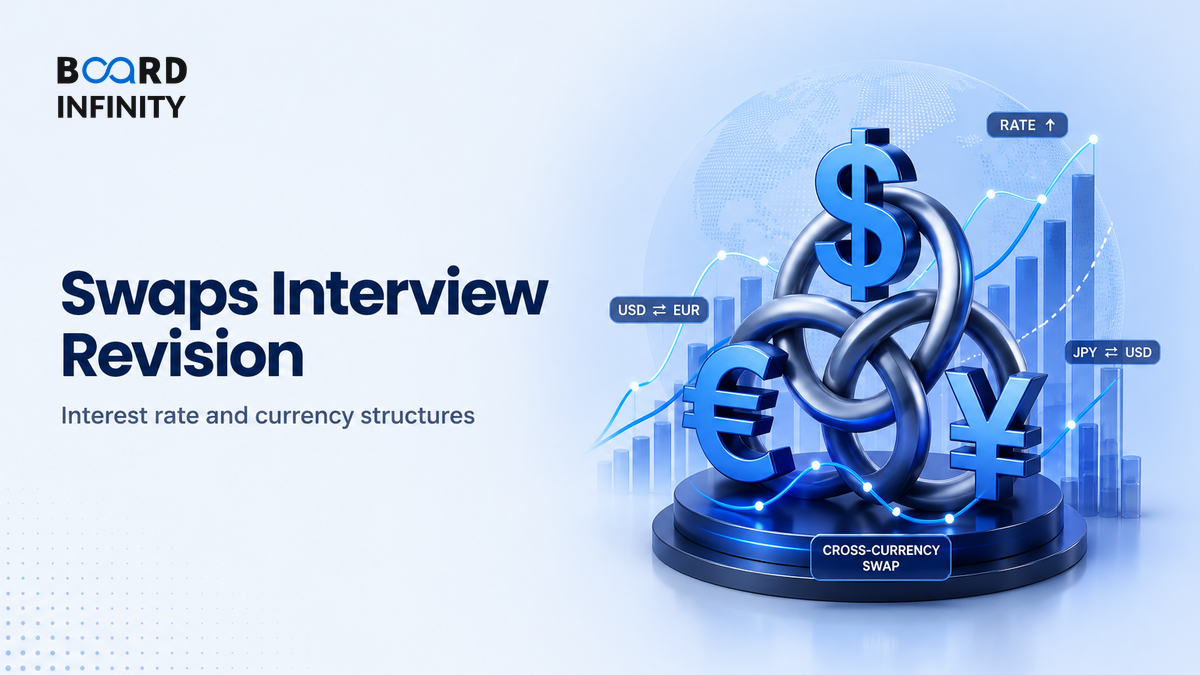
In 1981, IBM and the World Bank did something that looked almost like financial alchemy: each had access to one set of currencies, but wanted exposure to another. Instead of taking new loans, they exchanged cash-flow obligations - and the modern currency swap market became real.
- A swap converts one cash-flow pattern into another - fixed to floating, floating to fixed, one currency to another, or both.
- Interest rate swap: same currency; usually no principal exchange; one party pays fixed and receives floating, or vice versa.
- Currency swap: two currencies; principal is normally exchanged at start and re-exchanged at maturity.
- Cross-currency swap: two currencies plus interest-rate transformation, often fixed-to-floating or floating-to-floating with a basis spread.
- At inception, a par swap has near-zero NPV; value changes later as interest rates, FX rates and credit spreads move.
- Corporate use case: hedge debt, match cash flows, reduce funding cost or transform foreign-currency borrowing into home-currency exposure.
- Interview answer: always explain the exposure first, then the swap legs, then the net economic result and risks.
Big Picture: A Swap Is a Cash-Flow Translator
A swap does not magically remove risk. It repackages risk. A company starts with an exposure it does not want, enters a contract that offsets that exposure, and is left with the cash-flow profile it prefers.
Core Explanation: The Three Swap Structures You Must Know
A swap is an over-the-counter derivative: two parties agree to exchange future cash flows based on a notional principal. The notional is usually a reference amount, not always exchanged.
Think of every swap in four questions:
Interest Rate Swap: Fixed vs Floating in One Currency
In a plain vanilla interest rate swap, one party pays a fixed rate and receives a floating rate such as MIBOR, SOFR or EURIBOR. The other party does the opposite. Only the net interest difference is exchanged on settlement dates.
Worked Example: Floating Loan Converted to Fixed
Assume a company has a ₹100 crore floating-rate loan at MIBOR + 1%. It enters a quarterly swap where it pays fixed 7% and receives MIBOR on ₹100 crore notional. For one 90-day quarter, assume MIBOR is 6.4% and use a 360-day year.
The company has effectively locked in 8% annualized cost: 7% fixed swap rate plus the 1% loan spread. The floating benchmark cancels because the company receives MIBOR on the swap and pays MIBOR on the loan.
Currency Swap vs Cross-Currency Swap: The Key Difference
Students often use the terms interchangeably. In practice, cross-currency swap is the broader market structure: it exchanges cash flows in two currencies and may also transform the interest-rate type.
Here is the clean interview distinction:
- Interest rate swap: transforms interest-rate risk within one currency.
- Currency swap: swaps principal and interest payments across two currencies.
- Cross-currency interest rate swap: swaps both currency exposure and interest-rate exposure, often with a quoted basis spread.
How Swaps Are Priced and Monitored
A swap rate is set so that, at inception, the present value of the pay leg equals the present value of the receive leg. That is why a standard par swap starts with an NPV close to zero. After the trade date, market movements create positive value for one party and negative value for the other.
For interviews, you do not need to derive a full swap curve. You do need to know the logic: discount future cash flows, compare both legs, and track how the mark-to-market changes when rates or FX move.
Definitions You Can Say in One Breath
John C. Hull: “A swap is an agreement between two companies to exchange cash flows in the future.”
- Notional principal: reference amount used to calculate swap cash flows; it may or may not be exchanged.
- Fixed leg: swap cash flow calculated using a pre-agreed fixed rate.
- Floating leg: swap cash flow reset periodically using a benchmark rate such as SOFR, EURIBOR or MIBOR.
- Mark-to-market: current replacement value of the swap based on today’s market rates and FX levels.
- Basis risk: risk that the hedged exposure and swap benchmark do not move perfectly together.
Case Study: Bharti Airtel and Cross-Currency Risk Management
Bharti Airtel shows how an Indian company with global funding and rupee-led operations can use derivatives, including currency and interest-rate swaps, to manage financing risk.

Situation: Telecom is capital-intensive. Companies fund network expansion, spectrum commitments and refinancing needs through a mix of domestic and overseas borrowings. For an Indian telecom operator, the business may generate large rupee cash flows while some liabilities or financing costs may be linked to foreign currencies or global interest-rate benchmarks.
The move: Bharti Airtel has disclosed the use of derivative financial instruments in its financial reporting, including instruments used to manage foreign-currency and interest-rate risk. The treasury objective is not speculation; it is to align debt-service cash flows with the company’s risk appetite. A cross-currency swap can convert, for example, foreign-currency interest and principal obligations into a more predictable rupee-linked profile.
Outcome and lesson: The primary driver is cash-flow matching - reducing the mismatch between operating cash inflows and debt-service outflows. Supporting drivers include diversified funding access, disciplined treasury limits, counterparty controls, and hedge accounting discipline. The lesson is simple: a swap is valuable only when it is tied to a real exposure and governed by policy.
A shallow answer says, “Airtel uses swaps to reduce risk.” A strong answer says, “The swap transforms the currency and rate profile of debt so cash flows are better matched, while treasury still manages basis, collateral and counterparty risk.”
How AI Changes Swaps
AI is not replacing swap fundamentals. It is changing how treasuries and banks monitor, explain and stress-test swap books.
- Faster risk surveillance: ML systems can scan rate curves, FX moves, collateral calls and counterparty exposures to flag unusual changes in MTM or DV01 before manual reports arrive.
- Smarter hedge documentation: LLMs can help treasury teams summarise exposure rationale, hedge terms and accounting evidence, but humans must validate the numbers and policy fit.
- Scenario generation: AI can create plausible stress narratives - sharp rupee depreciation, delayed rate cuts, USD liquidity squeeze - and map which swap legs are affected.
Use NotebookLM: upload a company annual report and ask, “Identify all derivative instruments, the exposures they hedge, and likely interview questions on currency and interest-rate risk.” Then verify every answer against the notes to accounts.
Interview Relevance
“A company has a floating-rate loan but expects interest rates to rise. How can it use an interest rate swap? Also distinguish this from a cross-currency swap.”
If you draw one mini cash-flow diagram while answering, you will sound much clearer than a candidate who only says “fixed for floating.”
Common Mistake
The mistake: saying “swaps eliminate risk.” They do not - they transform one risk into another and introduce counterparty, basis, liquidity and valuation risk. Fix: say, “A swap hedges a specific exposure by changing the cash-flow profile, while residual risks must still be monitored.”
What to Revise Next
Revise Corporate Hedging Policy: Currency, Commodity & Interest Rate Exposure next to understand when a company should hedge, how much it should hedge, and who approves it. Then move to Market Risk: Value at Risk, Expected Shortfall & Stress Testing to connect swaps with portfolio-level risk measurement.