
Options From Scratch: Calls, Puts, Payoff Diagrams & Moneyness for Interviews
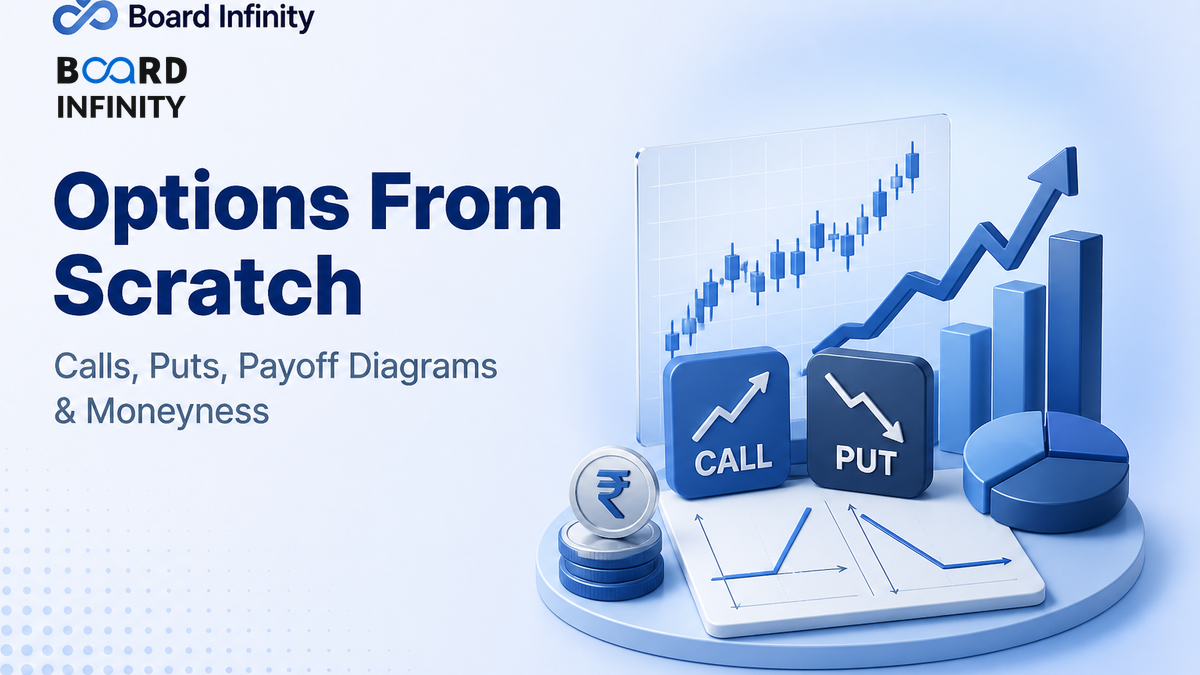
On an NSE expiry afternoon, two traders can look at the same NIFTY level and take opposite bets - one buys a call because she wants upside, another buys a put because he fears a fall. The magic is not prediction; it is structure: an option lets you pay a known premium today for a payoff that changes with the underlying price tomorrow.
- A call option gives the buyer the right, not obligation, to buy the underlying at the strike price.
- A put option gives the buyer the right, not obligation, to sell the underlying at the strike price.
- Premium is the price paid for the option; buyer pays it upfront, writer receives it upfront.
- Payoff ignores premium; profit includes premium. This is the most tested distinction.
- Call payoff = max(Spot at expiry - Strike, 0). Put payoff = max(Strike - Spot at expiry, 0).
- Moneyness tells whether the option has intrinsic value now: in-the-money, at-the-money or out-of-the-money.
- Breakeven for a long call = Strike + Premium; for a long put = Strike - Premium.
Big Picture: An Option Is a Paid Right, Not a Compulsory Trade
Think of an option as a one-page contract with five moving parts: the underlying asset, whether it is a call or put, the strike price, the expiry date and the premium. Once you know these five, the payoff diagram becomes almost mechanical.
Core Explanation: Calls, Puts, Payoff and Profit
An option buyer gets a right. An option writer, also called the seller, takes the obligation if the buyer exercises that right. This asymmetry is why the buyer pays a premium upfront.
1. Call Option - You Want Upside
A call option benefits the buyer when the underlying price rises above the strike price. If the market price is below the strike at expiry, the buyer can simply walk away.
Long call payoff = max(Spot at expiry - Strike, 0). Long call profit = Payoff - Premium.
2. Put Option - You Want Downside Protection or Downside Bet
A put option benefits the buyer when the underlying price falls below the strike price. It is like having the right to sell at a pre-decided price even if the market has dropped.
Long put payoff = max(Strike - Spot at expiry, 0). Long put profit = Payoff - Premium.
3. Payoff Versus Profit - The Interview Trap
Payoff is the value of the option at expiry before considering the premium. Profit is what the buyer actually makes after subtracting the premium paid. Candidates often draw the payoff correctly and still answer the profit incorrectly.
4. Worked Example - One Call and One Put
Assume a stock is trading at ₹1,000. A student evaluates two one-month options:
- Call option: Strike ₹1,050, premium ₹30
- Put option: Strike ₹950, premium ₹20
The call buyer wins only after ₹1,080, which is strike plus premium. The put buyer wins only below ₹930, which is strike minus premium.
Moneyness: ITM, ATM and OTM Without Jargon
Moneyness compares the current spot price with the strike price. It tells you whether an option has intrinsic value right now.
If NIFTY is at 22,000 and a 21,800 call is trading, that call is in-the-money because the index is already above the strike. A 22,200 call is out-of-the-money because it needs NIFTY to rise before it has intrinsic value. The strategic so what: option chains let traders quickly separate current value from future expectation.
Definitions You Should Be Able to Say in One Breath
- Option: A derivative contract giving the holder the right, not obligation, to buy or sell an underlying at a fixed price.
- Call option: An option giving the holder the right to buy the underlying at the strike price.
- Put option: An option giving the holder the right to sell the underlying at the strike price.
- Strike price: The fixed price at which the option holder can buy or sell the underlying.
- Premium: The upfront price paid by the option buyer to the option writer.
- Moneyness: The relationship between the underlying price and strike price that indicates intrinsic value.
NSE: How Index Options Became India's Visible Options Classroom
NSE's index options market shows how standardised contracts can turn abstract payoffs into a daily risk-transfer mechanism for India.
Situation: India has a large base of investors, institutions and traders exposed to market swings. A mutual fund may want downside protection, a proprietary trader may want event exposure, and a retail participant may want a defined-risk view. All three need a market where risk can be transferred quickly and transparently.
The move: NSE built highly standardised index derivative contracts around benchmarks such as NIFTY and Bank NIFTY, with electronic trading, clearing, margining and visible option chains. The primary driver of adoption was the liquidity of broad benchmark indices. Supporting drivers were cash settlement, standardised strikes and expiries, broker app access, market-making depth and the familiarity of weekly expiries before recent regulatory tightening.
Outcome and lesson: NIFTY and Bank NIFTY options became among the most actively traded index options globally by contract volume. But the same accessibility also raised concerns about excessive retail speculation. In 2024, SEBI tightened index-derivative rules, including larger contract sizes and limits on weekly expiries, to strengthen investor protection. The lesson for interviews is sharp: options are not only speculative instruments; they are market infrastructure for transferring risk, but the product design and regulation decide whether that risk transfer stays healthy.
How AI Changes Options From Scratch
AI does not change the payoff formula. It changes how quickly students, traders and risk teams can read option data, simulate scenarios and detect hidden risk.
Use ChatGPT with data analysis: create a small table of spot prices, strike and premium, then ask it to calculate call payoff, put payoff, profit and breakeven. Then verify the formulas manually. For company prep, load an annual report into NotebookLM and ask whether the firm mentions derivative instruments, hedging or market-risk exposure.
Interview Relevance
"Explain a call option and a put option from scratch. Then draw their payoff diagrams and explain in-the-money, at-the-money and out-of-the-money."
When drawing a payoff diagram, label the X-axis as underlying price at expiry and the Y-axis as payoff or profit. If you switch from payoff to profit, shift the line down by the premium.
The single biggest mistake is mixing up payoff and profit. It costs candidates because they forget the premium and give the wrong breakeven. One-line fix: first draw payoff, then subtract premium to get profit.
What to Revise Next
Now that the mechanics are clear, move from "what the option pays" to "why the option is priced that way" and then to "how the option price moves."