
AI & Algorithmic Pricing: Interview-Ready Guide to Engines, Surge and the Ethics Line
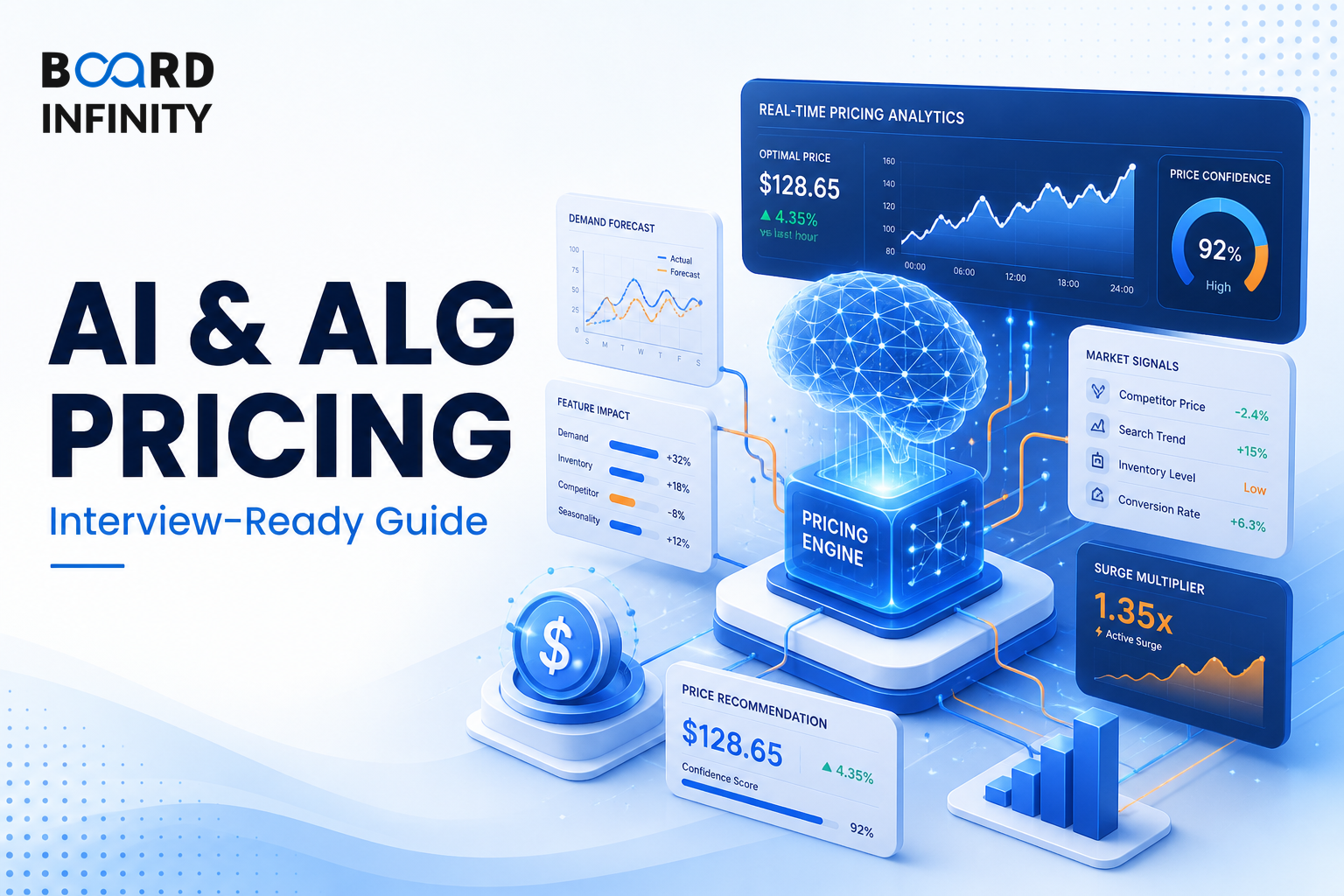
A rider opens a mobility app during heavy rain and sees the fare jump just when they need the ride most. The company calls it demand-supply balancing; the customer calls it unfair. That tension is the heart of AI and algorithmic pricing - not whether prices can change, but whether the logic is explainable, defensible and trusted.
- Algorithmic pricing uses rules, data or machine-learning models to set or recommend prices automatically.
- Dynamic pricing changes price by context - time, demand, inventory, season, competitor price or capacity.
- Surge pricing is a special case of dynamic pricing used when demand temporarily exceeds supply.
- A good pricing engine has five jobs: sense the market, predict response, optimize price, publish with guardrails and learn from outcomes.
- The ethics line is crossed when pricing becomes opaque, discriminatory, exploitative during distress or impossible to audit.
- In interviews, never say “AI charges the highest possible price.” Say “AI optimizes for business goals within fairness, legal and trust constraints.”
Big Picture: The Pricing Engine Is a Learning Loop
Think of algorithmic pricing as a controlled feedback system. It does not merely “increase price when demand rises.” It observes signals, predicts customer and supply response, chooses a price under constraints, then learns whether that price improved revenue, margin, utilization and trust.
Core Explanation: Engines, Surge and the Ethics Line
Algorithmic pricing means automated price-setting or price-recommendation using rules, statistical models or machine-learning models. The algorithm may be simple, like raising train fares after booking slabs fill, or complex, like predicting the booking probability of a holiday home at different price points.
The engine usually works across five layers:
The Four Pricing Modes You Must Not Confuse
Most weak answers collapse everything into “dynamic pricing.” A better answer separates four modes by how much the price changes and whether it changes for the market or for an individual customer.
Where Surge Pricing Is Legitimate
Surge pricing is defensible when it solves a real supply-demand imbalance. In ride-hailing, higher prices can attract more drivers to a busy area and ration limited capacity to riders with higher urgency. In hotels and airlines, higher prices near peak dates help allocate limited rooms or seats.
But surge becomes ethically weak when three conditions appear together: the customer has urgent need, limited alternatives and poor transparency. A midnight medical ride, a disaster zone or a stranded traveller is not the same as a Saturday-night restaurant table.
Indian Railways introduced flexi fares on select premium trains such as Rajdhani, Shatabdi and Duronto, where fares rose in booking slabs as seats filled, subject to caps and class-wise rules. The primary driver was capacity rationing on limited high-demand inventory, supported by advance-booking visibility and clear fare slabs. The so what: even rule-based dynamic pricing needs public trust, because a transparent formula can still feel unfair if customers perceive the service as essential.
The Ethics Ladder: From Legal to Trustworthy
Do not draw the ethics line only at “legal versus illegal.” A pricing system can be legal and still damage the brand. In interviews, use a ladder: the higher the pricing decision sits, the more defensible it is.
What to Measure in an Algorithmic Pricing System
A pricing algorithm should be judged on business performance and customer harm signals together. A model that lifts revenue but increases complaints, cancellations or regulatory risk is not a good pricing model.
Definitions You Can Say in One Breath
- Kotler and Armstrong: “Price is the amount of money charged for a product or service.”
- Algorithmic pricing: Automated price setting or recommendation using rules, data or models to meet objectives under constraints.
- Dynamic pricing: Pricing that changes with market context such as demand, supply, inventory, timing or competition.
- Surge pricing: A temporary price increase used when short-run demand exceeds available supply.
- Price discrimination: Charging different prices for similar offerings based on customer, quantity, channel, time or willingness to pay.
Airbnb Smart Pricing: The Full Framework in One Business
Airbnb built Smart Pricing to recommend nightly prices to hosts by estimating demand, competition and booking likelihood, while letting hosts retain control through minimum and maximum prices.

Situation: Airbnb is a marketplace with a difficult pricing problem. A hotel chain can centrally price its rooms, but Airbnb has millions of independent hosts with different homes, locations, reviews, amenities and calendars. If hosts underprice, they lose income. If they overprice, nights remain empty and the marketplace loses bookings.
The move: Airbnb’s Smart Pricing tool recommends prices using signals such as location, seasonality, local demand, listing attributes, booking lead time and comparable listings. The primary driver is better demand forecasting at the listing-night level. Supporting drivers include host-controlled min-max guardrails, marketplace liquidity, review signals and continuous learning from booking outcomes.
The lesson: Airbnb’s system is powerful because it does not replace the human owner completely. It combines algorithmic recommendation with host control. That is the ethics line in practice: AI can recommend, but users should understand the logic, set boundaries and override when needed.
The takeaway for interviews: algorithmic pricing succeeds when the primary driver - better prediction - is supported by human control, transparent limits and marketplace trust.
How AI Changes AI & Algorithmic Pricing
1. From rule-based slabs to predictive willingness-to-pay models. Older systems often used simple rules: raise price when inventory falls, discount when demand is weak. AI models can estimate how different customers or micro-markets may respond to different prices, using richer signals such as local events, browsing patterns, stockouts, weather and competitive moves.
2. From manual A/B tests to continuous experimentation. AI can run controlled price experiments, learn which segments are price-sensitive and update recommendations faster. The danger is overfitting short-term revenue while missing long-term trust loss, so experiments need fairness and complaint-rate monitoring.
3. From invisible black boxes to auditable pricing governance. In 2026, strong companies are expected to explain pricing decisions, check for bias and prevent sensitive attributes from becoming hidden proxies. This matters especially in financial services, mobility, healthcare, education and essential services.
Use NotebookLM before an interview: upload the company annual report, pricing page screenshots and recent news articles, then ask, “What pricing signals, guardrails, customer risks and likely interview questions emerge for this company?” Use ChatGPT or Claude next to convert the answer into a 60-second case response.
Interview Relevance
“Design an algorithmic pricing model for a food-delivery, ride-hailing or hotel-booking platform. What data would you use, how would you prevent unfair pricing and which metrics would you track?”
If the interviewer says “surge,” immediately discuss both sides: it improves supply allocation, but it needs caps, transparency and emergency safeguards to protect trust.
Common Mistake
The costliest mistake is saying, “AI pricing means charging each customer the maximum they are willing to pay.” That sounds exploitative and incomplete. The fix: say, “AI pricing optimizes a business objective within legal, fairness, transparency and trust guardrails.”
What to Revise Next
Now move from the engine to the customer. Revise Pricing for the Value-Conscious Indian Consumer to understand why affordability, trust and perceived fairness shape Indian pricing decisions. Then study Case Study: Pricing Masterclass - Jio, Netflix & D2C Brands to see how real companies combine penetration pricing, bundles, subscriptions and digital experiments.