
The Psychology of Pricing: Interview-Ready Behavioral Pricing Tactics
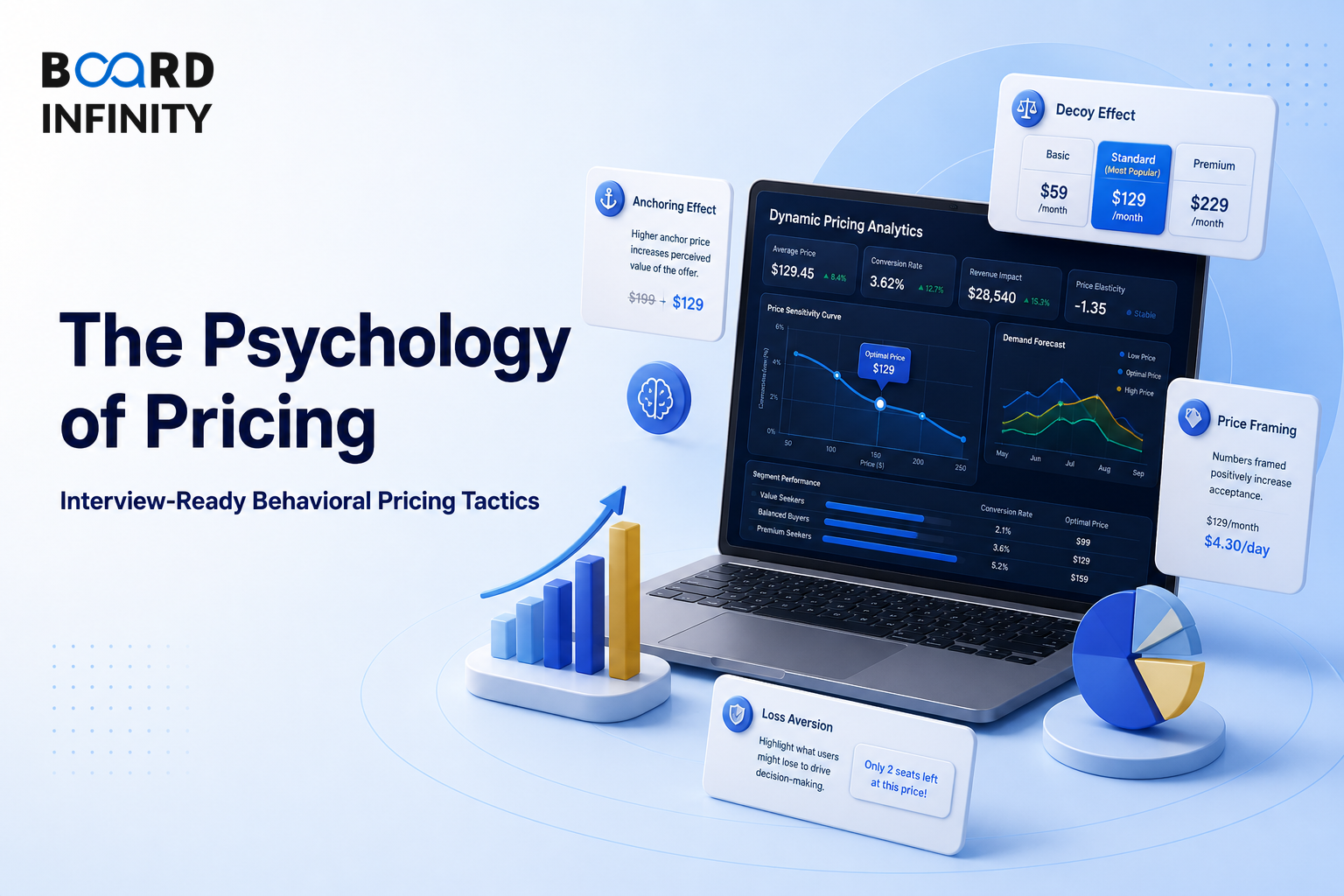
One price says ₹1,000 and feels expensive. Another says ₹999, sits beside a ₹1,499 premium option, promises “free delivery above ₹499,” and suddenly feels like a smart buy.
That tiny before-after is the heart of behavioral pricing: customers do not just calculate price, they interpret it.
- Behavioral pricing designs price presentation around perception, reference points, fairness and decision shortcuts.
- The customer rarely judges price in isolation. They compare it with an anchor, a past price, a competitor price or a nearby option.
- Powerful tactics include anchoring, decoy pricing, charm pricing, good-better-best tiers, bundle pricing, thresholds and scarcity cues.
- The best pricing tactic improves both conversion and price realization. A tactic that sells more but destroys margin is weak.
- Discounts are dangerous when they train customers to wait. Use them with a clear role: trial, clearance, loyalty or basket expansion.
- In interviews, always connect the psychology to unit economics, brand positioning and customer trust.
Big Picture: Price Is a Signal, Not Just a Number
A customer sees a price and instantly asks four questions: “Compared to what?”, “What do I get?”, “Is this fair?” and “Should I act now?” Behavioral pricing works because it shapes those four answers before the customer opens a spreadsheet in their head.
Core Explanation: The Main Behavioral Pricing Tactics
The big idea is simple: customers compare before they choose. A pricing manager therefore designs not just the price, but the comparison set around the price.
1. Anchoring: Make the First Number Do Heavy Lifting
An anchor is the reference number customers use to judge the current price. It may be a printed MRP, a premium plan, a competitor price, or the customer’s memory of what the product used to cost.
Example: A SaaS brand may show an enterprise plan first, then the professional plan. Even if the buyer never chooses enterprise, that higher anchor can make the professional plan feel more reasonable.
2. Charm Pricing: Use ₹999 When the Left Digit Matters
Charm pricing uses prices like ₹99, ₹499 or ₹999 because customers often process the left-most digit first. ₹999 can feel closer to ₹900 than to ₹1,000, even though the difference is tiny.
This works best in low-to-medium involvement categories where customers scan quickly. It is less suitable for luxury brands, where rounded prices can signal confidence and premium quality.
3. Decoy Pricing: Add an Option That Clarifies the Choice
A decoy is an intentionally less attractive option that pushes customers toward the target option. It is not meant to sell heavily. It is meant to make another option look obviously better.
Classic pattern: Small popcorn ₹150, medium ₹270, large ₹300. The medium makes the large look like a good deal.
4. Good-Better-Best: Give Customers a Safe Middle
Good-better-best pricing creates three tiers. The lowest tier captures price-sensitive buyers, the highest tier anchors value, and the middle tier often becomes the comfortable compromise.
This is common in streaming subscriptions, edtech plans, SaaS pricing, salon packages, gym memberships and D2C bundles.
5. Bundle Pricing: Reduce Pain by Combining Items
Bundle pricing combines multiple products or services into one offer. It works because customers find it harder to evaluate each component separately, and the combined offer can feel more valuable.
Examples include meal combos, phone plus accessories, beauty kits and annual software plans. The risk: if customers only wanted one item, the bundle may feel forced.
6. Threshold Pricing: Nudge Customers to Increase Basket Size
Threshold pricing offers a benefit after a minimum spend - for example, free delivery above a certain cart value. The customer focuses on the small gap to the threshold, not the total additional spend.
This is especially powerful in grocery, quick commerce and fashion e-commerce because customers can easily add one more item to cross the line.
Where Each Tactic Works Best
How to Judge Whether a Behavioral Pricing Tactic Is Working
A pricing tactic is not successful just because sales go up for a week. Track conversion, margin, customer quality and trust together.
Definitions You Can Say Clearly
- Price: Kotler and Keller: “Price is the only element of the marketing mix that produces revenue; the other elements produce costs.”
- Behavioral pricing: Pricing that uses customer perception, reference points, fairness and decision shortcuts to influence willingness to pay.
- Reference price: The internal or external comparison price customers use to judge whether the current price is fair.
- Willingness to pay: The maximum price a customer is prepared to pay for a product under given conditions.
- Price fairness: The customer’s judgment that a price is reasonable relative to value, alternatives and seller conduct.
Case Study: Zepto and the Psychology of the Quick-Commerce Cart
Zepto shows how quick-commerce pricing uses thresholds, fees, memberships and urgency to shape perceived value in a high-frequency Indian category.

Situation: Indian quick-commerce customers are highly convenience-driven but also price-aware. A cart may contain everyday items, so even small delivery charges, handling fees or minimum-order nudges are noticed.
The move: Zepto and similar quick-commerce platforms use a behavioral pricing architecture around the cart: visible product discounts to create deal perception, delivery or small-cart charges to protect unit economics, free-delivery thresholds to increase basket size, and subscription passes to reduce the pain of repeated fees.
Why it works: The primary driver is basket expansion through thresholds - the customer sees that adding one or two items may unlock a benefit. Supporting drivers include instant-need urgency, dark-store proximity, wide assortment, app nudges, membership benefits and the habit loop of repeat grocery top-ups.
Outcome or lesson: The lesson is not “add fees and discounts.” The lesson is to design a pricing journey where the customer feels the final cart is still fair because convenience, speed and savings are framed together.
How AI Changes Behavioral Pricing Tactics
AI does not remove pricing judgment. It makes pricing experiments faster, more granular and more risky if governance is weak.
Use Perplexity or NotebookLM to study a company’s app pricing journey. Upload screenshots or notes from the cart flow, annual report excerpts if available, and competitor pages. Ask: “Identify the behavioral pricing levers, the likely business objective of each, and the risks to trust or margin.”
Interview Relevance
“A D2C personal care brand wants to increase average order value without looking expensive. Which behavioral pricing tactics would you use, and how would you measure success?”
A strong answer says: “I would test the tactic against a control group.” Pricing psychology without experimentation sounds like guesswork.
Common Mistake
The mistake: treating behavioral pricing as a bag of tricks - ₹999, fake scarcity, big discount, done. Why it costs candidates: it ignores brand trust, customer fairness and unit economics. One-line fix: always say the reference price, the behavioral lever, the business objective and the metric guardrails.
What to Revise Next
Next, connect pricing psychology to hard economics. Revise Price Elasticity of Demand - Made Simple to understand how customers respond to price changes, then study Discounting, Promotions & the Risk of a Price War to avoid the trap of using discounts as a permanent strategy.