
Modern Pricing Models: Answer Subscription, Freemium and Dynamic Pricing with Confidence
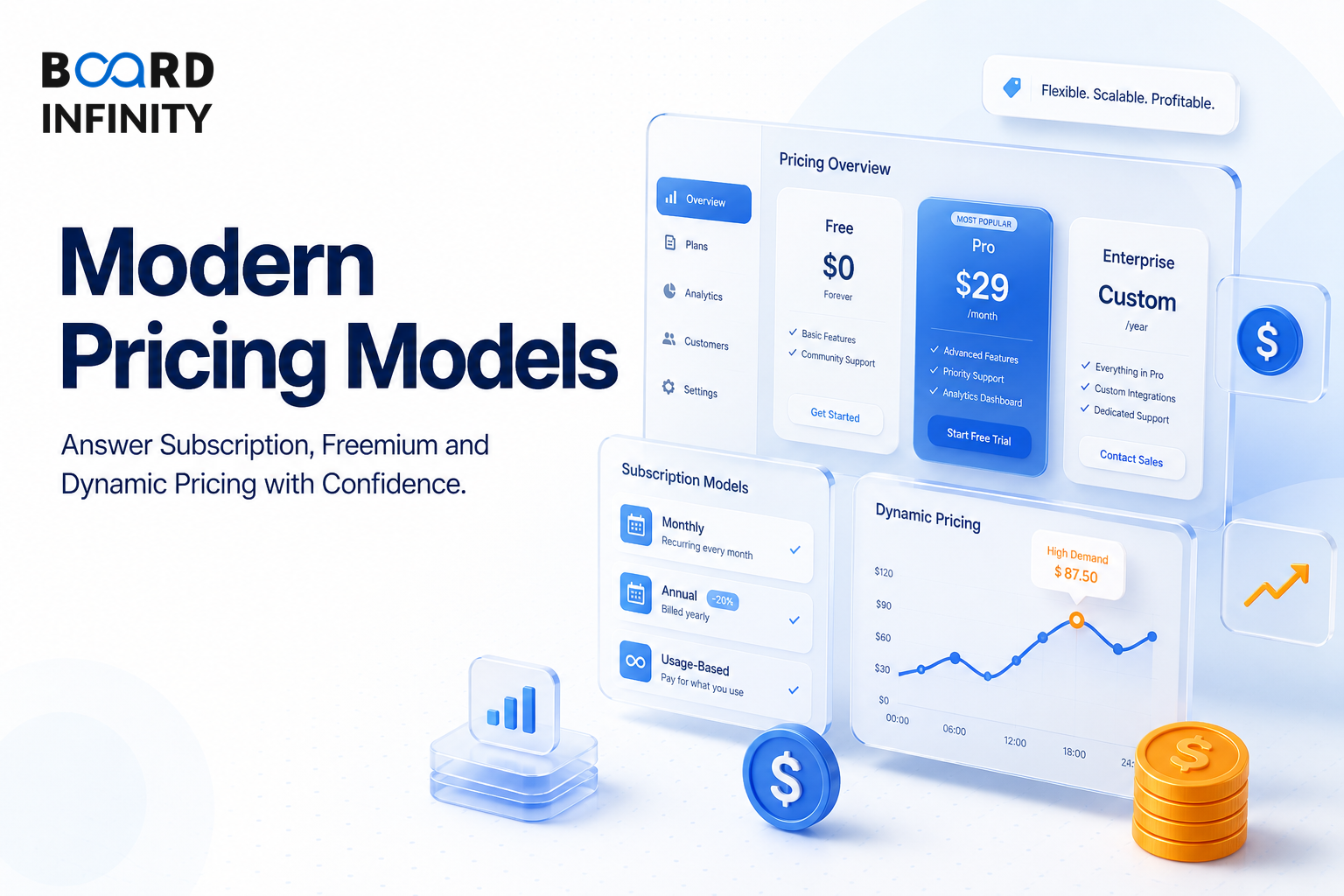
At 8:42 p.m. during a rainy Bengaluru evening, your food app shows three prices at once: a monthly membership badge, free browsing for everyone, and a delivery fee that has quietly risen with demand. That single screen is modern pricing in action - recurring revenue, freemium conversion and dynamic pricing working together.
- Subscription pricing sells continued access for a recurring fee; the strategic prize is predictable revenue and retention.
- Freemium gives a useful free version to build adoption, then converts high-intent users to paid plans.
- Dynamic pricing changes price based on demand, supply, timing, capacity or customer context.
- The best modern pricing systems connect three questions: acquire users cheaply, convert the right users, and adjust price when value or capacity changes.
- Key metrics: MRR, churn, NRR, freemium conversion, CAC payback and LTV:CAC.
- The interview-winning answer links pricing model to business model economics - not just customer affordability.
- The biggest trap is calling every recurring or app-based price “subscription” without explaining the value metric and retention logic.
Think of modern pricing as a revenue architecture. Subscription creates stability, freemium creates reach, and dynamic pricing captures contextual value when demand, capacity or urgency changes.
Core Explanation: Three Models, Three Jobs
Subscription pricing converts a one-time transaction into a recurring relationship. The customer pays weekly, monthly or annually for continued access - for example Netflix, Amazon Prime, Microsoft 365, Swiggy One or a SaaS CRM plan.
The business logic is simple: if retention is strong, a subscription business can afford higher acquisition cost because revenue repeats. The risk is equally clear: if customers do not keep using the product, churn destroys the model.
Freemium is not “free marketing.” It is a deliberate conversion funnel. The free product must be valuable enough to attract users but limited enough that serious users see a reason to upgrade. Spotify, Canva, Grammarly and many mobile apps use this model.
Dynamic pricing changes prices when the value of the same unit changes by time, demand, supply or scarcity. Airlines, hotels, ride-hailing, food delivery, quick commerce and event ticketing all use some form of it.
The key is fairness. Customers accept dynamic pricing more easily when the reason is visible - peak-hour capacity, rain, distance, limited inventory or last-minute demand. They resist it when it feels opaque, discriminatory or exploitative.
The Pricing Design Checklist
Use this checklist whenever you are asked to evaluate whether a subscription, freemium or dynamic model makes sense.
Metrics That Prove the Model Is Working
In interviews, do not stop at “subscriptions give predictable revenue.” Prove it with metrics. These benchmarks are broad thumb rules; a good number depends on category, ticket size and customer segment.
A Tiny Worked Example: Is This Subscription Healthy?
Suppose a learning app has 10,000 paid subscribers paying ₹500 per month. Monthly gross margin is 80 percent, monthly churn is 4 percent, and CAC is ₹2,000 per paid user.
The insight: a subscription looks powerful only when retention, gross margin and acquisition cost work together. High MRR with high churn can still be a weak business.
Definitions You Can Say in One Breath
- Subscription pricing: Customers pay recurring fees for continued access instead of buying the product outright.
- Freemium: A free base product attracts users; paid tiers monetize advanced features, capacity, convenience or status.
- Dynamic pricing: Prices change by context, demand, supply, time or customer willingness-to-pay rules.
- Value metric: The unit by which price scales with customer value received.
Case Study: Swiggy and the Pricing Stack
Swiggy shows how an Indian consumer platform can combine free access, paid membership and context-based delivery pricing in one pricing architecture.

Situation. Food delivery has thin unit economics: customer acquisition is expensive, delivery capacity is perishable, and order frequency varies widely. A platform cannot rely only on a simple commission or fixed delivery fee.
The move. Swiggy built a layered pricing system. The core app remains open to users without a subscription, which preserves reach. Swiggy One adds a paid membership layer with benefits such as delivery-related savings and partner offers, encouraging repeat usage. Delivery charges and fees can vary by distance, demand, weather, restaurant availability and operational context.
Result or lesson. The primary driver is not “discounting.” The primary driver is frequency economics - nudging high-intent users to order more often through membership. Supporting drivers include broad restaurant selection, delivery density, app habit, cross-category use cases such as food and quick commerce, and operational pricing that protects capacity during peaks.
So what: Swiggy is a strong interview example because it shows that modern pricing is a stack. Free access creates reach, subscription monetizes frequency, and dynamic pricing manages real-world capacity constraints.
How AI Changes Modern Pricing Models
1. AI personalizes freemium conversion. Instead of one generic paywall, apps can identify usage patterns - heavy storage use, collaboration need, export frequency, skipped ads - and show the upgrade message at the moment of highest intent. The risk is over-targeting: if every screen becomes a paywall, activation falls.
2. AI improves subscription retention. Churn models can flag users whose usage is declining and trigger interventions such as onboarding help, plan downgrade options or relevant feature education. In B2B SaaS, AI can connect product usage, support tickets and billing data to predict renewal risk.
3. AI powers dynamic pricing engines. Models can process demand, inventory, competitor signals, weather, events and capacity in near real time. The ethics line matters: companies must avoid unfair discrimination, hidden manipulation and prices that customers cannot reasonably understand.
Use Perplexity to collect a company's pricing page, recent annual report or DRHP, and customer reviews. Then ask ChatGPT or Claude: “Map this company's pricing to subscription, freemium and dynamic pricing. Identify the value metric, likely KPIs, fairness risks and two interview questions.”
Interview Relevance
“Compare subscription, freemium and dynamic pricing. If you were advising an Indian food delivery or SaaS company, which model would you recommend and what metrics would you track?”
A strong answer says, “I would not choose the pricing model first. I would first identify the value metric and cost structure, then choose the model that monetizes usage without damaging trust.”
Common Mistake
The mistake: treating subscription, freemium and dynamic pricing as isolated tactics. This costs candidates because it sounds like a textbook list, not business judgment. One-line fix: always link the model to acquisition, retention, unit economics and customer fairness.
What to Revise Next
Next, move from consumer pricing patterns to sharper monetization design. Revise B2B & SaaS Pricing: Seats, Usage & Value Metrics to understand how companies choose what to charge for, then study AI & Algorithmic Pricing: Engines, Surge and the Ethics Line to handle the future-facing interview questions on pricing automation.