
Pricing Masterclass for Interviews: Jio, Netflix and D2C Brands
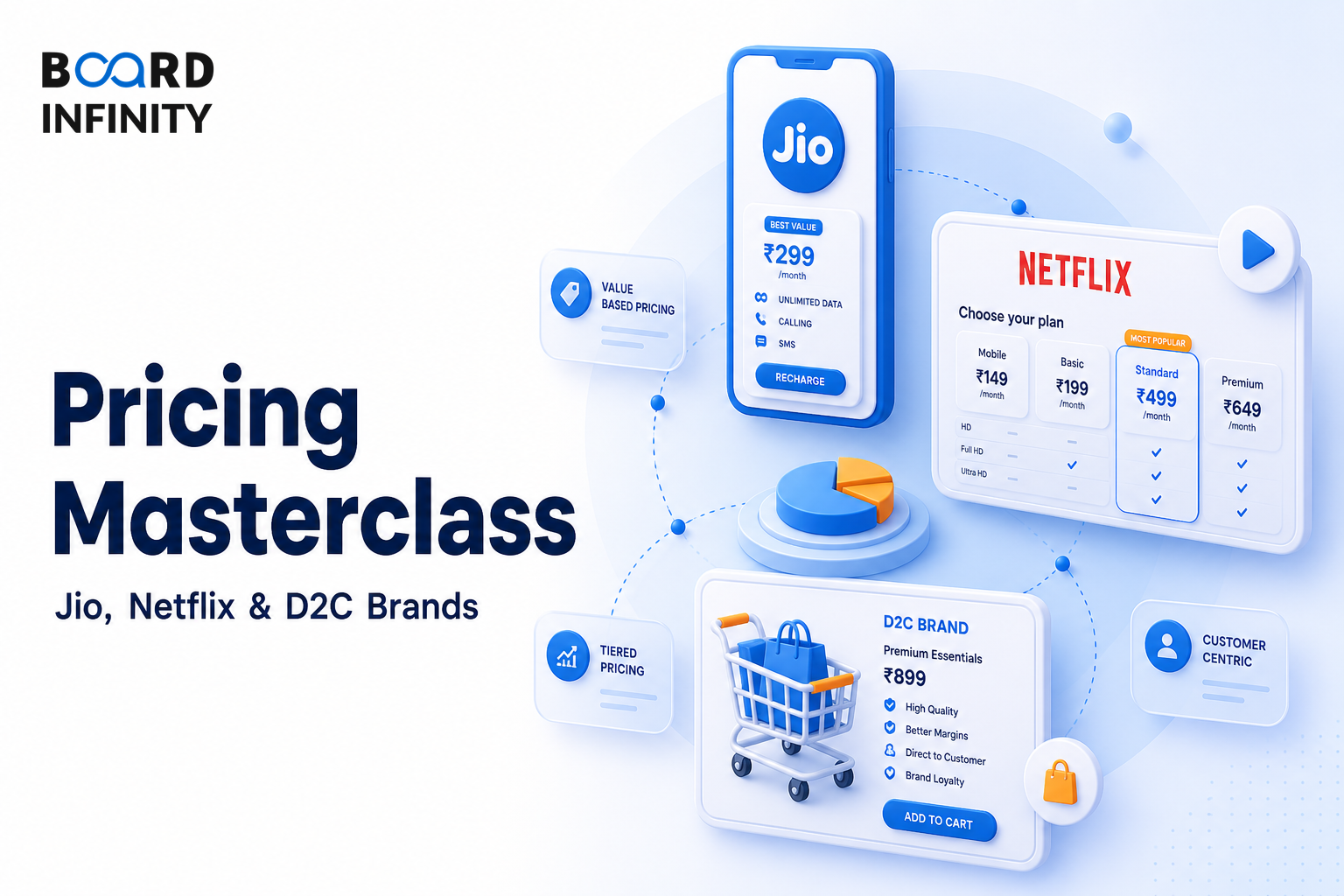
When Reliance Jio entered India, the most disruptive number in telecom was not a discount - it was zero. Free voice and introductory free data made millions of customers try a new network before competitors could defend their old price ladders.
- Pricing is strategy in numbers: it decides who buys, how often they buy, how profit is captured and how competitors react.
- Never start with cost alone. Start with the customer segment, value delivered, alternatives, cost floor and strategic objective.
- Jio used penetration pricing: low entry friction helped build scale, supported by network investment, distribution and ecosystem ambition.
- Netflix uses tiered pricing: plans separate customers by willingness to pay using device access, screens, quality and ad-supported options in some markets.
- D2C brands often win through price architecture: hero SKU, bundles, subscriptions, first-order offers and premium proof, not just one MRP.
- The core metric is contribution, not revenue: a fast-growing brand can still destroy value if discounts, shipping and CAC eat margin.
- Interview answer formula: Segment - Value - Cost - Competition - Architecture - Test.
Pricing is not the last step after product and promotion. It is the operating system that converts customer value into revenue while signalling positioning to the market.
The Core Idea: Price Is a Strategic Lever, Not a Math Exercise
A weak pricing answer says, “Add margin to cost.” A strong answer says, “Choose a price architecture that matches customer willingness to pay, covers unit economics and supports the business goal.”
Three companies show three different pricing jobs:
- Jio: use low entry friction to acquire users and change the category reference price.
- Netflix: use tiers to monetise different willingness-to-pay segments without building a different product for each person.
- D2C brands: use bundles, subscriptions and premium proof to lift average order value and protect margins.
The Three Pricing Plays You Must Know
Most interview cases around pricing are variations of three plays: penetration, tiering and premium value capture.
Jio, Netflix and D2C Brands: Same Word, Different Pricing Logic
Do not describe all low prices as “discounting.” Jio’s early low-friction pricing, Netflix’s plan ladder and D2C bundle pricing solve different business problems.
Jio’s primary driver was scale-led market entry: remove adoption barriers, build network usage and create a new price expectation. The supporting drivers were heavy network investment, strong distribution, device affordability, data-led consumer behaviour and a broader digital ecosystem.
Netflix’s primary driver is willingness-to-pay segmentation. A casual mobile viewer, a family watching on multiple screens and a high-definition user do not value the service equally. Supporting drivers include content depth, habit formation, device access, household usage and local market competition.
D2C pricing’s primary driver is contribution economics. A brand must cover product cost, packaging, fulfilment, payment charges, returns, discounts and customer acquisition cost. Supporting drivers include repeat purchase, community, trust signals, product education and bundle design.
The Pricing Toolkit: Terms You Should Be Able to Apply
- Willingness to pay: the maximum price a customer is prepared to pay for a perceived benefit.
- Price architecture: the full system of list price, tiers, discounts, bundles, subscriptions and payment terms.
- Price fence: a rule that separates customer groups so one segment does not easily access another segment’s price.
- Reference price: the price customers use as a mental benchmark while judging a deal.
- Price elasticity: how sensitive demand is to a change in price.
- Contribution margin: the money left after variable costs, used to recover fixed costs and profit.
Kotler and Armstrong: “Price is the amount of money charged for a product or service.”
Value-based pricing: setting price primarily from perceived customer value, not seller cost.
Price elasticity of demand: percentage change in quantity demanded divided by percentage change in price.
The Metrics That Tell You Whether Pricing Is Working
Use these as interview heuristics. The exact “good” number changes by category, but the logic is stable: price must create demand without destroying contribution.
A Small Worked Example: Why Revenue Can Lie
Suppose a D2C nutrition brand sells a snack box with a list price of ₹249. It gives a ₹20 first-order discount, so net revenue is ₹229.
If the brand pays ₹180 CAC for a first customer, the first order loses ₹81 after acquisition. That may still be acceptable only if repeat purchase brings later contribution. This is why D2C pricing must be read with cohort retention, not just order revenue.
Case Study: The Whole Truth and Premium D2C Pricing
The Whole Truth built a premium clean-label food brand in India by tying higher prices to ingredient transparency, trust and repeatable proof.

Situation: Packaged snacks and protein bars in India are crowded, promotion-heavy and easy to compare on price. A new entrant cannot simply charge more because it says “healthy.” The customer needs proof.
The move: The Whole Truth chose a trust-first premium position. Its core pricing logic was not “we cost more, so we charge more.” It was “we remove hidden ingredients, explain what goes into the product and make transparency the value proposition.”
The primary driver was credibility around clean ingredients. Supporting drivers included direct-to-consumer storytelling, founder-led communication, product education, packaging that reinforces transparency, repeat-use categories and selective expansion beyond the website into modern retail and quick-commerce channels.
Outcome and lesson: The brand shows a central pricing principle: premium is not a price tag, it is a promise with evidence. Without proof, a premium looks expensive. With proof, it becomes a shortcut to trust.
How AI Changes Pricing Strategy
AI does not remove pricing judgement. It makes testing, segmentation and monitoring faster - and it makes bad discounting easier to detect.
- Willingness-to-pay research becomes faster: teams can analyse reviews, sales calls, competitor pages and social comments to identify which benefits customers repeatedly mention before paying.
- Dynamic pricing becomes more practical: marketplaces, travel, quick-commerce and subscription platforms can use demand signals, inventory, time, location and competitor context to recommend price changes. The caution: unfair or opaque pricing can damage trust and invite regulatory attention.
- Promotion leakage can be spotted earlier: AI models can flag cohorts that buy only during discounts, SKUs where price realisation is falling, or bundles that raise revenue but reduce contribution.
Use Perplexity or ChatGPT to build a pricing teardown before an interview: ask it to compare one company’s tiers, discounts, customer segments, competitors and likely unit-economics pressures. Then verify every factual claim from the company website, annual report or credible news sources.
Interview Relevance
“Compare Jio, Netflix and a D2C brand. How would you decide which pricing strategy is right for each business?”
Use this sentence if stuck: “I would not recommend a single price first; I would design a price architecture and test which segment moves profitably.”
Common Mistake
The biggest mistake is treating pricing as cost-plus arithmetic. It costs candidates because they ignore customer value, competitor reference prices and contribution after discounts. One-line fix: start with willingness to pay, check the cost floor, then design tiers or bundles that can be tested.
What to Revise Next
This is a natural capstone topic. To close the course, build a one-page pricing teardown of any company you might mention in interviews: Jio, Netflix, Zomato, boAt, The Whole Truth, Razorpay, Indigo or a campus recruiter’s own product.