
Pricing Fundamentals: Answer Cost, Value and Competition-Based Pricing in Interviews
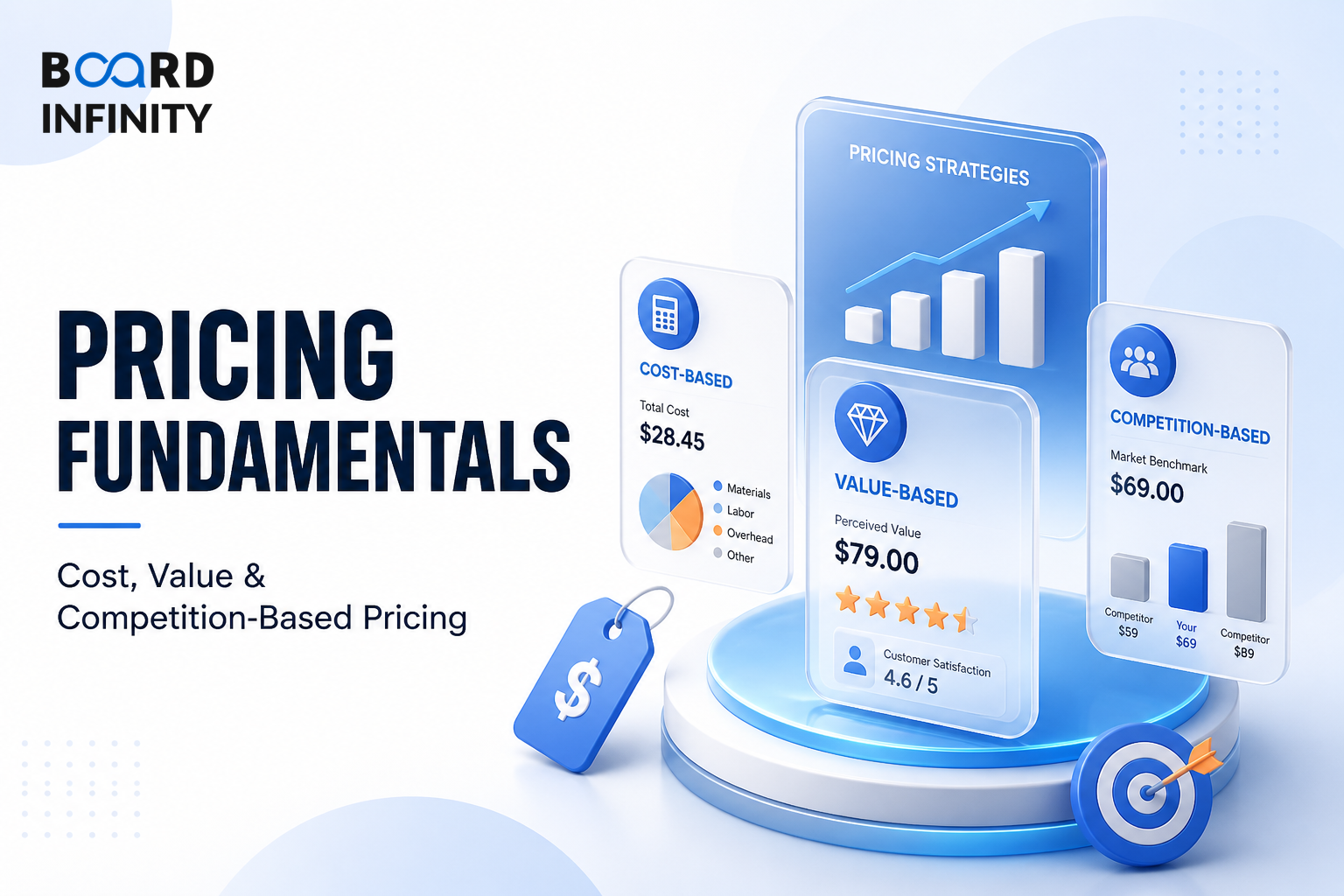
Most bad pricing starts with one comforting myth: “If we know our cost, we know our price.” Walk into a supermarket, an app store or an electronics marketplace and you will see the truth immediately - the winning price is shaped by cost, customer value and competitor alternatives at the same time.
- Cost-based pricing starts with unit cost and adds a target margin; it protects profitability but may ignore customer willingness to pay.
- Value-based pricing starts with the customer’s perceived benefit; it captures upside when differentiation is strong.
- Competition-based pricing benchmarks rival prices and substitutes; it is useful in transparent, crowded markets.
- The smart pricing zone sits between the cost floor and the customer value ceiling, with competitors acting as reference points.
- Use cost pricing for survival checks, value pricing for profit upside and competitor pricing for market reality checks.
- Track gross margin, contribution margin, price realization, elasticity, win rate and LTV:CAC where relevant.
- The biggest interview mistake is choosing one approach blindly instead of triangulating across all three.
Big Picture: Price Is a Decision Loop, Not a Formula
A good price is not calculated once and forgotten. Managers set an initial price using cost, value and competition, observe market response, then refine it through discounts, packs, tiers or repositioning.
Core Explanation: The Three Pricing Approaches
Pricing fundamentals become easy once you separate the three questions every price must answer.
1. Cost-Based Pricing: Start with Economics
Cost-based pricing sets price by adding a markup to the cost of producing, sourcing or delivering the product. It is common in manufacturing, retail, projects and categories where costs are visible.
The strength of cost-based pricing is discipline: it stops you from selling below economic viability. Its weakness is that it can underprice a high-value offer or overprice a weak one.
2. Value-Based Pricing: Start with the Customer
Value-based pricing sets price according to the customer’s perceived value, not the seller’s cost. The customer may pay more because the product saves time, reduces risk, improves outcomes or signals identity.
For example, a B2B SaaS tool that reduces manual finance work should not price only on server cost. It should quantify time saved, errors reduced and faster reporting, then price against a share of that value.
3. Competition-Based Pricing: Start with Alternatives
Competition-based pricing uses rival prices, substitutes and category norms as anchors. It is especially important in e-commerce, airlines, telecom, consumer electronics and commodity-like services where customers can compare quickly.
The trap is matching competitors without understanding whether your own value proposition and cost structure are different. A low-cost challenger can survive a price war that a high-service incumbent cannot.
Cost, Value and Competition Compared
Use this table to decide which approach fits the business situation.
Worked Example: Setting a Launch Price
Assume a D2C backpack brand is launching a laptop bag. These are hypothetical interview numbers, designed only to show the logic.
The recommendation should not be “price at ₹1,333 because the formula says so.” A stronger answer is: price around ₹1,399 if the design and warranty are credible, because it clears the cost floor, stays inside the competitor range and remains below the estimated value ceiling. Then test conversion and margin during the first sale cycle.
Metrics to Track After Pricing
Pricing is only real when it meets the market. Benchmarks vary by category, so treat the ranges below as directional checks, not universal laws.
Definitions You Should Be Able to Say
AMA: “Price is the formal ratio that indicates the quantities of money, goods, or services needed to acquire a given quantity of goods or services.”
Kotler and Keller: “Price is the one element of the marketing mix that produces revenue; the other elements produce costs.”
For interview use, say it simply: pricing is the decision of what to charge by balancing company economics, customer value and competitive alternatives.
Case Study: boAt and the Pricing Corridor in Indian Audio
boAt built a mass-premium Indian audio brand by pricing between unbranded low-cost accessories and expensive global lifestyle electronics.

Situation: India’s smartphone-led audio market had a wide gap. At one end were low-priced generic accessories; at the other were global premium brands that many young consumers found expensive. Marketplaces made prices transparent, so customers could compare instantly.
The move: boAt used the pricing corridor well. Its primary driver was a sharp mass-premium price position - aspirational enough to feel like a lifestyle purchase, accessible enough for Indian e-commerce shoppers. Supporting drivers included online-first distribution, frequent product launches, youth-oriented branding, marketplace ratings and a portfolio across earphones, speakers and wearables.
The lesson: boAt did not win because of “low price” alone. It combined a credible value promise with prices that were visibly below global premium alternatives and above the cheapest generic products. That is competition-based pricing disciplined by perceived value and cost control.
So what: A complete pricing answer explains the corridor. boAt’s example shows that winning prices are rarely just cheap; they are cheap relative to the value customers believe they are getting.
How AI Changes Pricing Fundamentals
AI does not replace pricing judgment, but it makes the feedback loop faster and more granular.
Use Perplexity to collect public competitor price ranges for a category, then use ChatGPT to build a pricing corridor table: cost assumptions, competitor anchors, likely value drivers and interview questions.
Interview Relevance
“A company is launching a new product. How would you decide the price? Would you use cost-based, value-based or competition-based pricing?”
Use the phrase: “I would not choose one approach in isolation. I would use cost as the floor, value as the ceiling and competition as the market reference.”
Common Mistake
The mistake that costs candidates is saying “cost-plus pricing is safest” without checking customer value or competitor alternatives. It sounds practical but shows weak market thinking. Fix: always triangulate - cost floor, value ceiling, competitor anchor.
What to Revise Next
Now that you understand how prices are set, move to how pricing is used strategically and psychologically.