
B2C vs B2B Buying Behavior - Key Differences That Matter
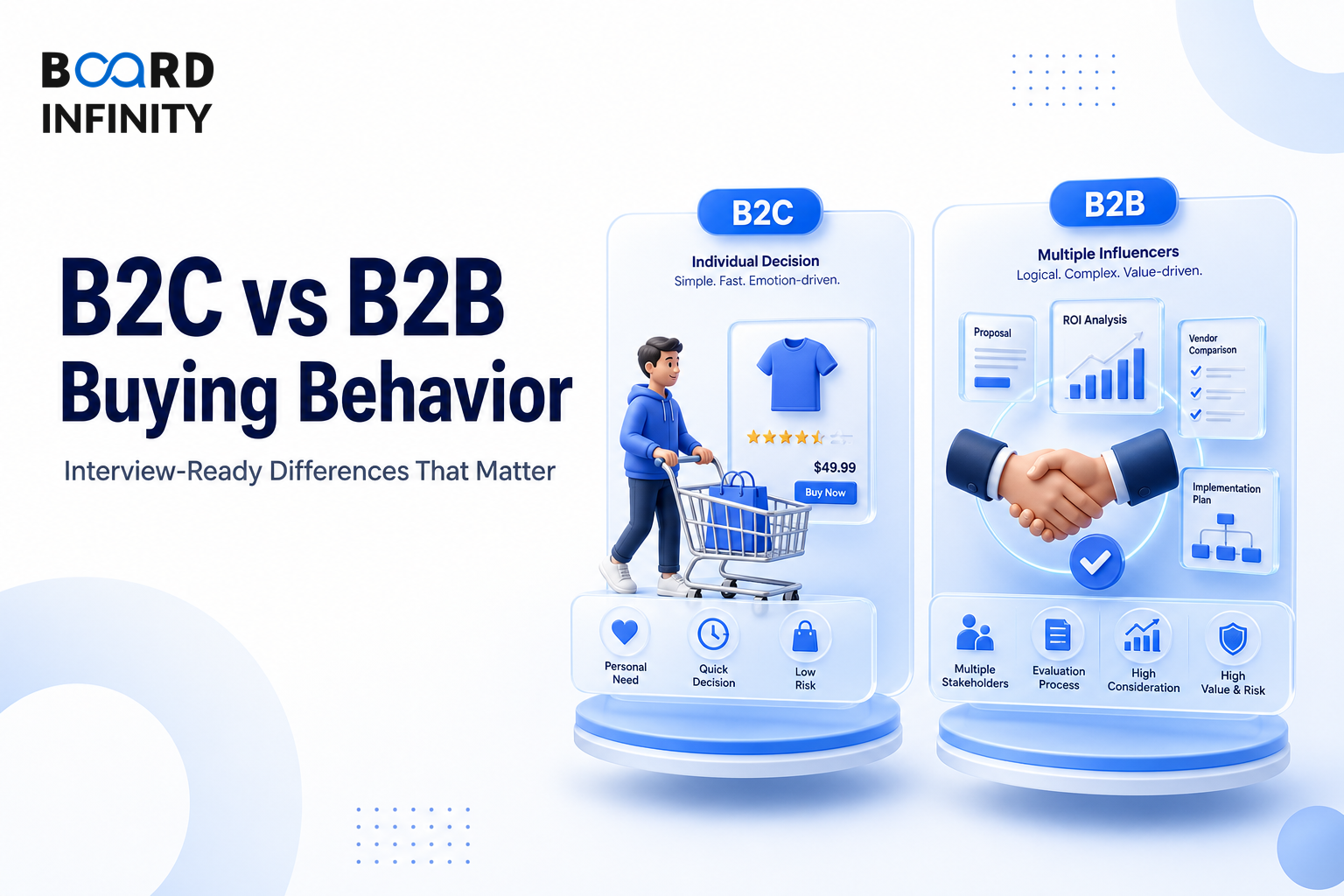
A teenager adds wireless earbuds to cart at midnight because a creator made them feel cool. The next morning, a manufacturing firm spends weeks evaluating a supplier for safety gloves because one wrong choice can disrupt compliance, cost and operations.
- B2C buying is about individual or household need satisfaction; B2B buying is about organizational value, risk control and operational fit.
- B2C decisions are often faster, emotionally influenced and lower-ticket; B2B decisions are slower, rationally justified and involve multiple stakeholders.
- The B2C “buyer” is usually one person or a family; the B2B “buyer” is a buying center - users, influencers, buyers, deciders and gatekeepers.
- B2C marketing wins through brand salience, convenience, price-value, social proof and experience. B2B marketing wins through trust, ROI, technical proof, service and procurement fit.
- B2C journeys look like awareness to purchase to repeat; B2B journeys look like problem recognition to specification, vendor evaluation, negotiation, approval and onboarding.
- The biggest difference is not “emotional vs rational.” B2B buyers are also emotional - but the emotion is career risk, credibility and trust.
Big Picture: One Is a Personal Choice, the Other Is an Organizational Decision
Think of B2C as a person choosing for consumption and B2B as a firm choosing for performance. The same product category can behave differently depending on who buys it: a phone bought by a student is B2C; 500 phones bought by a sales organization for its field force is B2B.
Core Explanation: The Differences That Actually Matter
The clean way to compare B2C and B2B buying behavior is not to memorize ten random points. Use five lenses: buyer, motivation, process, risk and marketing response.
The B2C Journey: Faster, Messier and More Emotionally Triggered
In B2C, the buyer often moves from a trigger to search to purchase with fewer formal barriers. But “fast” does not mean “simple.” A consumer may compare ratings, watch creator videos, ask friends, check discounts and abandon the cart twice before buying.
Nykaa grew by making beauty buying feel safer online: discovery content, reviews, curated brands and assisted choice reduced uncertainty in a category where shade, skin type and trust matter. The primary driver was confidence-building content and assortment; supporting drivers included marketplace convenience, private labels, influencer-led discovery and omnichannel stores. The so what: in B2C, conversion often improves when the brand reduces perceived risk without killing the excitement of choice.
The B2B Journey: Slower Because the Cost of Being Wrong Is Higher
In B2B, the buyer is rarely one person. A software purchase may begin with a frustrated sales team, be evaluated by IT, negotiated by procurement, approved by finance and finally signed by a business head. Each stakeholder asks a different question.
Definitions You Can Say in One Breath
B2C buying behavior: how individuals or households select, purchase, use and dispose offerings for personal consumption.
B2B buying behavior: how organizations identify needs, evaluate suppliers and purchase offerings to achieve business objectives.
Derived demand: business demand that arises from demand for the final goods or services the firm produces.
The important nuance: B2C is not “irrational” and B2B is not “purely rational.” B2C buyers can be highly analytical in categories like insurance, education or smartphones. B2B buyers can be deeply emotional because their reputation, bonus, workload or job security may depend on the vendor they choose.
What to Track: Metrics That Reveal the Difference
Use metrics to show that you understand behavior, not just theory. B2C metrics usually track traffic, conversion and repeat purchase. B2B metrics track lead quality, pipeline movement, win rate and account value.
Mini Case Study: Moglix and the Logic of B2B Buying
Moglix built a B2B commerce and procurement platform for industrial supplies, showing why B2B buyers value reliability, compliance and process control as much as price.

Situation: Industrial procurement is not like buying a pair of sneakers online. A manufacturing company may need safety equipment, electrical items, tools or MRO supplies across plants, with correct specifications, vendor reliability, GST-compliant invoicing, delivery timelines and internal approvals.
The move: Moglix focused on making industrial buying more structured: broad supplier access, digitized procurement workflows, catalog standardization and enterprise servicing. The primary driver was reducing procurement complexity and risk for businesses. Supporting drivers included supplier aggregation, technology-led ordering, documentation support and account-level relationship management.
Outcome or lesson: The lesson is not “B2B buyers only want the lowest price.” They want a defensible decision. If a vendor can lower total cost, reduce stockouts, simplify compliance and make procurement teams look reliable internally, it becomes easier to approve.
How AI Changes B2C vs B2B Buying Behavior
AI is changing both sides, but in different ways.
Practical student workflow: Use Perplexity or NotebookLM to compare one B2C company and one B2B company before an interview. Load annual reports, investor presentations or website pages, then ask: “Who is the buyer, what risk do they face, who influences the purchase, what proof does the company provide, and what metric shows success?” This turns AI into a structured revision assistant, not a shortcut.
Interview Relevance
“How is B2B buying behavior different from B2C buying behavior? Explain with an example and tell me how marketing strategy changes.”
A strong answer says: “B2B is not just bigger B2C. It has derived demand, multiple stakeholders, formal evaluation and higher perceived risk.” That one line signals maturity.
Common Mistake
Candidates often say, “B2C is emotional, B2B is rational.” This is too shallow because B2B decisions also involve emotion - fear of failure, trust in the vendor and internal credibility. Fix: say B2C has more personal emotion, while B2B has rational justification plus organizational risk emotion.
What to Revise Next
Next, connect this comparison to how buyers actually move through modern markets. Revise The Digital Consumer Journey: ZMOT, the Messy Middle & Social Commerce for B2C discovery behavior, then Market Research Fundamentals: Primary vs Secondary, Qual vs Quant to learn how marketers study both consumer and organizational buyers.