
The Consumer Decision-Making Journey, Explained with Examples
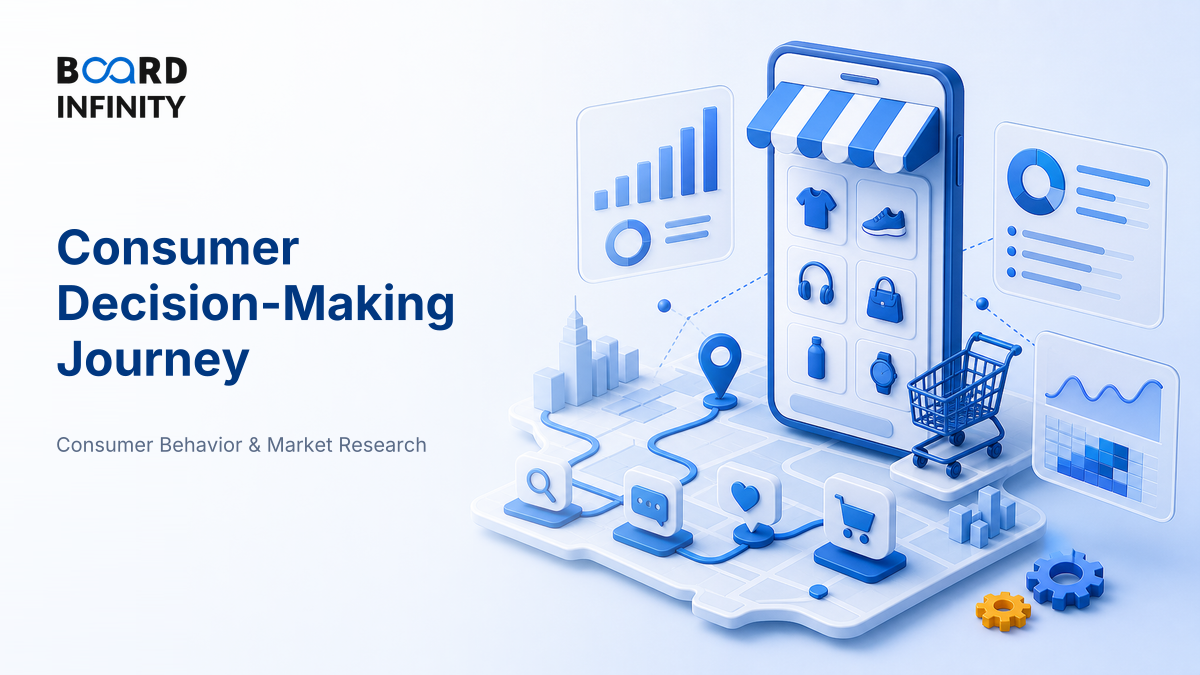
Why do we say a consumer “decided” at the checkout when the choice may have been shaped days earlier by a reel, a review, a price alert and a friend’s casual recommendation? The real consumer decision-making journey is not a neat walk to a shelf - it is a messy, looping path of triggers, shortcuts, proof and post-purchase emotion.
- Consumer decision-making journey is the path from need recognition to information search, evaluation, purchase, post-purchase experience and possible loyalty.
- The classic five stages are need recognition, information search, evaluation of alternatives, purchase decision and post-purchase behavior.
- The journey is rarely linear - reviews, retargeting, returns, service experience and word-of-mouth can loop the consumer back or forward.
- High-involvement purchases need trust, comparison and reassurance; low-involvement purchases need availability, habit and salience.
- Marketers win by reducing friction at each stage - making the need visible, search easy, comparison credible, purchase low-risk and usage satisfying.
- Track the journey with metrics like awareness, CTR, conversion rate, cart abandonment, repeat purchase rate and NPS.
- The biggest interview trap is describing the five stages without adapting them to the category, consumer segment and touchpoints.
Think of the consumer journey as a decision system, not a single decision. A marketer’s job is to understand what the consumer is trying to resolve at each stage - “Do I need this?”, “Can I trust it?”, “Is it worth the price?”, “Will I regret this?” - and then design the right touchpoint to move them forward.
The Core Framework: Five Stages of Consumer Decision-Making
The classic model is useful because it gives you a clean structure. The nuance is that consumers do not spend equal time in every stage. Buying toothpaste may skip deep evaluation; buying a car, laptop or insurance policy may involve weeks of research, family inputs, dealer visits and financing decisions.
What the Consumer Is Really Asking at Each Stage
A strong marketer does not just “communicate” at each stage. They remove the specific uncertainty blocking progress.
Nykaa benefits because beauty consumers often search for shade matches, reviews, ingredient explanations and influencer validation before buying. The primary driver is rich decision-support content around products, supported by wide assortment, marketplace trust, app convenience and repeat-purchase nudges. The strategic so what: in categories with high perceived personal risk, the brand that helps consumers evaluate confidently often wins before the cart is opened.
The 2x2 Matrix: Not Every Purchase Journey Looks the Same
The journey changes with involvement and perceived brand differences. Involvement means how much time, money, risk or identity the consumer attaches to the decision. Perceived brand differences mean whether the consumer sees meaningful variation between options.
Metrics That Tell You Where the Journey Is Breaking
Interviewers like candidates who can move from theory to measurement. Use these metrics to diagnose which stage needs attention. Treat the “good” value as category-dependent - a strong answer compares against competitors, past campaigns and cohort trends.
Mini worked example: suppose a D2C eyewear site gets 10,000 product-page visits, 700 add-to-carts and 280 purchases. Add-to-cart rate = 700 / 10,000 = 7%. Conversion rate = 280 / 10,000 = 2.8%. Cart abandonment rate = (700 - 280) / 700 = 60%. If visits are strong but abandonment is high, the problem is likely not awareness - it may be price shock, delivery uncertainty, prescription complexity, payment failure or weak return reassurance.
Definitions You Can Say Cleanly
Kotler and Armstrong: “Consumer buyer behavior refers to the buying behavior of final consumers - individuals and households that buy goods and services for personal consumption.”
Consumer decision-making journey: the path a consumer follows from recognizing a need to searching, evaluating, buying, using and responding after purchase.
Post-purchase dissonance: discomfort after buying, especially when the decision was expensive, risky or hard to reverse.
Moment of truth: a decisive interaction where the consumer forms or changes their judgment about the brand.
Lenskart: Turning a Risky Eyewear Purchase into a Guided Journey
Lenskart shows how an Indian consumer brand can redesign the entire eyewear journey by reducing uncertainty before, during and after purchase.

Situation: Eyewear is a high-involvement category because consumers worry about fit, face shape, prescription accuracy, lens quality and whether the frame will look good in real life. Traditional optical retail also made comparison difficult: limited store inventory, dependence on staff advice and uneven pricing transparency.
The strategic move: Lenskart attacked friction across the journey instead of treating eyewear as a simple online sale. It used digital discovery, virtual try-on, home eye-check options in some markets, physical stores, standardized pricing cues, after-sales support and repeat-purchase nudges. The primary driver was omnichannel confidence-building. Supporting drivers included technology-assisted trial, private-label and supply-chain control, retail presence, financing or offer visibility and CRM-led retention.
Outcome and lesson: The lesson is not “online wins.” The lesson is that a complex purchase journey improves when the brand removes uncertainty stage by stage. For eyewear, the consumer does not only need a product - they need proof that the product will fit, look right, correct vision and be serviceable later.
How AI Changes the Consumer Decision-Making Journey
1. AI reshapes discovery and search. Consumers increasingly ask AI assistants for “best options under my budget” instead of browsing ten links. This means brands must optimize not only for SEO, but also for answer engines, comparison content, structured product data and credible third-party mentions.
2. AI personalizes the next best action. Retailers and apps can use browsing history, cohort behavior and purchase signals to decide whether a consumer needs a reminder, review proof, bundle, price drop alert or service message. The best use is not “more messages” - it is better timing and relevance.
3. AI improves journey diagnosis, but raises trust and privacy questions. Sentiment mining of reviews, call-center transcripts and app feedback can reveal where consumers are stuck. In India, marketers must also respect consent, data minimization and privacy expectations under the DPDP Act framework.
Use NotebookLM or Perplexity to study a company before an interview: upload the company annual report, recent app reviews and two competitor pages, then ask, “Map the consumer journey stage by stage, identify friction points, and suggest three metrics to track.”
Interview Relevance
“Explain the consumer decision-making journey for an Indian D2C eyewear or beauty brand. Where would you intervene as a marketer?”
Always tailor your answer to the category. A grocery app, luxury watch, insurance product and skincare brand do not have the same journey, even if the five-stage framework is the same.
The common mistake is reciting the five stages as a linear theory and stopping there. It costs candidates because it sounds memorized and ignores real consumer behavior. The one-line fix: state the stage, identify the consumer friction, then propose the touchpoint and metric for that stage.
What to Revise Next
Now that you understand the journey, revise the forces that shape each decision inside it. Move next to The Psychology of Buying: Motivation, Perception & Attitudes, then study Cultural, Social & Personal Influences on Consumer Behavior to explain why two consumers can move through the same journey very differently.