
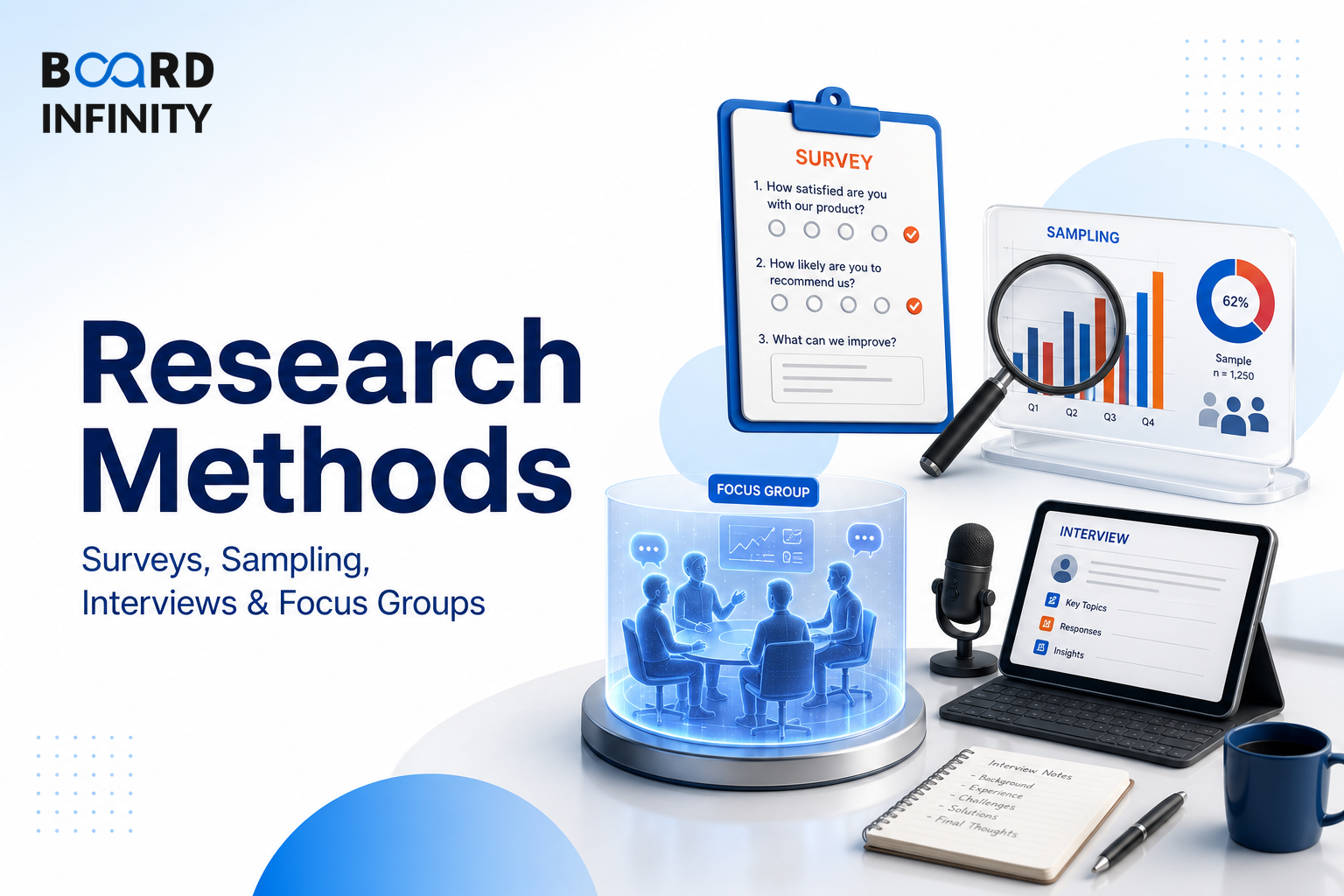
Research Methods: Surveys, Sampling, Interviews & Focus Groups
A beverage founder watches shoppers pause in front of a supermarket chiller: they scan cola, juice, energy drinks, then smile at a familiar Indian flavour from childhood. That smile is not luck - it is the visible end of research done well: the right people asked the right questions, in the right way, before the product reached the shelf.
- Research method choice starts with the decision: use interviews or focus groups to explore, surveys to measure, and observation or data to validate behaviour.
- A survey is only as good as its sample: a large biased sample is worse than a smaller representative one.
- Sampling has four layers: population, sampling frame, sampling method, and final respondents.
- Interviews find depth: motivations, language, trade-offs, anxieties and unmet needs.
- Focus groups find social meaning: how people react, disagree, copy, justify or negotiate in a group.
- Track quality metrics: response rate, completion rate, incidence rate, margin of error and data-quality fail rate.
- Best interview answer structure: objective - method - sample - instrument - bias controls - analysis - business decision.
Think of research methods as a funnel. You begin with a messy business question, narrow it into a research objective, choose a method, recruit the right respondents, and end with a decision-ready insight.
The Core Idea: Match the Method to the Unknown
The biggest research mistake is choosing the tool before naming the unknown. If you do not know what people think, feel or mean, use qualitative methods. If you need to know how many, how often, how strongly or which segment, use quantitative methods.
The Four Research Methods You Must Be Able to Compare
A Clean Six-Step Research Process
Surveys: How to Design Questions That Do Not Mislead
A survey is a structured method for collecting comparable responses from many people. It is powerful when the answer must be measured, but fragile when questions are vague, leading or asked to the wrong people.
Bad question: “How much do you love our affordable and high-quality app?” It assumes love, affordability and quality.
Better question: “How satisfied are you with the app’s value for money?” followed by a five-point scale from very dissatisfied to very satisfied.
Sampling: The Part Candidates Underestimate
Sampling is the process of selecting a subset from a population to estimate or understand the larger group. In business research, the central question is not “How many responses did we get?” It is “Who could have responded, and how were they selected?”
Types of Sampling
Worked Example: Estimating Survey Sample Size
For a simple proportion, a common planning formula is:
n = z² × p × (1 - p) / e²
Suppose you want to estimate the percentage of target customers who would try a new subscription, with 95% confidence, maximum uncertainty and ±5 percentage point margin of error.
- z = 1.96 for 95% confidence
- p = 0.5 when you do not know the proportion, because it gives the most conservative sample size
- e = 0.05 for ±5 percentage points
n = 1.96² × 0.5 × 0.5 / 0.05² = 384.16, so you would plan for about 385 completed responses. If you expect drop-offs or poor-quality responses, invite more people than 385.
This formula assumes probability sampling and independent responses. It does not rescue a biased panel, a weak screener or a convenience sample.
Research Quality Metrics: What to Track
Interviews: How to Find the Why
An interview is a one-on-one qualitative conversation designed to uncover motivations, context and meaning. The interviewer’s job is not to prove a hypothesis. It is to help the respondent reconstruct real behaviour.
Use interviews when you need to understand:
- how a customer chooses between alternatives
- what triggers a purchase or cancellation
- what language customers naturally use
- where anxiety, friction or delight appears in the journey
- which trade-offs people actually make
Strong interview questions are open, neutral and behaviour-based:
- “Tell me about the last time you bought this category.”
- “What happened just before you decided?”
- “What alternatives did you consider?”
- “What made the decision difficult?”
- “If this product disappeared tomorrow, what would you use instead?”
Focus Groups: When the Group Is the Data
A focus group is a moderated group discussion where participant interaction helps reveal reactions, norms, objections and shared language. It is especially useful for communication, packaging, concept testing and social categories where people influence one another.
The crucial distinction: a focus group is not “six interviews in one room.” If people only answer the moderator one by one, the method is being wasted. The value comes from agreement, disagreement, surprise, imitation and debate.
Definitions You Can Say in One Breath
The American Marketing Association says marketing research “links the consumer, customer, and public to the marketer through information.”
Case Study: Paper Boat and the Power of Listening Before Scaling
Hector Beverages built Paper Boat around Indian traditional drinks and nostalgia, showing how qualitative insight can create sharper product and brand choices.

Paper Boat entered a beverage market where large players already owned colas, packaged juices and energy drinks. Competing head-on on refreshment alone would have made it another product on a crowded shelf.
The sharper opportunity was emotional and cultural: many Indian consumers had strong memories attached to drinks like aam panna, jaljeera and kokum, but the category was not always available in a modern, hygienic, ready-to-drink format. That insight is exactly the kind of thing surveys alone often miss. People may not write “nostalgia” in a checkbox, but they reveal it in stories, memories and language.
The strategic move was to translate that listening into a full research-led proposition: product flavours rooted in Indian memory, packaging that felt distinct from standard bottles, and communication built around childhood and home rather than only thirst. The primary driver was a differentiated consumer insight around nostalgia and authenticity. Supporting drivers included modern packaging, consistent availability through organised retail and a brand world that made the emotional benefit easy to understand.
The lesson is not “nostalgia wins.” The lesson is better: research helped convert a cultural memory into a business proposition, and the win depended on insight, product execution, distribution and brand consistency working together.
How AI Changes Research Methods
AI does not remove the need for research judgement. It changes the speed, scale and risk profile of how research is designed and analysed.
- AI-assisted questionnaire and guide design: Tools can generate draft survey questions, interview probes and screener logic. The researcher must still remove leading language, double-barrelled questions and irrelevant scales.
- Qualitative coding at scale: LLMs can summarise interview transcripts, cluster themes and extract repeated pain points. The risk is hallucination or over-smoothing, so always verify themes against raw quotes.
- Smarter sampling and fraud detection: Research platforms increasingly use ML to detect speeding, duplicate respondents, straight-lining and low-quality open-ended answers. This improves data quality but must be transparent and privacy-aware, especially under India’s DPDP Act context.
Use NotebookLM: upload your research brief, draft questionnaire and 5-10 interview transcripts, then ask it to generate themes, possible biases, missing probes and likely interviewer questions. Use ChatGPT or Claude only after you write the research objective yourself.
Interview Relevance
“Suppose a D2C skincare brand wants to launch a sunscreen for Indian college students. How would you design the research using surveys, sampling, interviews and focus groups?”
In answers, say “I would first do qualitative research to discover variables, then survey to measure them.” This single sentence signals mature research thinking.
Common Mistake
The mistake that costs candidates is treating a large survey as automatically reliable. It costs you because interviewers know biased sampling creates confident but wrong answers. The fix: always mention target population, sampling frame, sampling method and bias controls before quoting survey results.
What to Revise Next
Research methods help you collect evidence. Next, revise how that evidence becomes customer understanding: move to From Data to Insight: Personas & Jobs-to-be-Done (JTBD), then Consumer Insight in the Age of Data & AI.