
Connected Devices, Sensors & Real-Time Tracking
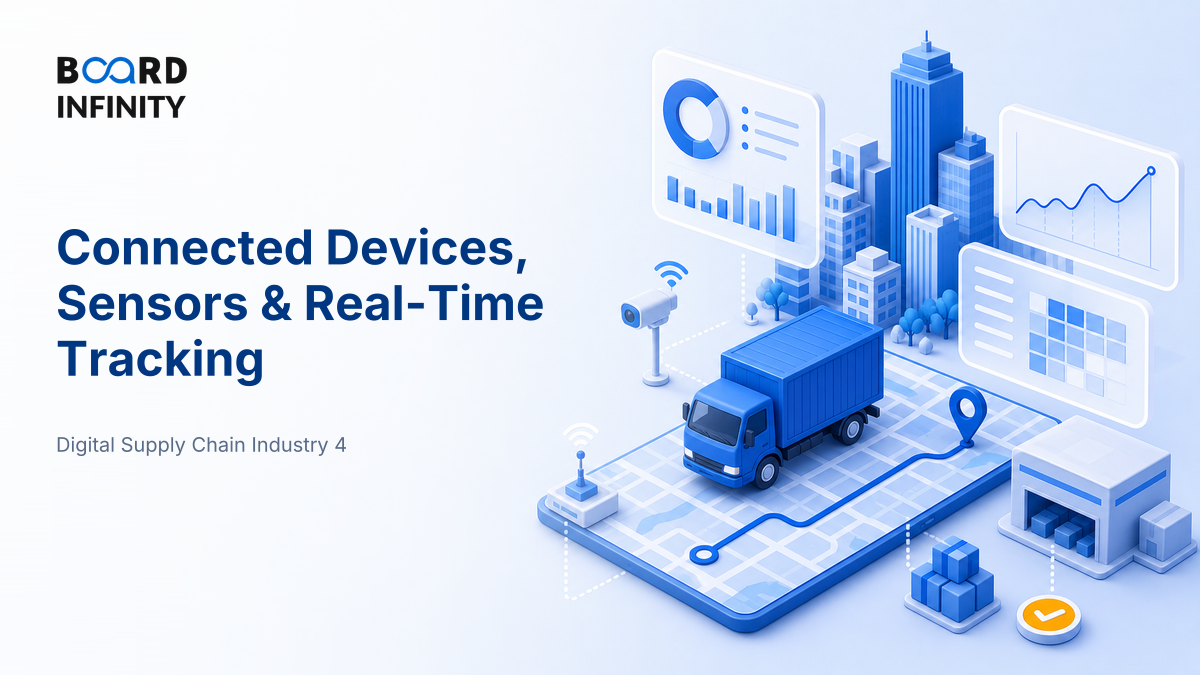
A truck carrying temperature-sensitive vaccines does not fail when it reaches the customer late. It fails the moment its temperature quietly crosses the safe range and nobody notices. Connected devices change that moment from a post-mortem into a live operating decision.
- Connected devices are physical assets with sensors, connectivity and software that send operational data from the real world.
- Sensors detect conditions such as location, temperature, vibration, pressure, humidity, speed or machine status.
- Real-time tracking is not just GPS dots on a map - it is live visibility plus alerts, decisions and corrective action.
- The core architecture is: sense physical state - capture data - transmit - analyse - act.
- The business value comes from fewer blind spots: better ETA accuracy, cold-chain compliance, asset utilisation, theft prevention and exception management.
- The danger is data noise. A company wins only when sensor data is filtered into useful exceptions, not dumped into dashboards.
- In interviews, explain the use case first, then device choice, data flow, KPIs, risks and ROI.
Big Picture - The Supply Chain Gets a Nervous System
Traditional supply chains run on delayed updates: manual scans, phone calls, gate entries and ERP transactions. Connected devices add a digital nervous system - assets start reporting where they are, what condition they are in and whether something needs attention.
Core Explanation - How Connected Tracking Actually Works
The simplest mental model is this: a connected device turns an asset into a data source. The asset may be a truck, pallet, container, machine, warehouse bin, retail shelf, refrigerated box or delivery bike.
A complete system has five layers:
This is why connected devices are closely linked to inventory and operations topics. For example, sensors can feed live stock movement into AI-based inventory optimisation and replenishment, while bin-level or consumption-level signals can strengthen Kanban and pull-based replenishment.
The Main Types of Sensors and Tracking Technologies
Do not say “IoT” generically in an interview. Name the technology based on the decision problem.
The strategic choice is not “which sensor is coolest?” It is “which sensor gives the decision-maker a reliable signal at the right cost?”
From Tracking to Business Value - The Closed Loop
Real-time tracking is powerful because it closes the loop between event and response. A delayed temperature report may help with root-cause analysis. A live temperature alert can trigger a reroute, container check or customer warning while the shipment is still recoverable.
The most common use cases are:
Metrics That Prove Real-Time Tracking Is Working
A strong interview answer should name KPIs. Connected devices are not justified by “more visibility”; they are justified by measurable improvements in reliability, compliance and cost.
Notice the pattern: the best KPIs connect device data to operational outcomes. A dashboard metric such as “number of pings received” is useful for system health, but it does not by itself prove business value.
Definitions - Say These Cleanly
- Connected device: A physical asset with embedded sensing, software and connectivity that can send or receive operational data.
- Sensor: A device that detects a physical condition and converts it into a usable data signal.
- Real-time tracking: Near-instant visibility of an asset’s location, condition or status while operations are still underway.
- EPCIS: A GS1 standard for sharing event data across supply chains - the “what, when, where and why” of product movement, described by GS1’s EPCIS standard.
For MBA interviews, the phrase to remember is: visibility is the input; actionability is the value.
Case Study - Tata Motors Fleet Edge and Connected Commercial Vehicles
Tata Motors’ Fleet Edge shows how telematics can turn commercial vehicles into connected operating assets for fleet owners.

Situation: Indian fleet owners operate across long routes, variable road conditions, driver availability constraints and customer pressure for reliable delivery updates. Without connected vehicle data, many decisions depend on driver calls, manual logs and delayed trip information.
The move: Tata Motors built Fleet Edge as a connected vehicle platform for commercial vehicle customers, offering vehicle tracking, diagnostics, alerts and fleet performance visibility through its official Tata Motors Fleet Edge platform. The primary driver is embedded vehicle telematics - the vehicle itself becomes the data source. Supporting drivers include dashboard access for fleet managers, alerting, vehicle health visibility and linkage to the wider service ecosystem.
The lesson: The value is not the GPS location alone. The value comes when vehicle data helps a fleet owner reduce uncertainty - where the truck is, whether it is being used well, whether it needs attention and whether a customer promise is at risk.
So what: This is a good case because it shows the full connected-devices logic in an Indian B2B context: device data is useful only when it improves decisions for vehicle owners, drivers, service teams and customers together.
How AI Changes Connected Devices, Sensors & Real-Time Tracking
AI makes connected tracking more useful because it shifts the system from “show me what happened” to “tell me what is likely to go wrong and what to do next.”
- Predictive alerts become sharper. Instead of fixed rules such as “alert if temperature crosses threshold,” ML models can learn route patterns, equipment behaviour and risk signals to warn earlier.
- ETA and disruption prediction improve. AI can combine GPS, traffic, dwell time, weather, lane history and carrier behaviour to predict delivery risk before the customer escalates.
- Sensor data becomes easier to query. GenAI can let managers ask questions like “Which shipments had repeated temperature excursions last week?” instead of manually searching dashboards.
Use ChatGPT or Claude to practise: paste a short company description, list the assets being tracked, and ask it to create a use-case map with sensors, data captured, decisions triggered, KPIs and risks. Then refine the answer using real company facts from official pages.
The caution: AI does not fix poor sensor design. If devices are unreliable, timestamps are messy or master data is wrong, AI will simply automate confusion faster.
Interview Relevance
“Our company wants to track high-value shipments in real time. How would you design the system, and how would you prove ROI?”
Use this line in interviews: “I would not start by buying sensors. I would start by identifying the decision that is currently blind or delayed.”
Common Mistake
The mistake: treating real-time tracking as a dashboard project. Candidates talk about GPS and IoT but forget exception workflows, data quality, user adoption and ROI. The fix: always link each sensor signal to a decision, owner, action and KPI.