
Traceability, Serialisation & Distributed Ledgers
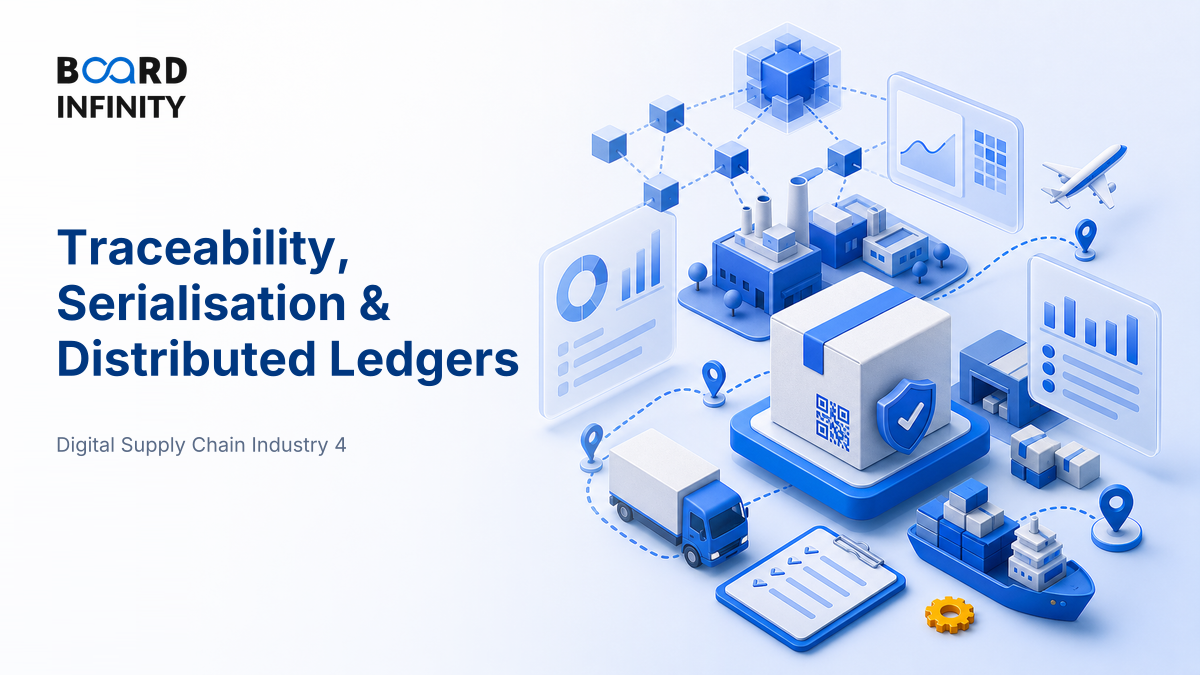
A contaminated pack of food can force a company to pull entire shelves because nobody knows exactly where the risk travelled. In a stronger supply chain, the same problem becomes a surgical action: identify the lot, isolate the serials, notify the right nodes, and prove the corrective action.
- Traceability answers: where did this item come from, where did it go, and what happened to it?
- Serialisation gives each saleable unit a unique identity; traceability uses that identity across events.
- Distributed ledgers help when multiple parties need a shared, tamper-evident record without trusting one central owner.
- The core stack is: identify the item - capture events - share trusted data - verify exceptions - act fast.
- DLT is not automatically better than a database; use it when multi-party trust, auditability and non-repudiation matter.
- Track read rate, event completeness, trace-back time, recall precision, exception closure time and partner adoption.
- The interview trap: saying “blockchain solves traceability” while ignoring master data quality, scanning discipline and supplier adoption.
Big Picture: The Chain of Custody, Not the Technology, Is the Point
Traceability is not a software feature. It is an operating capability that connects a physical product to a trustworthy digital history across suppliers, factories, logistics partners, distributors and regulators.
Core Explanation: Traceability, Serialisation and Distributed Ledgers
Traceability is the ability to follow a product’s history, location and movement through the supply chain. It works at different levels: batch, lot, pallet, case or individual unit.
Serialisation is a specific design choice inside traceability: each unit gets a unique identifier, often encoded in a barcode, QR code, Data Matrix or RFID tag. A batch code says “this group was made together.” A serial number says “this exact unit is uniquely identifiable.”
Distributed ledger technology is a shared record system where multiple parties hold synchronised copies of transactions. In supply chains, it is useful when a manufacturer, supplier, logistics partner and buyer all need a common audit trail, but no single party is fully trusted to own or edit the record alone.
How the Three Concepts Fit Together
Think of the system as a stack. The lower layers make the product visible. The upper layers make decisions faster and more defensible.
For example, a pharmaceutical carton may carry a unique serial number. When it is packed, shipped, received, returned or verified, each event is captured. If the product crosses several independent organisations, a distributed ledger can record those events in a way that is hard for one party to quietly alter later.
India’s Drug Authentication and Verification Application is built around authentication and traceability for exported drugs. The strategic point is clear: in regulated categories, traceability is not just efficiency - it protects patient safety, export credibility and compliance.
When to Use Batch Tracking, Serialisation or a Distributed Ledger
Do not recommend the most advanced system by default. Match the traceability design to risk, regulation, product value and partner complexity.
If supplier quality and compliance are weak, fix the upstream governance first. Traceability depends heavily on supplier onboarding, audits and scorecards, so revise Supplier Selection, Scorecards & Evaluation before proposing a complex technology layer.
Definitions You Can Say in One Breath
- Traceability: “ability to trace the history, application or location of an object” - ISO 9000:2015.
- Serialisation: assigning a unique identifier to each saleable unit so it can be individually tracked and verified.
- Blockchain: NIST describes it as a tamper-evident, tamper-resistant digital ledger implemented in a distributed fashion (NISTIR 8202).
The Operating Process: From Product Identity to Recall Action
A practical answer should show the process, not just name technologies.
This is also why traceability sits close to procurement risk management. A supplier that cannot generate accurate lot data or event records becomes a risk node, so connect this topic to Supplier Risk, Compliance & Responsible Sourcing.
Key Metrics to Track in a Traceability System
In interviews, metrics show that you understand execution. Use these as operating benchmarks, not universal laws - the right target depends on category risk, regulation and economics.
Worked Example: Why Serialisation Shrinks Recall Scope
Suppose a company discovers a contamination risk in one ingredient batch used in a food product.
The lesson: serialisation does not remove risk. It reduces uncertainty. That uncertainty reduction is what creates operational and financial value.
Bumble Bee Foods: Blockchain Traceability for Tuna
Bumble Bee Foods used blockchain-enabled traceability with SAP to let consumers and supply-chain partners verify the journey of selected tuna products, as described by SAP News Center.

Situation: Seafood supply chains face a difficult trust problem. A consumer at the shelf cannot easily verify where a fish came from, whether claims are credible, or how many hands the product passed through. For the company, the same opacity creates risk in sourcing, compliance and brand trust.
The move: Bumble Bee Foods worked with SAP on blockchain-enabled traceability so information about selected tuna products could be linked to a scannable code and shared across the chain. The primary driver was trust in product provenance. Supporting drivers included consumer transparency, stronger partner accountability and better auditability of handoffs.
Outcome and lesson: The case is memorable because the technology did not replace operations. It sat on top of product identification, event capture and partner participation. The strategic lesson: distributed ledgers create value only when the physical process is already disciplined enough to produce reliable events.
Where Distributed Ledgers Add Value - and Where They Do Not
A distributed ledger is worth discussing when several independent parties need a common record and the audit trail matters. It is weaker when the problem is simply poor internal discipline.
In procurement-heavy settings, traceability becomes stronger when sourcing contracts specify data-sharing obligations, labelling standards and audit rights. That makes Digital Procurement, Electronic Sourcing & Spend Analytics a natural adjacent topic.
How AI Changes Traceability, Serialisation & Distributed Ledgers
AI is making traceability more predictive, not just more visible.
- Exception detection: ML models can flag suspicious serial movements such as duplicate scans, impossible routes, unusual returns or stock appearing after expiry.
- Computer vision capture: Cameras can read labels, detect damaged codes and verify pack-level compliance where manual scanning is slow or error-prone.
- Traceability intelligence: LLMs can summarise supplier certificates, quality deviations, shipment notes and audit reports so operations teams find the likely root cause faster.
Load a company annual report, supplier code of conduct and this lesson into NotebookLM. Ask: “Where would traceability failures occur in this company’s supply chain, what data would I capture, and which metrics would prove improvement?”
If your answer moves into forecasting or replenishment, connect it carefully to Using AI for Inventory Optimisation and Replenishment - traceability tells you where stock is and what it is; optimisation tells you how much to hold and where to place it.
Interview Relevance
“A pharma distributor is facing counterfeit risk and slow recall response. How would you design a traceability system, and would you use blockchain?”
The best answer says “blockchain may help, but only after identity, event capture and governance are solved.” That sounds far more managerial than saying “use blockchain” as a magic fix.
Common Mistake
The costly mistake: treating distributed ledger as the solution instead of the trust layer. It costs candidates because interviewers immediately see that they have ignored physical scanning, supplier data quality and process compliance. One-line fix: always answer in this order - product identity, event capture, data sharing, verification, action.