
Enterprise Systems, Planning Software & the Operations Stack
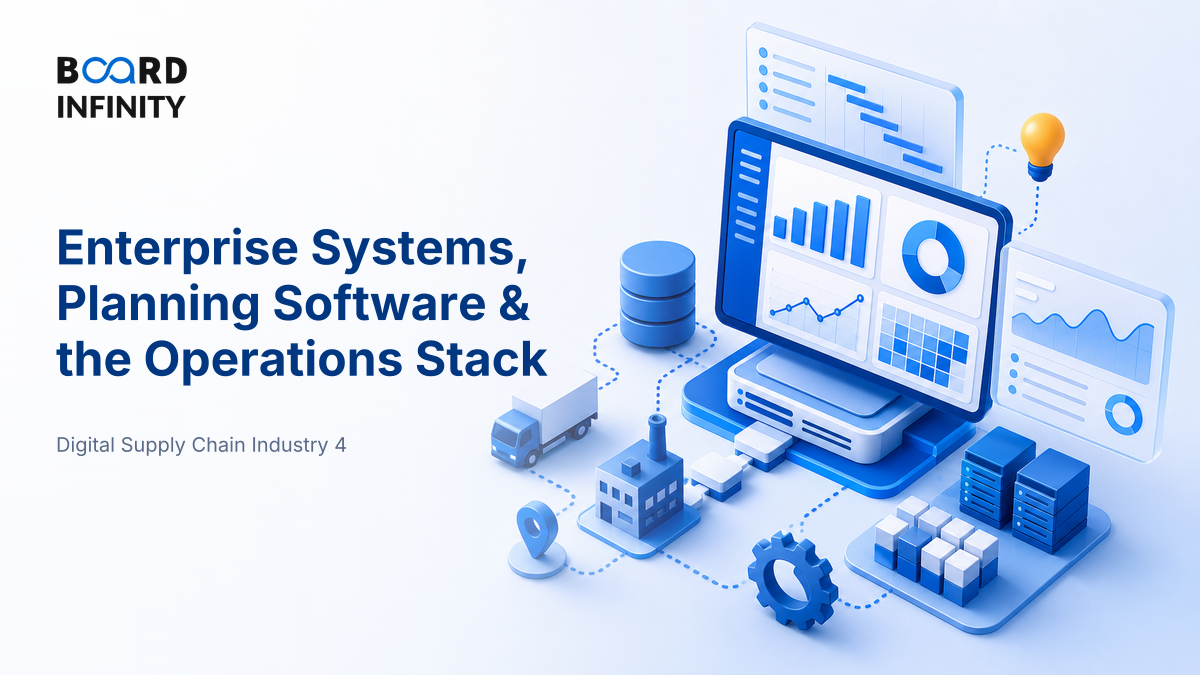
A plant manager sees it first as a red line on a dashboard: demand has changed, one supplier shipment is late, and the shop floor is still running yesterday's plan. The crisis is not just operational - it is informational. Enterprise systems matter because modern operations fail when planning, execution and real-time data live in separate worlds.
- Enterprise systems integrate core business processes such as finance, procurement, production, inventory, sales and HR on shared data.
- Planning software converts demand, supply, capacity and constraints into feasible plans - examples include MRP, APS, S&OP and demand planning tools.
- The operations stack has layers: sensors and machines, control systems, MES/WMS/TMS execution, planning systems and ERP decision records.
- ERP is not the whole stack. ERP records and coordinates; MES, WMS, TMS and IoT systems execute and sense what is happening.
- Good implementation is process-first: clean master data, standard workflows, clear ownership, integration and adoption before fancy dashboards.
- Interview answer formula: define the stack, map layers, explain planning logic, name KPIs, then discuss data and change-management risks.
- Most common trap: saying "SAP solves it" without explaining business process, data quality and execution integration.
Big Picture: Think of It as a Layered Operations Stack
The easiest way to understand enterprise systems is to stop thinking of them as "one big software." Think of them as a layered operating nervous system: the bottom layer senses and executes, the middle layer plans and coordinates, and the top layer records decisions for the enterprise.
Core Explanation: What Each Layer Does
Enterprise systems are software platforms that connect major business processes around shared master data and transaction records. In operations, the most important family is ERP - enterprise resource planning - because it links procurement, inventory, production, sales, finance and costing.
Planning software sits between strategy and execution. It answers questions like: What should we make? When should we buy? Which plant should produce? What inventory buffer is needed? How do we respond when demand changes?
Execution systems run the work. A manufacturing execution system tracks shop-floor work orders; a warehouse management system controls put-away, picking and dispatch; a transportation management system plans routes, freight and delivery execution.
Real-time tracking systems - sensors, barcode scans, RFID, GPS and machine signals - feed the stack with live status. Without this layer, the ERP can become a beautiful record of yesterday's reality.
The Planning Flow: From Demand Signal to Purchase Order
Planning software creates value by converting market demand into executable supply actions. A simple planning chain begins with the demand signal, checks inventory and capacity, calculates material requirements and releases actions into procurement or production.
For example, if a company improves inventory planning using AI, the algorithm still needs clean item masters, reliable lead times and accurate inventory balances. That is why AI-driven inventory optimisation and replenishment is a natural next layer after understanding enterprise planning systems.
Mini Worked Example: How MRP Calculates What to Buy
MRP - material requirements planning - is the classic planning logic used to convert demand into component requirements. The basic idea is gross-to-net calculation: start with demand, subtract usable supply, add safety stock, then round up based on lot-sizing rules.
Net requirement = Gross requirement + Safety stock - On-hand inventory - Scheduled receipt.
So, net requirement = 1,000 + 80 - 220 - 100 = 760 units. Because the lot size is 500, the planned order is rounded up to 1,000 units. This is exactly where enterprise planning becomes managerial: the software calculates, but managers set lot sizes, safety stock and lead-time assumptions.
ERP vs Planning vs Execution: Do Not Mix Them Up
Interviewers often test whether you can separate systems by purpose. ERP, planning and execution systems are connected, but they do not do the same job.
Definitions You Should Be Able to Say in One Breath
- ERP: An integrated system that standardizes enterprise processes and data across functions for planning, control and transaction recording.
- MRP: The APICS Dictionary defines MRP as techniques using BOM, inventory and master schedule data to calculate material requirements.
- MES: A manufacturing system that manages, monitors and records production execution between the shop floor and enterprise systems.
- Master data: Stable reference data - item, supplier, customer, BOM and routing - used repeatedly across transactions.
- Operations stack: The layered set of sensing, execution, planning and enterprise systems that run physical operations.
Key Metrics: How to Judge Whether the Stack Is Working
A strong answer should not stop at "implementation went live." Enterprise systems are valuable only if they improve planning reliability, execution discipline and decision speed.
If the issue is specifically replenishment, revise setting inventory policy for a multi-product business after this topic, because ERP parameters such as reorder point, safety stock and lot size directly shape system recommendations.
Implementation Framework: The 6-Step Way to Roll Out an Operations Stack
Procurement is often one of the first functions affected because supplier master data, purchase requisitions, contracts and spend visibility all sit inside the enterprise system. For that angle, digital procurement, electronic sourcing and spend analytics is the most natural companion topic.
Case Study: Tata Steel Kalinganagar and the Integrated Operations Stack
Tata Steel Kalinganagar shows how a heavy manufacturing site can connect shop-floor data, planning discipline and digital decision systems into a more integrated operations stack.

Steelmaking is a high-stakes environment: raw-material variability, furnace performance, energy use, quality, maintenance and dispatch planning all affect output. A disconnected stack creates familiar pain - planners see one version of demand, the shop floor sees another version of capacity, and leaders receive delayed reports.
Tata Steel Kalinganagar has been recognized in the World Economic Forum Global Lighthouse Network, a program that highlights advanced manufacturing sites using Fourth Industrial Revolution technologies. The important interview lesson is not "they used digital tools." The lesson is that digital value in manufacturing comes from linking the full stack: process instrumentation, execution visibility, planning routines, analytics and managerial governance.
The primary driver is integration between operational reality and decision workflows. Supporting drivers include process standardization, stronger data governance, analytics capability, cross-functional ownership and disciplined change management. That is the "so what": enterprise systems win when they change how decisions are made, not when they merely digitize old forms.
How AI Changes Enterprise Systems, Planning Software & the Operations Stack
1. Planning becomes probabilistic, not just rule-based. Traditional MRP follows fixed logic: demand, inventory, BOM, lead time and lot size. AI improves this by detecting demand shifts, supplier risk, lead-time variability and substitution patterns. The manager's job shifts from manual calculation to validating assumptions, exceptions and guardrails.
2. ERP becomes a conversational decision layer. Modern enterprise platforms increasingly use copilots to let managers ask natural-language questions such as "Which SKUs are at risk next week?" or "Which purchase orders are blocking production?" The value depends on role-based access, clean data and strong audit trails.
3. Execution data feeds predictive operations. Sensors, MES and maintenance data can help predict machine failures, quality deviations and warehouse congestion before they become customer-service failures. This only works when machine signals are integrated with work orders, inventory and schedules.
Use NotebookLM like an interview simulator: upload a target company annual report, your notes on ERP/MRP/MES/WMS and this lesson, then ask it to generate five operations-stack questions and a model answer using that company's supply chain context.
Interview Relevance
"A manufacturing company has implemented ERP but still faces stockouts, schedule changes and poor shop-floor visibility. How would you diagnose the problem?"
A strong answer sounds like an operations manager, not a software salesperson: connect system gaps to business outcomes such as stockouts, working capital, production loss, delivery reliability and customer service.
Common Mistake
The costly mistake: treating ERP as a magic solution. It costs candidates because it ignores process design, master data, user adoption and execution integration. One-line fix: say, "ERP gives the system of record; performance improves only when planning logic, execution systems and data governance work together."