
Supply Chain Control Towers and End-to-End Visibility
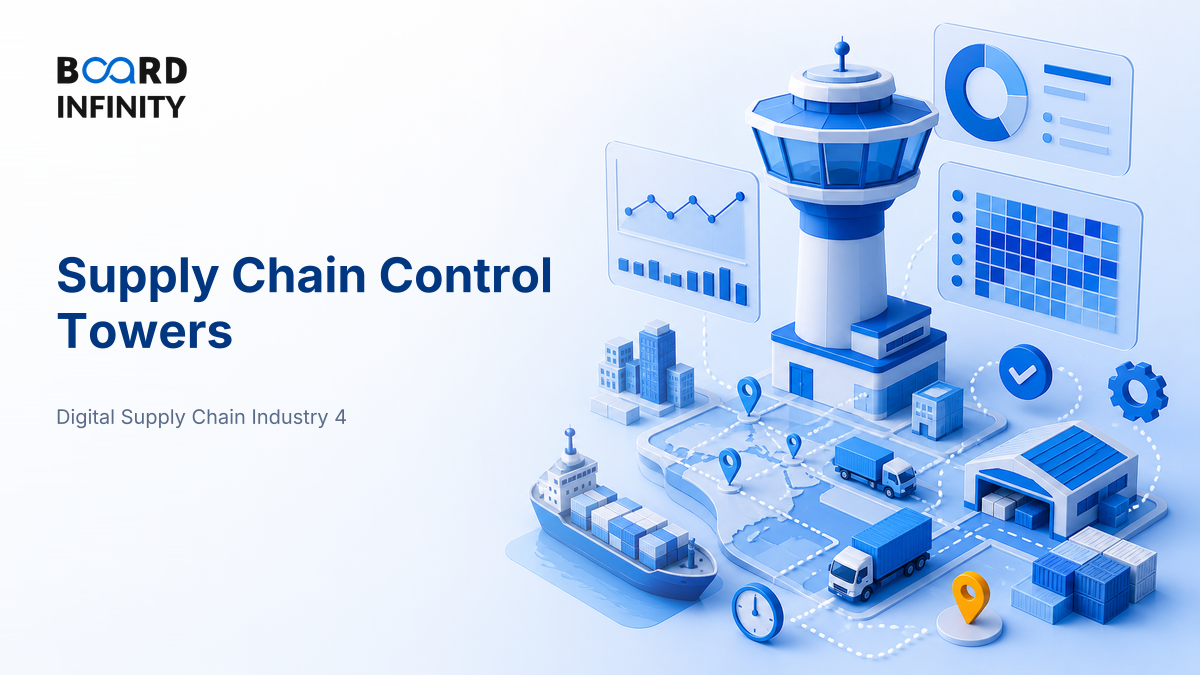
What is the point of knowing a shipment is late if nobody is empowered to reroute it? That is the hard question behind supply chain control towers: visibility without action is just a prettier way to panic.
- A supply chain control tower is a digital operating capability that gives end-to-end visibility, exception alerts, decision support, and coordinated action.
- It connects data from ERP, WMS, TMS, suppliers, carriers, IoT devices, and customer orders into one operational view.
- The real value is not tracking everything - it is spotting the few exceptions that threaten service, cost, cash, or risk.
- A good control tower works in four layers: sense, prioritise, decide, and act.
- End-to-end visibility means seeing inventory, orders, capacity, shipments, risks, and customer impact across the full network.
- Key KPIs include OTIF, fill rate, exception ageing, inventory turns, forecast accuracy, and expedite cost as a percentage of freight cost.
- The common trap: describing a control tower as a dashboard instead of an operating model with decision rights.
Big Picture: A Control Tower Is a Nerve Centre, Not a Screen
Think of a supply chain control tower as the organisation’s operations nerve centre. It does not replace planners, warehouse managers, buyers, or logistics teams. It gives them a shared truth, highlights what needs attention, and triggers the right response before a small delay becomes a customer failure.
Core Explanation: What Supply Chain Control Towers Actually Do
A control tower is best understood as a visibility-plus-decision system. Visibility tells you what is happening. A control tower helps you decide what to do about it.
In a traditional supply chain, procurement sees supplier delays, logistics sees carrier issues, sales sees customer complaints, and finance sees working capital pressure. Each team has part of the truth. The control tower brings these pieces into one shared operating view.
The Four Jobs of a Control Tower
This is why control towers sit naturally next to topics like AI for inventory optimisation and replenishment. The control tower spots the exception; inventory optimisation decides how much buffer or replenishment logic is needed to prevent it next time.
End-to-End Visibility: What Must Be Visible
End-to-end visibility means seeing the chain from supplier commitment to customer delivery. A weak system tracks only outbound shipments. A strong system connects demand, supply, inventory, capacity, logistics, and customer impact.
The 2x2 That Separates Dashboards from Real Control Towers
The fastest way to test whether a company has a real control tower is to ask two questions: how much can it see, and who can act on what it sees?
The bottom-left quadrant is where many firms begin: manual calls, email escalations, and scattered spreadsheets. The top-left quadrant looks modern but disappoints in practice because nobody owns the next action. The top-right quadrant is the target: shared data, prioritised exceptions, and defined decision rights.
Types of Supply Chain Control Towers
Not every control tower has the same scope. In interviews, classify it before you evaluate it.
Supplier-focused control towers also connect with supplier risk, compliance and responsible sourcing, because a late shipment, a labour compliance issue, and a geopolitical disruption may all affect the same customer promise.
Key Metrics: What to Track in a Control Tower
These are interview-safe working metrics. The “good” number depends on industry, product criticality, and service-level agreements, but the direction of improvement is universal.
A sharp answer always links metrics to trade-offs. OTIF can improve if you hold more inventory, but that may hurt working capital. Expedite cost can protect service, but repeated expediting signals that the network is not stable.
Definitions You Can Say in One Breath
- Supply chain control tower: A digital operating capability that provides end-to-end visibility, exception alerts, decision support, and coordinated action.
- End-to-end visibility: The ability to track orders, inventory, capacity, shipments, risks, and customer impact across the full supply network.
- Exception management: The process of identifying, prioritising, resolving, and learning from deviations from the supply chain plan.
- ETA: Estimated time of arrival for a shipment, order, vehicle, or material movement.
Mahindra Logistics: A Control Tower Mindset in a 3PL Network
Mahindra Logistics shows why control towers matter in third-party logistics: the value lies in coordinating multiple customers, carriers, facilities, routes, and exceptions through one operating model.
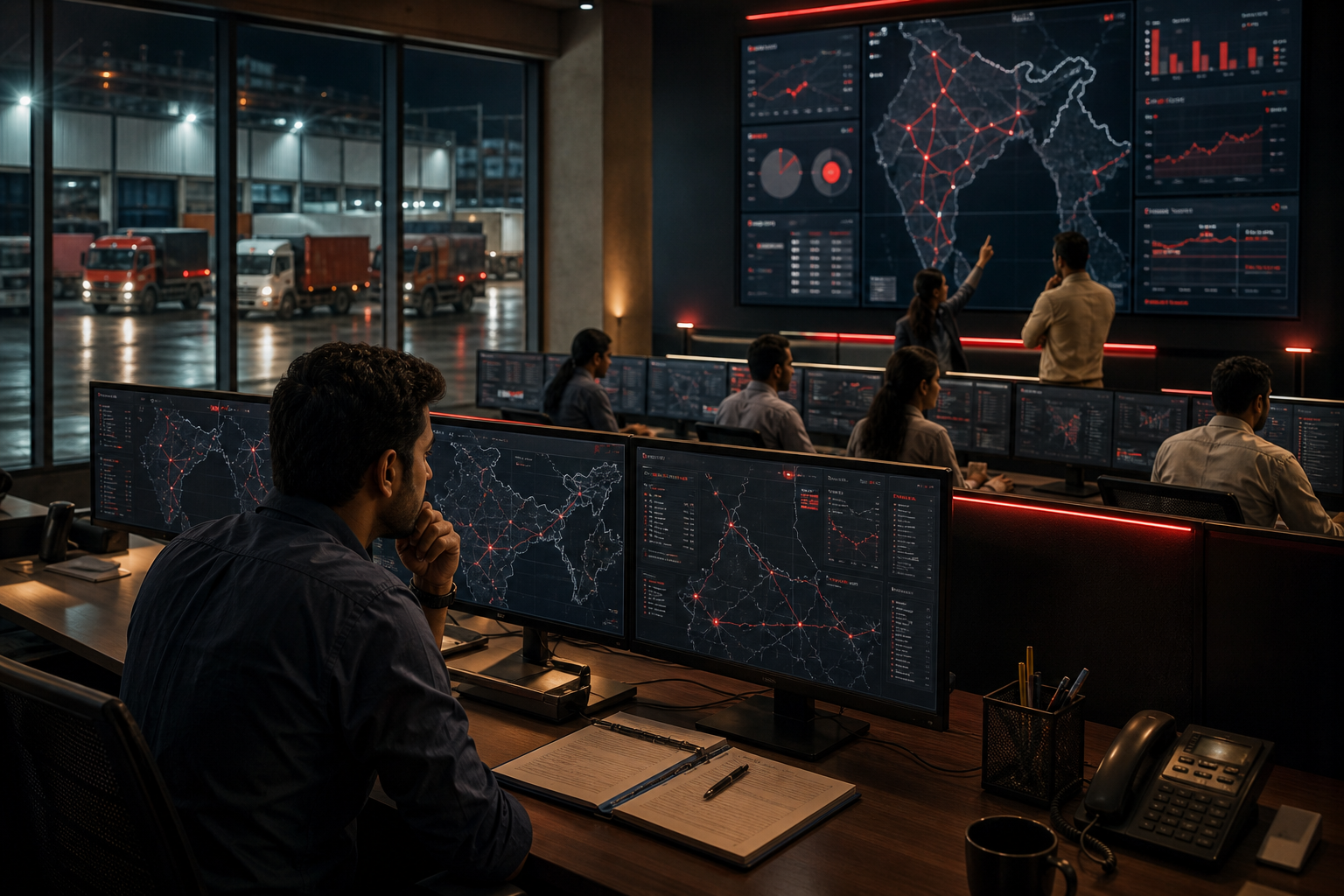
Situation. A third-party logistics player does not control every factory, supplier, vehicle, warehouse, and customer promise directly. It operates in a messy ecosystem: enterprise customers, contract transporters, warehouse teams, drivers, route planners, and customer-service teams all need the same operational truth.
The move. A control-tower approach centralises shipment visibility, exception escalation, carrier coordination, and customer communication. The primary driver is exception-based orchestration: planners do not watch every truck equally; they focus on the lanes, orders, and customers where failure has the highest impact. Supporting drivers include standard operating procedures, transporter governance, digital tracking, route-level planning, and disciplined communication with customers.
The lesson. In 3PL, the control tower is not only a technology layer. It is a service promise. A customer buys not just trucks and warehouses, but confidence that exceptions will be noticed, prioritised, and resolved before they damage production or customer delivery.
So what? The case proves the central interview point: control towers win when technology, process, and decision rights work together. A dashboard alone cannot deliver service reliability.
How AI Changes Supply Chain Control Towers
AI makes control towers more predictive, more automated, and more conversational. The change is not “AI replaces planners.” The change is that planners can act earlier, with better-ranked choices.
A practical student workflow: take a company’s annual report, logistics notes, and this lesson into NotebookLM. Ask it to generate five likely control-tower risks for that company, the data sources required, and the KPIs an interviewer may expect you to mention. Then cross-check the answer with your own supply chain logic before using it.
AI recommendations are only as good as the data and constraints behind them. A model that ignores supplier capacity, customer priority, customs rules, or transporter reliability can recommend actions that look optimal but fail operationally.
Interview Relevance
“Suppose a consumer goods company wants to build a supply chain control tower. What should it include, and how would you measure whether it is working?”
Use the phrase “visibility plus decision rights.” It immediately separates a mature answer from a dashboard-only answer.
Common Mistake
The biggest mistake is saying “a control tower is a dashboard that tracks shipments.” That answer misses the operating model. The fix: define it as a system that senses exceptions, prioritises business impact, assigns decision rights, and coordinates action.