
What a Digital Supply Chain Actually Changes
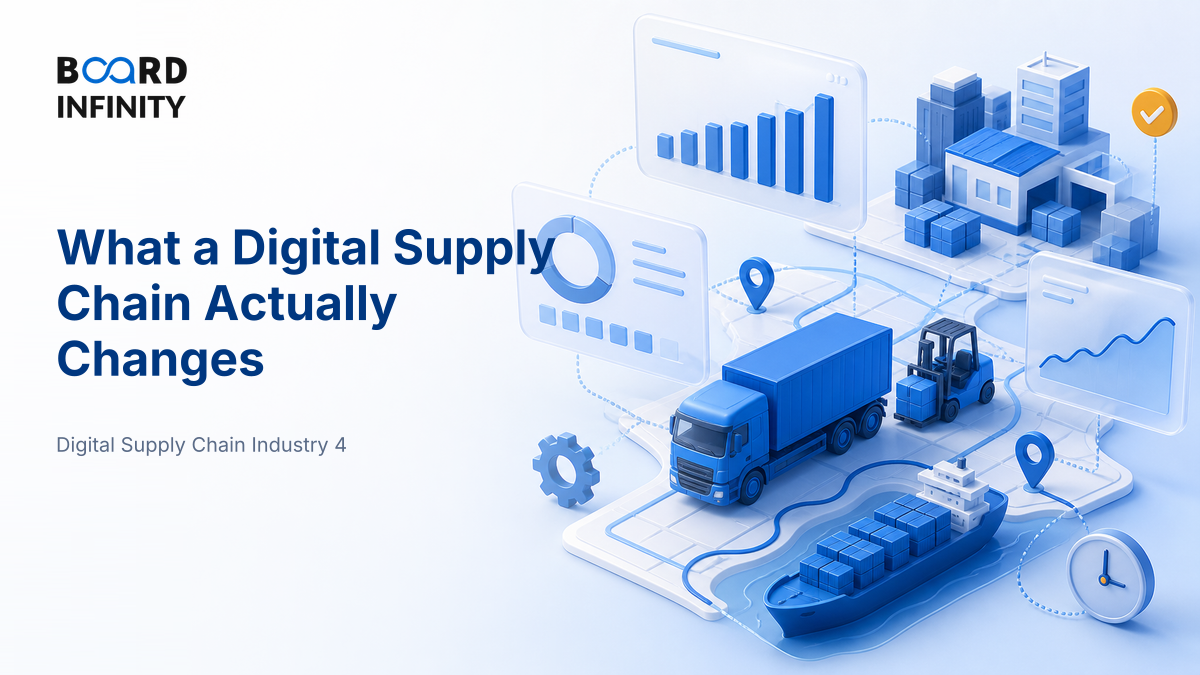
A warehouse scanner beeps, a distributor order drops, a supplier shipment gets delayed - and in many companies, these events still travel as emails, Excel files and phone calls. The common misconception is that a digital supply chain means “we implemented software.” It actually means the business can see, decide, act and learn faster than the physical chain can drift out of control.
- A digital supply chain connects data, decisions and execution across suppliers, plants, warehouses, transporters, channels and customers.
- The real shift is from periodic, siloed planning to near-real-time sensing and coordinated response.
- It changes five things: visibility, planning, execution, exception management and learning loops.
- Technology is only the surface. The deeper change is in master data, process ownership, governance and cross-functional decision rights.
- Interview answer frame: start with the business problem, map the physical flow, show the data layer, explain decision changes, then name KPIs.
- The biggest trap is saying “digital supply chain = automation.” Automation without clean data and process discipline just makes bad decisions faster.
Big Picture - What Actually Becomes Digital?
A supply chain has always had physical flows: materials, finished goods, trucks, pallets and orders. A digital supply chain adds a live information spine around those flows, so the company can sense a disruption, simulate options, decide faster and trigger execution without waiting for the next weekly review.
Core Explanation - The Five Changes a Digital Supply Chain Creates
The simplest way to understand this topic is to ask: what decision becomes better, faster or more coordinated because of digital capability? If no decision changes, it is only digitisation, not a digital supply chain transformation.
1. Visibility changes from “where is the report?” to “what is happening now?”
Traditional supply chains often know the truth late: inventory is updated after dispatch, supplier delays are known after escalation, and demand signals are reviewed after the month closes. Digital supply chains connect order management, warehouse systems, transport updates, supplier portals, IoT devices and planning tools so teams see events closer to when they happen.
Example: If a transporter delay threatens a service-level commitment, the system can flag the affected orders, inventory alternatives and customer risk before the customer complains.
2. Planning changes from static forecasts to demand sensing
Classic planning uses history, sales inputs and periodic forecasting cycles. Digital supply chains add fresher signals: channel orders, point-of-sale trends, promotions, weather, lead-time changes and inventory positions. This does not remove forecasting uncertainty, but it reduces the lag between market signal and supply response.
For the inventory-policy side of this topic, revise setting inventory policy for a multi-product business, because digital tools only help when reorder points, safety stock and service levels are logically designed.
3. Execution changes from manual follow-up to system-triggered action
In a digital chain, execution systems can trigger purchase requisitions, replenishment moves, slot bookings, production schedules or transport assignments based on business rules. Humans still intervene for exceptions, negotiations and trade-offs, but routine coordination becomes less dependent on phone calls.
4. Exception management changes from firefighting to prioritisation
Every supply chain has exceptions: late supplier, stockout risk, short shipment, quality hold, vehicle breakdown, demand spike. Digital supply chains do not eliminate exceptions. They rank them by business impact, show root causes and recommend actions.
5. Learning changes from experience-based judgement to rule improvement
Once exceptions and decisions are captured, the organisation can learn. Which SKUs repeatedly stock out? Which suppliers miss confirmed dates? Which lanes create the most damage? Which forecast inputs add noise? This is where digital supply chain becomes a performance system, not just a dashboard.
Digitisation vs Digitalisation vs Digital Supply Chain
Interviewers often test whether you can separate buzzwords. Use this clean distinction:
The shift is not “paper to screen.” It is isolated information to coordinated action.
The Operating Stack - What Has to Work Under the Hood
A digital supply chain depends on more than one software product. Think of it as a layered operating stack.
Layer 1: Data foundation
This includes item master, supplier master, customer master, bill of materials, lead times, inventory records, route data and transaction history. If this layer is poor, every higher layer gives wrong recommendations with confidence.
Layer 2: Integration
ERP, warehouse management systems, transport systems, supplier portals and channel systems must exchange data reliably. This is where API integration, EDI, middleware and workflow engines matter.
Layer 3: Applications
Typical systems include ERP for core transactions, WMS for warehouse execution, TMS for transport planning, APS for advanced planning and supplier platforms for collaboration.
Layer 4: Decisions
The top layer is managerial: service level versus cost, make versus buy, inventory versus responsiveness, supplier risk versus price, and speed versus stability. Digital tools support these trade-offs; they do not remove them.
Metrics That Prove a Digital Supply Chain Is Working
Do not claim success because “dashboards were implemented.” Track whether service, cost, speed and reliability improved together. Good targets vary by industry, SKU criticality and business model, so in interviews state the baseline, the direction of improvement and the trade-off being managed.
Notice the pattern: a digital supply chain is not judged by one metric. If inventory turns improve but service collapses, the chain is not smarter - it is just leaner in a risky way.
Definitions
- Supply chain: the network that sources, makes, moves and delivers products or services to customers.
- Digital supply chain: a supply chain where planning, execution and feedback are connected through shared, timely data.
- Control tower: a visibility layer that monitors supply chain events, exceptions and decisions across functions.
- Demand sensing: using recent market and operational signals to update demand plans faster than normal forecast cycles.
Asian Paints: Digital Supply Chain as a Responsiveness Advantage
Asian Paints shows how a digital supply chain supports responsiveness in a high-SKU, high-service, dealer-led business where availability matters deeply.

Situation: Decorative paints are operationally complex. Demand varies by geography, season, shade, pack size, project type and retail channel. A customer may choose from many colour options, but the dealer still expects quick availability and reliable replenishment. That creates a classic supply chain tension: high variety, uncertain demand and high service expectations.
The move: Asian Paints built its competitive strength not only through brand and distribution, but through a tightly managed supply chain connecting demand planning, manufacturing, depots, dealer replenishment and in-store tinting. The primary driver is responsiveness through integrated planning and distribution. Supporting drivers include a wide dealer network, product modularity through bases and colourants, disciplined inventory deployment, and process technology that helps the company serve variety without stocking every finished shade everywhere.
The lesson: The digital supply chain does not simply “reduce cost.” It helps the company hold the right form of inventory, postpone final colour creation closer to demand, replenish channels faster and protect service levels. That is a stronger answer than saying “Asian Paints uses technology.” The real strategic point is: digital supply chain capability turns complexity into customer availability.
So what: In interviews, use this case to show that digital supply chain success has a primary driver and supporting drivers. The win is not “software.” It is responsiveness created by data, network design, postponement, inventory policy and execution discipline working together.
How AI Changes Digital Supply Chain
AI makes digital supply chains more predictive and more adaptive, but only when the underlying data is usable. Three concrete shifts matter in 2026:
- Demand sensing becomes more granular. Machine learning can combine recent orders, promotions, holidays, weather, channel trends and stockout signals to improve short-term planning. This connects directly with AI for inventory optimisation and replenishment.
- Exception management becomes prioritised. AI can rank disruptions by margin impact, customer importance, substitute availability and recovery time, instead of showing hundreds of alerts equally.
- Planning becomes scenario-based. GenAI interfaces can help planners ask, “What happens if Supplier A is delayed by five days?” and receive a structured summary of affected SKUs, customers and options.
Use NotebookLM or ChatGPT like a supply chain analyst: upload a company annual report, paste this lesson, then ask, “Map the company's digital supply chain into Sense, Plan, Execute, Control and Learn. Identify likely interview questions and the KPIs I should mention.”
The caution is important: AI does not fix bad master data. If lead times, SKU codes, supplier records or inventory balances are wrong, AI recommendations become polished noise.
Interview Relevance
“What does a digital supply chain actually change for a company? Explain with an example.”
Use the phrase: “The digital supply chain is not a technology project first; it is a decision-quality and response-time project enabled by technology.” That line usually separates a mature answer from a buzzword answer.
Common Mistake
The mistake: equating digital supply chain with ERP, automation or dashboards. Why it costs marks: it ignores process ownership, data quality, planning logic and business trade-offs. One-line fix: always say which decision improves, which data enables it, and which KPI proves it.