
Digital Twins and Simulating a Supply Chain
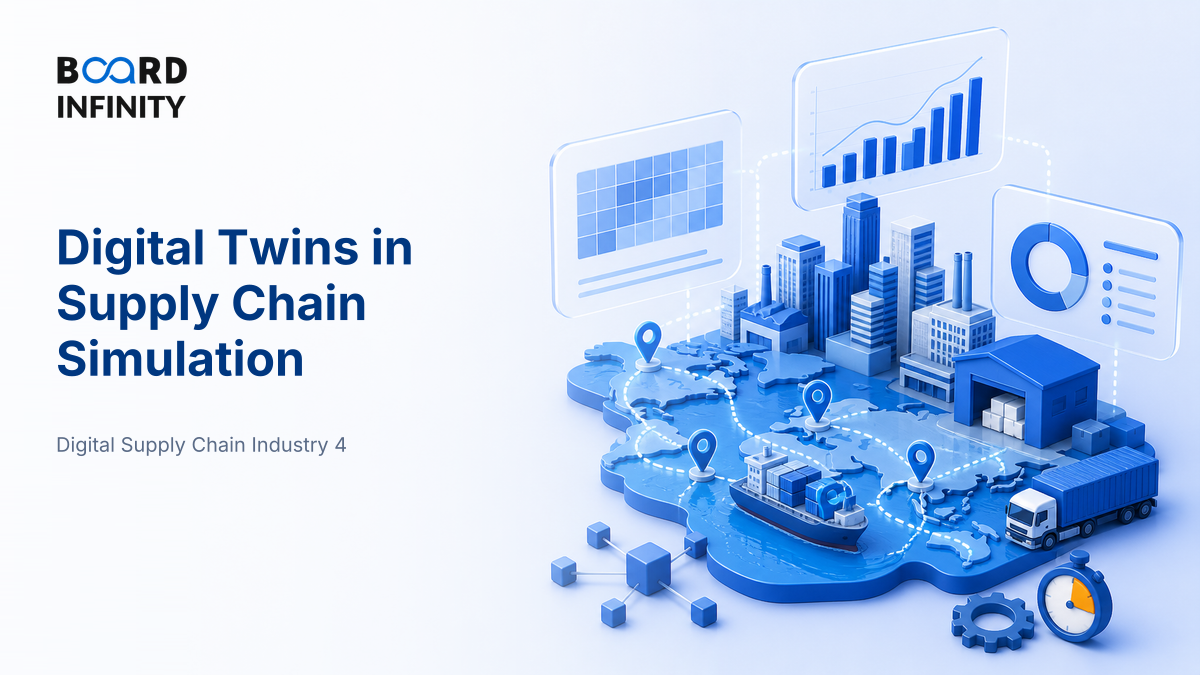
A control tower screen lights up: a port delay in Chennai, a supplier slip in Pune, a spike in orders from Bengaluru. Before a truck is rerouted or a buyer calls a backup vendor, the team runs the shock through a virtual copy of the supply chain and sees tomorrow's bottleneck today.
- A digital twin is a dynamic virtual representation of a real asset, process or network, updated with real operational data.
- For supply chains, it connects demand, inventory, capacity, suppliers, transport, service levels and cost in one testable model.
- Simulation answers “what if” questions: what if demand jumps, a supplier fails, a lane is blocked, or a warehouse runs at peak load?
- The core flow is: map the network - feed data - model rules - run scenarios - choose the best trade-off.
- Good twins are judged by decision quality, not visual beauty: service up, cost down, fewer stockouts, faster response.
- The trap: calling every dashboard a digital twin. A dashboard shows what happened; a twin tests what could happen.
Big Picture: A Supply Chain Twin Is a Decision Simulator
Think of a digital twin as a flight simulator for operations. The pilot is the supply chain manager; the aircraft is the network of suppliers, plants, warehouses, routes and customers; the storms are disruptions, demand shocks and constraints.
Core Explanation: How Digital Twins Simulate a Supply Chain
A supply chain digital twin is a virtual model of the network that behaves like the real chain closely enough to support decisions. It is not only a 3D model. In many companies, the most valuable twin is a mathematical and data model sitting behind planning, inventory and control-tower systems.
The twin becomes useful when it links four layers: the network, the data, the operating logic and the decision scenarios.
The Five-Step Process to Build and Use a Supply Chain Twin
This is why digital twins connect naturally with AI-led inventory optimisation and replenishment. The twin tests policies such as reorder points and safety stock before the business locks working capital into inventory.
What You Can Simulate: From Demand Funnel to Execution
A strong answer should show that supply chain simulation is not one model. It is a funnel of decisions: broad uncertainty enters at the top, and executable actions come out at the bottom.
Types of Supply Chain Simulation
In interviews, do not stop at “it helps planning.” Name the type of simulation and the decision it supports.
If the discussion goes into reorder points, cycle stock and service level, revise inventory policy for a multi-product business next. If it goes into bottlenecks inside a plant, line balancing and workstation design becomes the natural extension.
Definitions You Can Say in One Breath
According to the Digital Twin Consortium, “A digital twin is a virtual representation of real-world entities and processes, synchronized at a specified frequency and fidelity.”
A supply chain digital twin is a data-driven virtual model used to simulate supply chain behaviour before making operational decisions.
Key Metrics: How to Judge Whether the Twin Is Useful
The best digital twin is not the prettiest model. It is the model that improves decisions on service, cost, inventory and risk.
Worked Example: Testing a Festival Demand Spike
Suppose an e-commerce distribution centre normally processes 10,000 orders per day. During a festival sale, expected demand rises to 13,000 orders per day. The operations team wants to know whether to add a temporary shift.
The twin does not “decide” magically. It makes the trade-off visible: if the temporary shift prevents delayed orders, customer complaints and expensive last-mile firefighting, the extra capacity may be justified. If demand is uncertain, the team can simulate low, medium and high demand instead of making one brittle plan.
Indian Example: Quick-Commerce Dark Stores
For an Indian quick-commerce player such as Zepto, the twin logic would model dark-store inventory, picker capacity, rider availability, delivery radius and city-level demand peaks. The strategic point is not “more tech”; it is matching promised speed with stock placement, labour planning and routing capacity.
In a dense city like Mumbai or Bengaluru, a small change in SKU placement or rider availability can affect both fulfilment speed and stockout risk. The primary driver is local demand-density modelling; supporting drivers include micro-warehouse inventory policy, workforce scheduling, route batching and real-time exception handling.
BMW Group: Digital Twin Thinking for Factory and Supply Flow Planning
BMW Group uses virtual factory planning with NVIDIA Omniverse to simulate factory layouts and operations before physical changes are made.
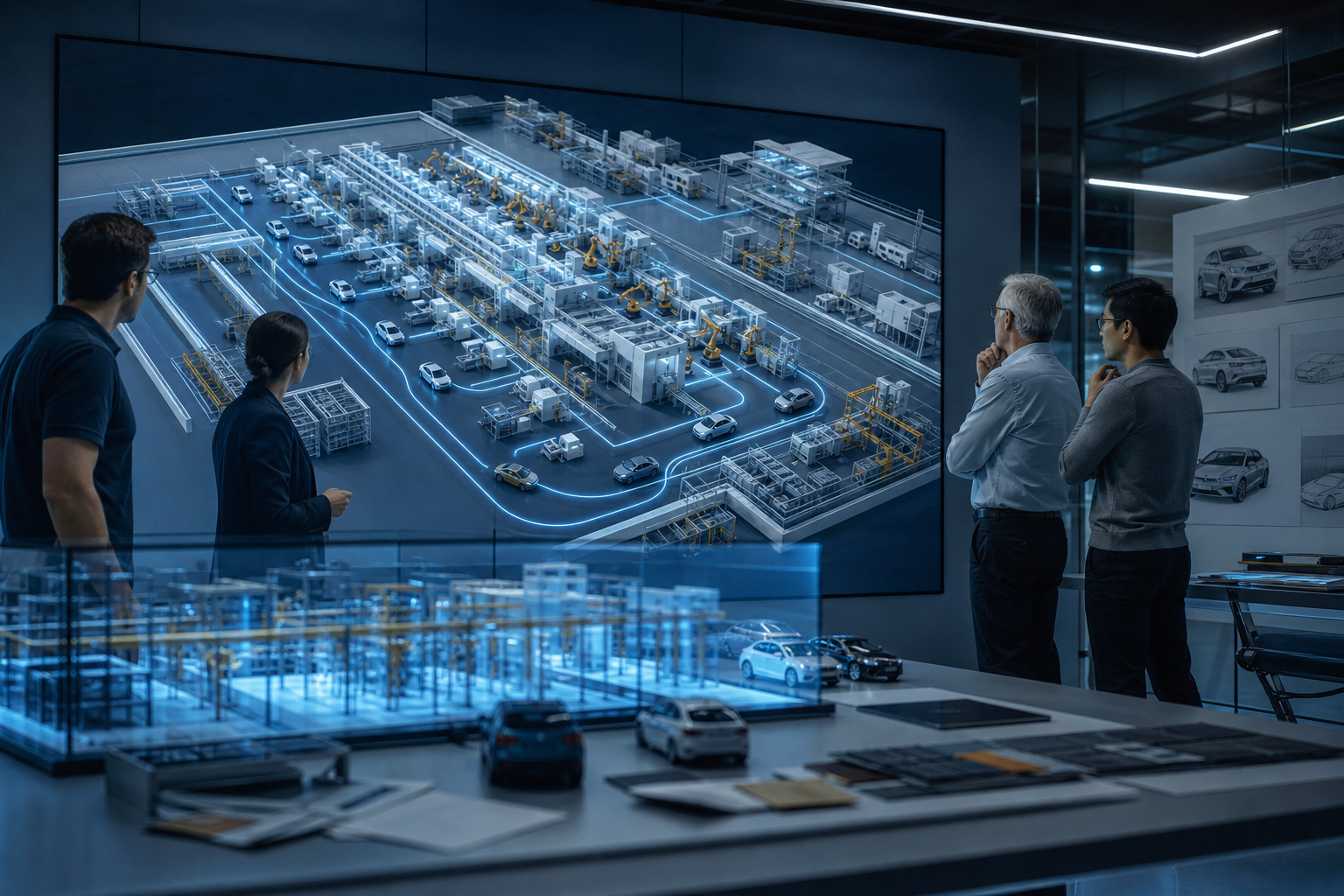
The situation: automotive manufacturing depends on tightly coordinated flows of parts, people, machines and finished vehicles. A layout error or bottleneck is costly because physical factories are hard to change once equipment, material paths and workstations are installed.
The move: BMW Group has worked with NVIDIA Omniverse to create virtual factory environments for planning and collaboration, as described by NVIDIA's BMW Omniverse announcement. The logic is digital-twin thinking: simulate layouts, workflows and operational interactions before committing capital and disrupting live operations.
The lesson for supply chain interviews: the primary driver is risk-free experimentation before physical execution. Supporting drivers include shared visibility across engineering and operations teams, faster layout testing, better bottleneck identification and fewer late-stage changes. This is exactly the managerial value of digital twins: they compress learning before reality charges you for mistakes.
How AI Changes Digital Twins and Simulating a Supply Chain
AI makes digital twins more predictive, more automated and easier to question in natural language. Three shifts matter for 2026.
- From static scenarios to probabilistic scenarios: machine learning can create demand, lead-time and disruption scenarios based on historical patterns, seasonality and external signals.
- From manual planning to AI-assisted optimisation: algorithms can recommend reorder levels, alternate routes, supplier switches or capacity changes, then the twin tests the trade-off before execution.
- From expert-only tools to natural-language control towers: planners can ask, “What happens if the North India lane is delayed by two days?” and receive a simulated impact summary.
A practical student workflow: load a company annual report, a supply chain note and this lesson into NotebookLM. Ask it to generate five likely interview questions on digital twins, then ask ChatGPT or Claude to convert one question into a structured answer using service, cost, inventory and risk metrics.
Interview Relevance
“How would a digital twin help an FMCG or e-commerce company make better supply chain decisions?”
If you are given an industry, make the twin concrete: for FMCG, talk about distributors and stockouts; for auto, supplier lead times and line stoppage; for e-commerce, dark stores, picker capacity and last-mile load.
Common Mistake
The biggest mistake is saying “a digital twin is just a dashboard.” A dashboard reports performance; a twin simulates behaviour under changed conditions. One-line fix: always add the phrase “to test what-if scenarios before execution.”