
D2C & Omnichannel Distribution: Website, Marketplaces & ONDC
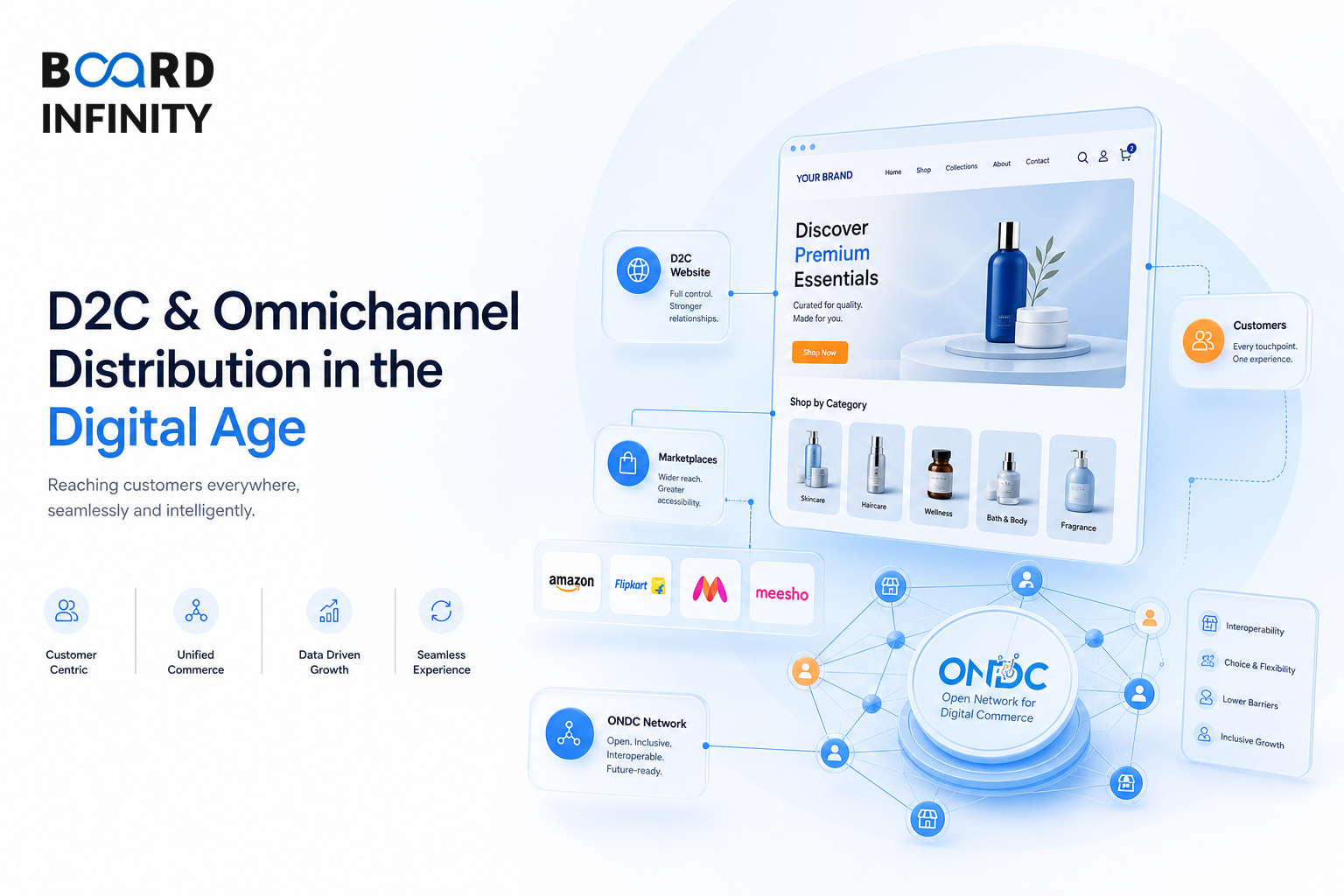
A clean-label protein bar brand does not win by choosing either its own website or Amazon. It wins when the website builds trust, marketplaces create discovery, quick commerce solves urgency, and every channel feeds the same customer understanding.
- D2C is not “sell only on your website”. It means the brand owns the customer relationship, data and experience as much as possible.
- Omnichannel distribution connects website, marketplaces, social commerce, quick commerce, offline retail and ONDC into one customer journey.
- Website = control. Best for brand storytelling, first-party data, subscriptions, bundles and loyalty.
- Marketplaces = reach. Best for search-led discovery, trust, ratings and fast scale, but margins and customer data are weaker.
- ONDC = open network logic. It unbundles buyer apps, seller apps and logistics instead of keeping commerce inside one platform.
- The right channel mix depends on unit economics. Track CAC, contribution margin, repeat purchase rate, fulfilment SLA, take rate and LTV:CAC.
- Interview answer frame: define the customer, assign each channel a role, prove the economics, integrate inventory and measure repeat behaviour.
Think of D2C and omnichannel distribution as a system, not a channel list. The brand must decide where the customer discovers, where they trust, where they buy, how the order is fulfilled, and how data comes back into future decisions.
Core Explanation: How D2C and Omnichannel Distribution Actually Work
D2C distribution means a brand sells directly to end consumers instead of relying only on traditional distributors and retailers. But modern D2C is rarely pure. Most winning brands use a portfolio of channels because each channel solves a different job.
The clean mental model is: website builds control, marketplaces build reach, quick commerce builds immediacy, offline builds habit, ONDC builds network access. A weak candidate says “D2C removes middlemen.” A strong candidate says “D2C changes who owns the customer relationship, data and margin pool.”
The Channel Portfolio: Reach Versus Control
Distribution strategy is a trade-off between reach and control. Marketplaces give reach but reduce control. Own websites give control but require the brand to earn traffic. ONDC is interesting because it tries to separate access from platform lock-in.
ONDC: The Important Twist in Indian Digital Commerce
ONDC, or Open Network for Digital Commerce, is India's open protocol network for digital commerce. Its core idea is simple: commerce should not be locked inside one platform where the same company controls discovery, seller onboarding, payments, logistics and customer interface.
In a traditional marketplace, the buyer, seller, catalogue, payment flow, logistics options and dispute process usually sit inside one platform. In ONDC, these roles can be performed by different network participants. A customer may discover a seller on one buyer app, the seller may be onboarded through a seller app, and delivery may be handled by a logistics participant.
For a D2C brand, ONDC is not a magic replacement for Amazon, Flipkart, quick commerce or its own website. It is a potential additional discovery and transaction layer. The hard work remains catalogue quality, pricing, inventory accuracy, fulfilment reliability, customer service and economics.
Definitions You Can Say in One Breath
- Marketing channel: Kotler and Keller define marketing channels as “sets of interdependent organizations participating in the process of making a product or service available for use or consumption.”
- D2C: A model where a brand sells directly to consumers while owning first-party relationships, data and experience.
- Omnichannel distribution: Integrated selling across channels so the customer receives a consistent journey, inventory promise and service experience.
- Marketplace: A platform that connects many buyers and sellers, usually monetising through commissions, ads, fulfilment or seller services.
- ONDC: India's open digital commerce network that connects buyer apps, seller apps and service providers through interoperable protocols.
How to Evaluate a D2C Omnichannel Strategy
Do not evaluate a channel only by sales. A channel that gives revenue but destroys margin or repeat behaviour is not healthy. Use a dashboard that connects acquisition, profitability, operations and retention.
Mini Case Study: The Whole Truth Foods and Trust-Led Omnichannel
The Whole Truth Foods shows how a D2C brand can use its own website for trust and storytelling while using wider digital channels for availability.
Situation. Packaged food is a trust-sensitive category. Customers worry about sugar, additives, protein claims and ingredient labels. For a young brand, simply being listed online is not enough because the real conversion barrier is belief.
The move. The Whole Truth Foods built its positioning around radical ingredient transparency and clean-label communication. Its own digital presence helps explain the “why” behind the product - ingredients, nutrition, founder-led storytelling and category education. Wider online retail and fast-delivery channels then solve the second problem: being available when the customer is ready to buy or replenish.
Outcome and lesson. The strategic point is not that one channel won. The primary driver is trust-led differentiation. Supporting drivers include a clear product proposition, direct brand education, online availability, repeat purchase categories and disciplined consistency across touchpoints. This is the heart of omnichannel D2C: use each channel for the job it is best at.
So what: If the product needs education, the website cannot be treated as just a checkout page. It becomes the trust engine, while partner channels become reach and convenience engines.
How AI Changes D2C & Omnichannel Distribution
1. AI improves channel-level demand sensing. D2C brands can combine website traffic, marketplace search trends, quick-commerce sell-through, ad performance and weather or event signals to forecast demand by city, SKU and channel. This reduces stockouts in high-velocity channels and overstocking in slow ones.
2. AI changes merchandising and personalisation. Product recommendations, dynamic bundles, abandoned-cart nudges, review summarisation and personalised offers can be tuned separately for first-time visitors, repeat buyers and marketplace shoppers. The caution: discount personalisation must not train customers to wait for offers.
3. AI makes marketplace and ONDC operations more searchable. Better catalogue titles, attributes, image tagging, FAQ content and review mining improve discoverability across search-led platforms. In an ONDC-style ecosystem, clean structured product data becomes even more important because multiple buyer apps may surface the same seller catalogue.
Use Perplexity or ChatGPT to compare a D2C brand's website, Amazon listing, quick-commerce presence and ONDC availability. Ask: “What role is each channel playing, what friction is visible, and what metrics should the brand track?” Then convert the answer into a 5-point interview framework.
Interview Relevance
“A D2C personal care brand has strong sales on marketplaces but weak sales on its own website. Should it double down on marketplaces, invest in its own website, or explore ONDC?”
Use the phrase “channel role clarity”. It signals that you understand omnichannel distribution as a system of jobs, not a random expansion plan.
Common Mistake
The biggest mistake is saying “D2C means cutting out intermediaries, so marketplaces are not D2C.” That is too simplistic and costs candidates credibility. Fix: say D2C is about owning the customer relationship and data, while omnichannel uses partner channels for reach, trust and convenience.
What to Revise Next
Now move from distribution strategy to execution. Revise Sales Management: Structure, Territories & Targets to understand how channel plans become sales coverage, and then The Sales Process & Consultative Selling to learn how teams convert prospects and partners into revenue.