
Marketing vs Sales: How the Two Actually Work Together
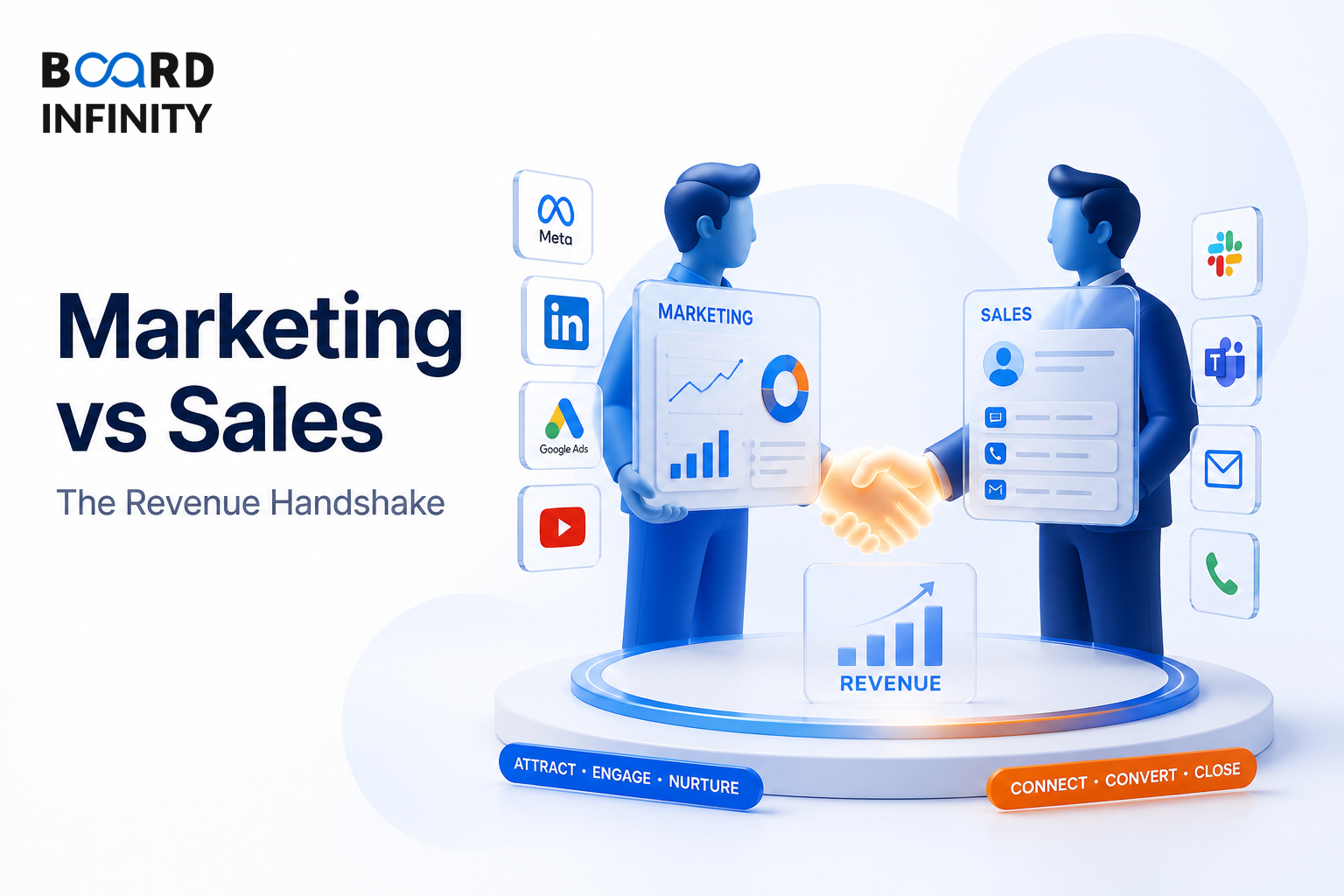
If marketing is supposed to create demand, why do sales teams still say, "These leads are not serious"? And if sales is closest to the customer, why do marketers complain that salespeople ignore campaign insights? The truth is simple: marketing and sales are not rivals - they are two halves of one revenue system.
- Marketing creates, communicates and captures demand at scale; sales converts qualified opportunities through conversations, negotiation and relationship-building.
- The cleanest distinction: marketing works primarily one-to-many; sales works primarily one-to-one or one-to-few.
- The two connect through the revenue funnel: awareness - interest - lead - qualified lead - opportunity - customer - retention.
- The critical handoff is not "lead sent to sales"; it is a shared definition of MQL, SQL, follow-up SLA and feedback loop.
- Great companies measure both teams on shared revenue metrics, not vanity metrics like impressions alone or calls alone.
- In interviews, answer with the role difference, funnel connection, metrics, example and common conflict.
Big Picture: Marketing Creates Demand, Sales Converts Demand
Think of marketing and sales as a relay race. Marketing studies the market, chooses the target customer, builds awareness and generates qualified demand. Sales takes the baton when a buyer is ready for deeper persuasion, pricing discussion, objection handling and closure. The winning team is not the one with the flashiest campaign or the most aggressive salesperson - it is the one with the cleanest baton pass.
Core Explanation: The Difference, the Handoff and the Shared Goal
The easiest way to explain marketing versus sales is this: marketing makes the customer ready to buy; sales helps the customer actually buy. In consumer categories, marketing may do most of the persuasion through brand, packaging, pricing and distribution. In B2B or high-ticket categories, sales becomes more visible because customers need demos, proposals, ROI justification and negotiation.
Neither function is superior. In a toothpaste brand, marketing and distribution may drive most buying. In enterprise software, sales may carry the final conversion. In a D2C brand, performance marketing may acquire the first purchase, while inside sales or customer success may drive subscription renewal. The right answer depends on product complexity, ticket size, buyer risk and channel structure.
The Revenue Funnel: Where Marketing Ends and Sales Begins
The funnel is the cleanest interview framework because it shows both difference and integration. Marketing typically owns the top and middle of the funnel; sales typically owns late-stage qualification, proposals and closure. But the boundary is not fixed - it depends on the business model.
The 2x2 Matrix: Why Alignment Succeeds or Fails
Most companies do not fail because marketing or sales is individually weak. They fail because lead quality and follow-up discipline are misaligned. A strong campaign without sales follow-up wastes demand. A strong sales team with poor leads burns time and morale.
Definitions You Can Say in One Breath
Marketing: Kotler and Keller call marketing "meeting needs profitably."
Sales: Sales converts qualified opportunities into paying customers through persuasion, negotiation and relationship management.
MQL: A marketing-qualified lead matches the target profile and shows enough interest to merit sales evaluation.
SQL: A sales-qualified lead has verified need, authority, budget or timing and is ready for direct sales engagement.
Metrics That Prove Marketing and Sales Are Working Together
A mature answer should include metrics because alignment cannot be managed through opinions. Track a mix of marketing quality, sales speed, conversion and economics.
In Indian B2B fintech, a payments or lending platform may generate demand through content, webinars, founder communities and partner ecosystems, but enterprise conversion often needs sales conversations on integration, compliance, pricing and settlement workflows. The strategic point: marketing creates credibility and inbound interest, while sales reduces buyer risk and closes the commercial agreement.
Mini Case Study: Freshworks and the SaaS Revenue Engine
Freshworks, an Indian-origin SaaS company, shows how content-led marketing, product-led trials and sales-assisted conversion can work as one revenue system.

Situation: Freshworks began with customer-support software and expanded into a broader suite of business software. Its market included small and mid-sized businesses that could discover, trial and adopt software digitally, but larger accounts still needed demos, security discussions, procurement support and sales engagement.
The move: Freshworks used a revenue motion where marketing and product lowered discovery friction through searchable content, clear positioning and free trials, while sales teams focused on qualified prospects that showed fit and buying intent. The primary driver was a low-friction product-led funnel. Supporting drivers included simple messaging, inside sales capability, customer success, multi-product expansion and global SMB demand for cloud software.
Outcome or lesson: Freshworks became a globally recognized Indian-origin SaaS company and listed on Nasdaq in 2021. The case proves that marketing and sales are not sequential departments fighting over credit - they are an integrated system where marketing creates scalable demand, product reveals intent and sales converts higher-value opportunities.
How AI Changes Marketing vs Sales
AI does not erase the difference between marketing and sales. It makes the handoff more data-rich, faster and more accountable.
- AI improves lead scoring: CRM and marketing automation tools can rank leads using behavior signals such as pages visited, webinar attendance, email engagement, company profile and product usage. The risk is false confidence - teams must still check whether the score reflects real buying intent.
- AI personalizes both campaigns and sales outreach: Marketing can generate segment-specific landing pages and ad variants, while sales can create account-specific email drafts and call preparation notes. The human role shifts to judgment, tone and commercial relevance.
- AI closes the feedback loop: Call transcripts, lost-deal reasons and customer objections can be summarized into themes that improve positioning, FAQs, competitor battlecards and campaign messaging.
Use NotebookLM: upload this lesson, a company annual report or website pages, and two recent campaign or sales articles. Ask: "Map this company's marketing-sales funnel, identify likely MQL and SQL signals, and generate five interview questions with model answers."
Interview Relevance
"What is the difference between marketing and sales? If both aim for revenue, why do companies need both?"
If the interviewer pushes you, say: "In low-ticket FMCG, marketing may dominate conversion through brand and distribution. In high-ticket B2B, sales plays a larger role because the buyer needs trust, customization and risk reduction."
Common Mistake
The biggest mistake is saying "marketing is advertising and sales is selling". That makes marketing sound like promotion only and ignores research, targeting, positioning, pricing, channel strategy and lead qualification. One-line fix: explain both as connected revenue roles - marketing creates qualified demand, sales converts it, and both share feedback and metrics.
What to Revise Next
Now that you can explain how demand is created and converted, revise how that demand reaches the customer. Move next to Distribution Channels: Direct, Indirect & Hybrid Models, then Channel Design & Channel Management. These topics complete the commercial chain: marketing creates pull, sales converts demand, and channels deliver access.