
Open Digital Commerce Networks and Their Operational Impact
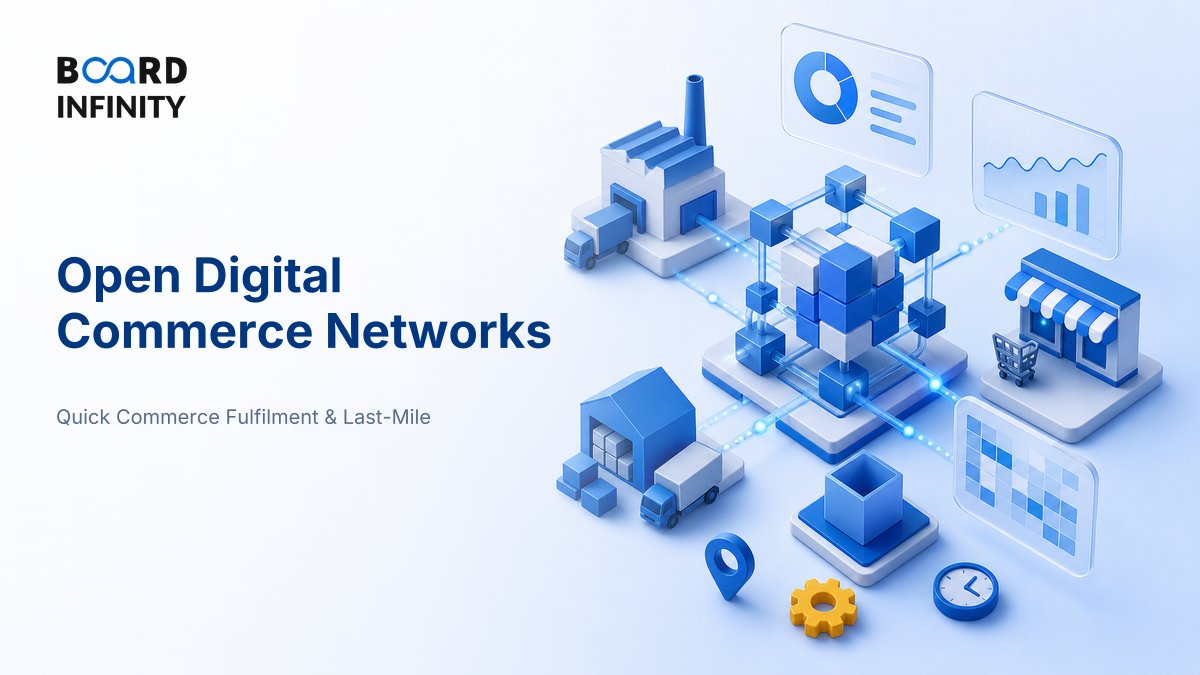
A customer taps “order” at 8:03 pm, but the seller, delivery partner, payment layer and customer-facing app may belong to four different companies. In a closed marketplace, one platform controls the whole promise; in an open digital commerce network, the promise has to travel across interfaces without breaking.
- Open digital commerce networks let independent buyer apps, seller apps, logistics providers and payment players transact through shared protocols.
- The big shift is from platform control to network coordination: no single firm owns the full customer journey.
- Operational impact shows up in five places: catalogue accuracy, order acceptance, inventory visibility, SLA orchestration and grievance handling.
- ONDC is India’s best-known example; it describes itself as an open network for digital commerce built to enable interoperability between participants (ONDC).
- The hardest operational problem is not technology alone - it is accountability when the customer promise crosses multiple entities.
- Measure the network through acceptance rate, catalogue accuracy, on-time pickup, first-attempt delivery success, cancellation rate and issue-resolution SLA.
- Interview answer shortcut: explain the network, contrast it with a marketplace, map operational changes, give an Indian example, then name the control metrics.
The Big Picture: Commerce Moves from a Platform to a Protocol
Think of an open digital commerce network as the commerce equivalent of a common road system. Shops, apps, logistics providers and payment services can all “drive” on the same road if they follow the network rules. The strategic promise is reach and interoperability; the operational challenge is making the customer experience feel seamless even when the work is distributed.
Core Explanation: What Actually Changes Operationally
Open digital commerce networks are interoperable digital networks where multiple independent participants use common protocols to discover, order, fulfil and settle commerce transactions.
That definition sounds technical, but the operating implication is simple: the customer promise is no longer controlled by one company’s internal systems. It is assembled across network participants. If the buyer app shows an item, the seller must have accurate catalogue data. If the seller accepts the order, the logistics provider must pick up within the promised window. If delivery fails, the grievance must move across participants without becoming a blame game.
If you need the fulfilment baseline before studying this topic, revise how e-commerce fulfilment actually works first; open networks add coordination complexity on top of the same pick-pack-ship fundamentals.
Open Network vs Traditional Marketplace
A traditional marketplace is integrated around one platform’s rules. An open network is coordinated around shared protocols and participant interoperability. That does not make one automatically better than the other; it changes where the operational bottlenecks appear.
The Operational Impact in Five Moves
For interviews, do not stop at “ONDC democratises commerce.” That is a policy-level answer. A management answer explains what happens inside operations.
Key Metrics to Track in an Open Commerce Network
Metrics matter because open networks fail quietly. A catalogue error, delayed seller confirmation or missed pickup may look like a customer-experience issue, but the root cause is usually an operating interface.
A Simple Worked Example: Why Acceptance Rate Matters
Assume a local retail seller receives 1,000 network orders in a week.
- At an 88% acceptance rate, accepted orders = 1,000 × 88% = 880.
- Rejected or expired orders = 120.
- If catalogue clean-up and seller staffing improve acceptance to 96%, accepted orders = 960.
- Recovered orders = 960 - 880 = 80 additional orders without increasing demand spend.
The lesson: in open networks, operational reliability can create growth without extra marketing. Demand is already arriving; the business leaks value when the seller cannot confirm, fulfil or update status fast enough.
Definitions You Should Say Cleanly
- Open digital commerce network: An interoperable commerce system where independent participants transact through shared digital protocols.
- Protocol: A common set of rules that lets different systems exchange requests, responses and status updates.
- Interoperability: The ability of different systems or organisations to work together without custom one-to-one integration.
- ONDC: India’s open digital commerce network initiative for enabling interoperability across digital commerce participants (ONDC).
- Beckn Protocol: An open protocol designed for decentralised digital transactions across domains such as commerce and mobility (Beckn Protocol).
Case Study: Pincode by PhonePe and the Local-Commerce Operating Challenge
PhonePe’s Pincode is a buyer-side commerce app built around ONDC participation, making it a useful example of how open networks change local retail operations (PhonePe Pincode).

Situation: Local stores often have inventory, proximity and customer trust, but they struggle to match the discovery, ordering and fulfilment convenience of large marketplace ecosystems. A shopper may want nearby options, but the store’s catalogue, serviceability and delivery capability are not always digitally visible.
The move: A buyer app such as Pincode sits on the customer-discovery side of the ONDC network. Instead of building every seller and logistics capability as a closed internal stack, the model relies on network participants - seller-side systems, local merchants, delivery partners and payment rails - to complete the transaction.
Operational lesson: The primary driver is interoperability: the customer-facing app can discover offers from participating sellers without each seller being locked into one closed marketplace. Supporting drivers are clean catalogue data, seller order discipline, local fulfilment readiness, payment reconciliation and issue-resolution governance. Without those supporting drivers, the open network promise becomes a fragmented experience.
So what: The case proves that open commerce is not merely a digital policy idea. It is an operating model where local supply becomes digitally discoverable only if data quality, fulfilment discipline and grievance ownership are strong enough.
How AI Changes Open Digital Commerce Networks
AI matters in open networks because the network creates messy, distributed signals: seller reliability, local demand spikes, catalogue mismatches, delivery exceptions and customer complaints across many participants. The value of AI is to turn those signals into faster operational decisions.
A practical student workflow: load this lesson, ONDC’s public pages and a target company’s annual report or product page into NotebookLM. Ask: “Generate five interview questions on how open commerce networks affect fulfilment reliability, seller onboarding and SLA governance for this company.” Then compare the answers with the metrics table above.
If you want to go deeper into forecasting and replenishment logic, revise using AI for inventory optimisation and replenishment after this topic.
Interview Relevance
“ONDC and similar open commerce networks are said to democratise digital commerce. What is their operational impact, and what risks should a company manage while participating?”
A strong answer balances policy promise with operating reality. Say “open networks reduce platform dependency, but they increase the need for standardisation, SLA discipline and cross-party accountability.”
Common Mistake
The biggest mistake is treating an open commerce network as “just another marketplace.” That misses the core issue: the customer experience is produced by multiple independent participants, not one integrated platform. One-line fix: always explain who owns discovery, catalogue, fulfilment, payment and complaint resolution.