
Using AI in Demand Prediction, Slotting & Dispatch
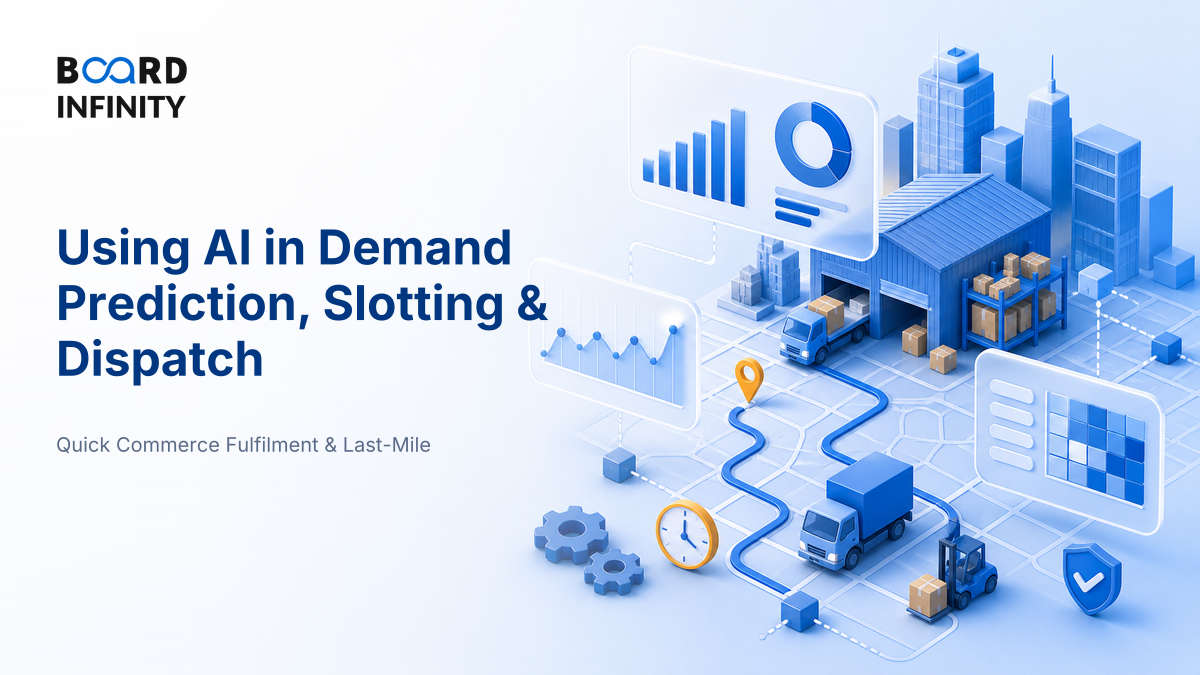
Before AI, a warehouse planner might place fast-moving items near the gate because “they usually sell well.” After AI, the same decision can change by store catchment, weather, hour of day, promotion, picker congestion and rider availability - before the first order even arrives.
That is the shift: AI is not just making better forecasts. It is turning demand prediction, slotting and dispatch into one live decision loop.
- Demand prediction estimates what will be ordered by SKU, location and time window.
- Slotting decides where items should sit in a warehouse, dark store or fulfilment centre to reduce pick time and congestion.
- Dispatch assigns orders to pickers, riders, vehicles or routes under time, capacity and service constraints.
- AI works best when the three engines are connected: forecast demand, place inventory intelligently, then dispatch dynamically.
- The key trade-off is not “accuracy versus inaccuracy”; it is service reliability versus operating cost.
- Track both model metrics and business metrics: WAPE, stockout rate, pick rate, on-time delivery and cost per order.
- The interview-winning answer: explain the operating loop, the data signals, the KPIs and the human-control guardrails.
Big Picture: From Static Planning to a Live Fulfilment Brain
Traditional fulfilment planning treats forecasting, warehouse layout and delivery assignment as separate problems. AI links them: the forecast tells the system what will be needed, slotting makes that demand faster to pick, and dispatch converts fulfilment capacity into promised delivery times.
If you want the foundation of how orders physically move through a fulfilment network, revise how e-commerce fulfilment actually works before going deeper into AI decisions.
Core Explanation: The Three Engines and How They Connect
Think of AI in this topic as three connected engines. Each engine makes a different operational decision, but the value appears only when they talk to each other.
1. Demand Prediction: Forecast the Order Before It Exists
Demand prediction estimates future orders by SKU, location and time window using historical, causal and real-time signals.
In a quick-commerce, food delivery or e-commerce setting, the question is rarely “How much will India buy this month?” The practical question is sharper: How many units of this SKU will this neighbourhood node need between 6 pm and 9 pm?
AI models can use signals such as:
The model output should not be a beautiful forecast sitting in a dashboard. It must trigger a decision: replenish more, reduce safety stock, pre-position inventory, adjust picker staffing or change delivery promises. For the inventory side of this logic, the natural next topic is AI in inventory optimisation and replenishment.
2. Slotting: Put the Right Item in the Right Place
Slotting assigns products to storage or pick locations to reduce travel, congestion, handling effort and fulfilment time.
AI improves slotting by learning not just what sells, but what sells together. For example, if chips, soft drinks and dips often appear in the same basket, placing them in a pick-friendly zone can reduce picker walking and order cycle time.
Good slotting balances four forces:
3. Dispatch: Assign the Next Best Resource
Dispatch decides which order goes to which picker, rider, driver or vehicle, in what sequence, under real-time constraints.
Dispatch is where AI becomes visibly operational. A model may estimate preparation time, rider arrival time, road conditions and promised service level, but the system must still make a clean decision: assign now, batch, reroute, hold, split or escalate.
The AI Operating Loop: What Actually Happens in the System
A strong answer in interviews should show the sequence. Avoid saying “AI predicts demand” and stopping there. The real system looks like this:
Definitions You Can Say in One Breath
- Demand prediction: estimating future demand by SKU, location and time period using historical, causal and real-time signals.
- Slotting: assigning items to storage or pick locations to reduce travel, congestion, handling cost and fulfilment time.
- Dispatch: assigning orders to operational resources in the right sequence under time, capacity and service constraints.
- Service level: the proportion of customer demand fulfilled as promised without stockout, delay or cancellation.
Metrics That Prove the AI Is Working
Do not evaluate this system only on model accuracy. A forecast can be accurate and still operationally useless if it does not reduce cost, stockouts or delivery failures.
Worked Example: Why Accuracy Alone Can Mislead
Suppose a dark store forecasts evening demand for a fast-moving snack SKU.
The forecast error is 16.7%, but the business impact is more important: 15 units of demand were not fulfilled. If those stockouts were concentrated during peak hours, the same error also hurts picker planning, customer promise accuracy and rider dispatch.
Interview line: “I would not stop at forecast accuracy. I would connect the forecast to stockout reduction, pick productivity, on-time delivery and cost per order.”
Indian Example: Blinkit-Style Quick Commerce
For an Indian quick-commerce service such as Blinkit, the operating problem is hyperlocal: the right assortment must be available close to the customer before a short delivery promise is made. The primary driver is neighbourhood-level inventory placement, supported by demand sensing, dark-store layout discipline and real-time rider dispatch. The so-what: in quick commerce, AI creates value only when prediction, slotting and dispatch are designed as one system.
Case Study: Ocado and the AI-Driven Grocery Fulfilment System
Ocado shows how online grocery fulfilment becomes powerful when demand prediction, automated slotting logic and dispatch-style orchestration operate as a connected technology system.
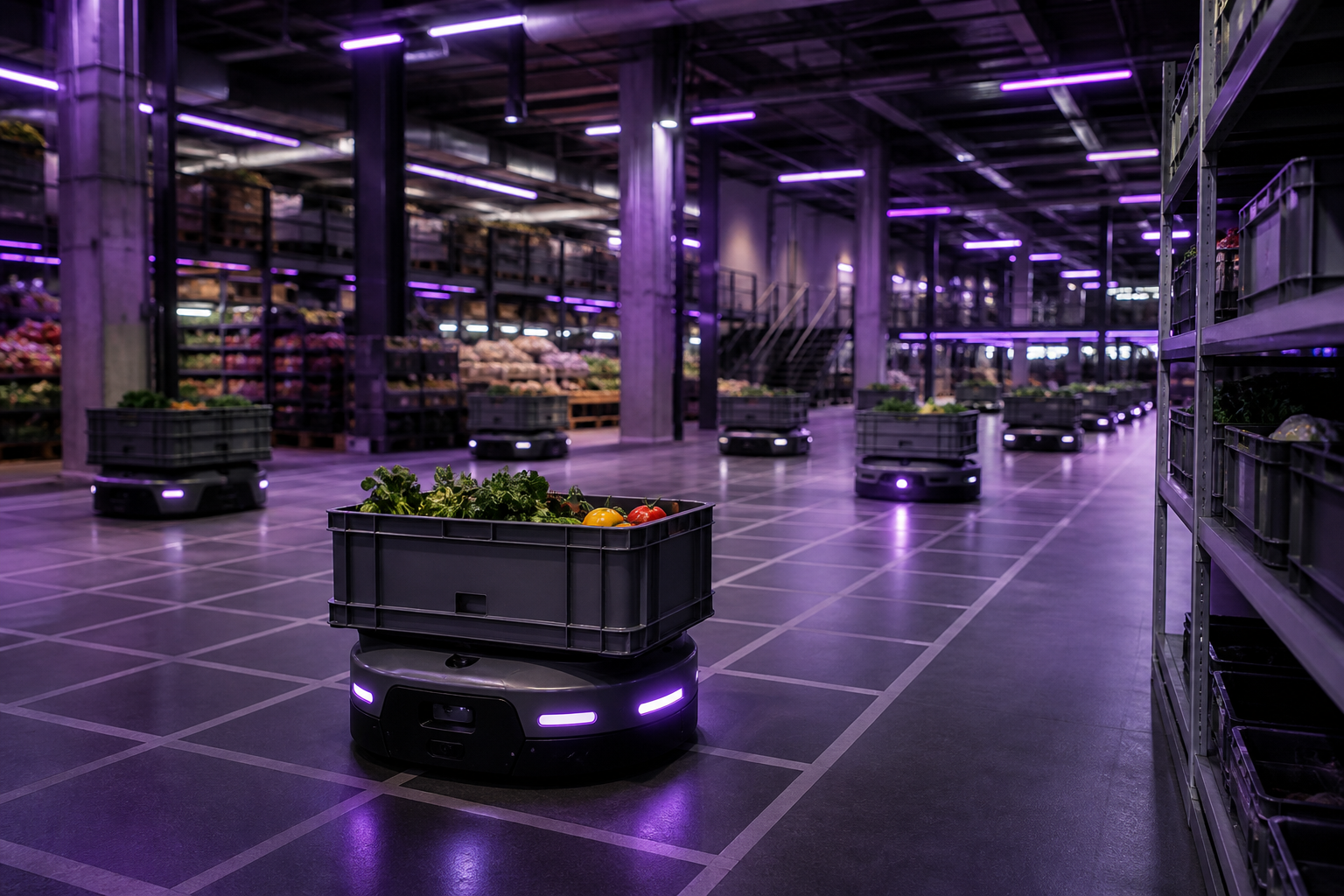
Online grocery is operationally brutal. Orders contain many low-value items, chilled and ambient goods have different handling needs, substitutions annoy customers, and delivery windows are tight. A normal warehouse mindset - receive, store, pick, ship - is too slow for this complexity.
Ocado Group built its model around technology-led grocery fulfilment, including automated fulfilment centres and the Ocado Smart Platform described on Ocado Group's technology page. The strategic move was not merely “use robots.” The primary driver was end-to-end orchestration: forecasting demand, storing items for efficient automated picking, sequencing fulfilment work and planning delivery execution as one connected system. Supporting drivers included warehouse automation, software control systems, data from repeated grocery baskets and partnerships with retailers.
The lesson for interviews is precise: Ocado's advantage is not one magic algorithm. It comes chiefly from integrating prediction, storage design and fulfilment execution, supported by automation, proprietary software and repeated operational learning.
How AI Changes Demand Prediction, Slotting & Dispatch
AI is not a bolt-on analytics layer anymore. In 2026, it changes the operating design in three concrete ways.
Student workflow: Use ChatGPT or Claude to practise this topic like an operations consultant. Prompt: “Create a fulfilment control-tower design for an Indian grocery dark store. Include demand signals, slotting rules, dispatch rules, KPIs, risks and human override points.” Then challenge the output by asking, “Where could this model fail during a festival peak?”
Interview Relevance
“Suppose you are advising a quick-commerce company. How would you use AI to improve demand prediction, slotting and dispatch without increasing delivery cost?”
Use the phrase “decision granularity.” It signals maturity. Forecasting at city level is not enough; the model must predict at the SKU-node-time-window level where operations actually make decisions.
Common Mistake
The costly mistake is treating AI as a forecasting project only. That answer sounds technical but misses the business system. A better one-line fix: “I would measure AI by downstream operating outcomes - fewer stockouts, faster picking, higher on-time delivery and lower cost per order - not just forecast accuracy.”