
How E-Commerce Fulfilment Actually Works
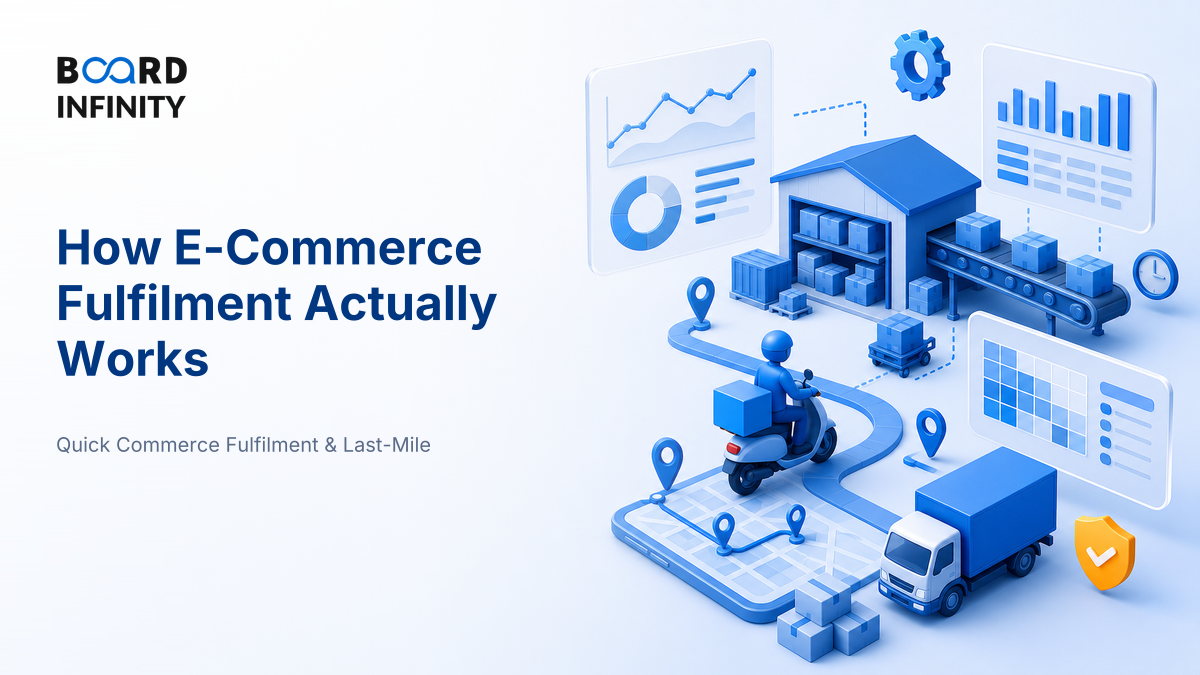
A customer buys a sofa online in ten seconds; the hard part begins after payment. That order now has to find available stock, reserve capacity, survive picking errors, fit into a delivery route, reach a home with stairs and still leave the customer feeling the promise was kept.
- E-commerce fulfilment is the end-to-end process of promising, allocating, picking, packing, shipping, delivering and returning online orders.
- The customer sees one button: Buy Now. The system solves three questions: where is the stock, who should fulfil it, and when can it reach?
- The main systems are OMS for order orchestration, WMS for warehouse execution, TMS for transport planning and last-mile apps for delivery proof.
- The biggest fulfilment trade-off is speed versus cost versus reliability. Faster is not always better if it destroys margin or accuracy.
- Strong fulfilment is measured by OTIF, perfect order rate, pick accuracy, inventory accuracy, cost per order and return rate.
- Indian e-commerce adds extra complexity: cash-on-delivery behaviour, high return sensitivity, pin-code serviceability, festive peaks and fragmented last-mile networks.
- In interviews, do not describe fulfilment as “warehouse plus delivery.” Explain the decision logic behind every step.
The Big Picture: One Order, Many Micro-Decisions
E-commerce fulfilment is not a straight warehouse activity. It is a promise engine. The company first decides what it can safely promise, then allocates the order to the best node, executes warehouse work, hands over to transport and handles delivery exceptions or returns.
The Fulfilment Engine: What Actually Happens After Checkout
The easiest way to understand fulfilment is to follow one order through the operating system. Each step looks simple on the website, but has a specific business decision behind it.
This is why inventory accuracy matters so much. If the system shows stock that is not physically available, the order will be promised, then cancelled - a direct hit to trust. For the inventory side of this problem, revise Using AI for Inventory Optimisation and Replenishment.
The Four Systems You Should Name in an Interview
A strong answer separates business logic from physical movement. These four systems usually sit behind the fulfilment process.
The Core Trade-Off: Speed, Cost and Reliability
Every e-commerce leader wants faster delivery, lower cost and fewer errors. In reality, pushing one lever too hard can hurt the others. Same-day delivery may improve conversion, but it can require more fulfilment nodes, more labour capacity, higher inventory duplication and expensive last-mile density.
For example, a fashion order and a grocery order need different fulfilment logic. Fashion can tolerate a slightly longer delivery window but has sizing-related returns. Grocery needs freshness, tight delivery slots and cold-chain discipline. Furniture adds bulky-item handling, appointment delivery and damage prevention.
In Indian e-commerce, serviceability often depends on pin code, not just city. A brand may deliver prepaid orders to one area, restrict cash-on-delivery in another, and promise faster shipping only where its fulfilment node and courier network have reliable capacity. The strategic lesson: fulfilment promises must be local, not national slogans.
Key Fulfilment Metrics: What to Track
If you are asked how to evaluate fulfilment, name measures that cover customer promise, warehouse accuracy, cost and returns. Do not use only delivery speed.
Inside the fulfilment centre, labour productivity depends on how workstations, picking paths and packing benches are balanced. If that operational angle comes up, connect it to Line Balancing and Workstation Design.
Definitions You Can Say Cleanly
- E-commerce fulfilment: The process of promising, allocating, picking, packing, shipping, delivering and handling returns for online orders.
- Order Management System: Software that captures orders and decides allocation, split shipment, promise date, cancellation and exception logic.
- Warehouse Management System: Software that controls warehouse tasks such as receiving, putaway, picking, packing, stock count and dispatch.
- Last mile: The final delivery leg from local hub or store to the customer.
- Reverse logistics: The flow that brings returned goods back for inspection, refund, repair, resale or disposal.
IKEA India: Fulfilment for Bulky, High-Touch E-Commerce
IKEA India shows why e-commerce fulfilment is not one generic delivery process: bulky products require promise accuracy, careful handling, service options and last-mile coordination.

Situation: Furniture e-commerce is harder than shipping a small parcel. Products are bulky, damage-prone, sometimes multi-box, and often need scheduled delivery or assembly support. The customer is not just buying a product; they are buying confidence that the product will fit, arrive safely and be usable.
The move: IKEA India supports online buying with service options such as delivery, assembly and customer-service support listed on IKEA India customer services. The fulfilment logic is different from a standard parcel network: orders may need item consolidation, damage-safe packing, capacity-aware delivery slots and coordination with service partners.
Primary driver: The core driver is fulfilment design around product characteristics - bulky furniture needs a different network from apparel or electronics.
Supporting drivers: IKEA also benefits from flat-pack-friendly product design, clear service choices, planned delivery windows and post-purchase support. That combination matters because a great website cannot compensate for a damaged product, missed appointment or confused delivery handover.
Lesson: Fulfilment strategy must follow the product. The right answer for furniture is not simply “deliver faster”; it is “promise accurately, handle safely, deliver reliably and support the customer after arrival.”
How AI Changes E-Commerce Fulfilment
AI is changing fulfilment most visibly in three places: demand prediction, execution control and exception management.
The caution: AI should not overpromise. If the model optimises only for conversion, it may show aggressive delivery dates that operations cannot meet. The right design optimises for profitable reliability, not headline speed.
Before an operations interview, load this lesson, the company website and a recent annual report or investor presentation into NotebookLM. Ask: “Map this company’s fulfilment model using OMS, WMS, TMS, last mile, returns, KPIs and likely bottlenecks.” Then turn the answer into a two-minute interview response.
Interview Relevance
“Walk me through what happens operationally after a customer places an e-commerce order. Also tell me how you would improve fulfilment performance.”
If the interviewer gives you a category, adapt the answer. Grocery means freshness and time slots; fashion means size returns; electronics means damage and serial-number control; furniture means bulky last mile and assembly support.
Common Mistake
The biggest mistake is treating fulfilment as “warehouse plus courier.” That misses the real management problem: promise logic, inventory accuracy, node allocation, warehouse execution, transport reliability and returns all have to work together. One-line fix: always answer using the flow - promise, allocate, execute, deliver, reverse.