
Where AI Is Landing in Energy & Renewables
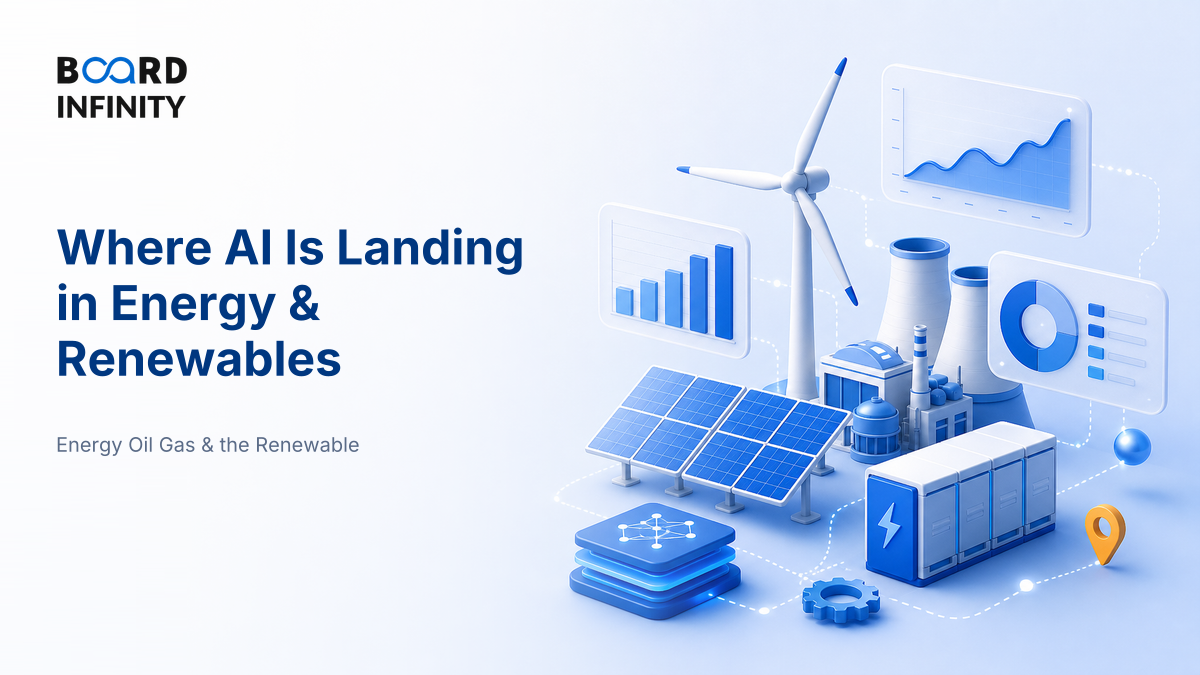
A wind farm does not fail only when a turbine breaks - it also loses money when tomorrow’s wind is forecast badly, when the grid cannot absorb power, or when a battery charges at the wrong hour. That is where AI is landing first in energy and renewables: not as a shiny robot, but as a prediction-and-control layer sitting above physical assets.
- AI in energy creates value where decisions are frequent, uncertain and data-rich: forecasting, dispatch, maintenance, trading and customer demand.
- Renewables need AI more because solar and wind are variable; the system must predict generation and balance supply, storage and demand.
- The main landing zones are renewable generation, grid operations, batteries, energy trading, EV charging, industrial energy efficiency and retail demand management.
- The business case is not “AI adoption”; it is lower downtime, lower curtailment, better forecast accuracy, better asset utilization and faster grid response.
- India angle: AI matters most in discom loss reduction, smart metering, rooftop solar forecasting, renewable asset monitoring and grid balancing.
- Interview answer formula: start with the energy problem, map the AI use case, name the data, explain the KPI, then mention risk and regulation.
- Big trap: treating AI as a software topic only. In energy, AI succeeds only when it respects physical constraints, grid rules and safety.
Big Picture: AI Is the Brain Between Weather, Assets and the Grid
Energy is a real-time system. Electricity must be generated, moved, stored or consumed almost instantly. AI becomes useful when it helps the system see ahead, decide faster and act within physical limits.
Core Explanation: Where AI Actually Lands in Energy & Renewables
The easiest way to understand AI in energy is to ask: which decision is being improved? AI rarely replaces the power plant, grid or battery. It improves the decisions around them.
1. Renewable Generation: Forecast More Accurately, Run Assets Better
Solar and wind output depends on weather. AI models use weather data, satellite imagery, SCADA data and historical generation patterns to forecast output and detect underperformance.
For a solar or wind operator, the business value is simple: better generation forecasting, fewer surprise failures, lower maintenance cost and better bidding into power markets.
2. Grid Operations: Balance a More Variable System
Grids were originally designed for predictable, centralized power flows. Renewables, rooftop solar, EV charging and batteries make flows more two-way and more volatile. AI helps utilities forecast load, detect anomalies, identify overloaded feeders and respond faster to outages.
3. Storage and Batteries: Decide When to Charge and Discharge
A battery is valuable only if it charges and discharges at the right time. AI can optimize battery dispatch based on renewable generation, grid demand, price signals, degradation risk and contractual obligations.
4. Energy Trading: Price Risk, Forecast Demand and Bid Smarter
In competitive power markets, traders need forecasts of demand, weather, grid congestion and prices. AI supports bidding, hedging and portfolio optimization. The value here is not magic prediction - it is better probabilistic decision-making under uncertainty.
5. Industrial and Commercial Energy Efficiency
Factories, data centres, malls and campuses use AI to optimize HVAC, compressed air, boilers, chillers and peak load. This is often the fastest-payback use case because the data is local and the KPI is visible on the electricity bill.
6. Retail and Customer Demand Management
Smart meters allow utilities to understand consumption patterns at a granular level. AI can segment customers, detect theft or abnormal usage, personalize energy-saving nudges and support demand response programs.
The Interview Map: Landing Zones by Business Problem
If an interviewer asks “Where is AI used in renewables?”, do not list buzzwords. Map each use case to a business problem and KPI.
For sector research, this is where you should combine company documents with operating logic. If you are reading a listed utility, renewable IPP or battery company, use annual report analysis for sector insight to identify which of these KPIs management already tracks.
Metrics That Prove the AI Business Case
Good candidates do not stop at “AI improves efficiency.” They show how improvement is measured. Use these six metrics as your interview anchor.
The 2x2: Where AI Value Is Highest
AI creates the most value when two things are true: the decision happens often, and the uncertainty is high. A monthly board decision may be important, but it is not the classic AI sweet spot. A grid dispatch decision every few minutes is.
Definitions: Say These Cleanly
- AI in energy: Models that predict, optimize or automate decisions across generation, grids, storage, trading and customer demand.
- Renewable energy: Energy from naturally replenishing sources such as solar, wind, hydro, biomass and geothermal.
- Load forecasting: Predicting future electricity demand for a region, feeder, building or customer segment.
- Predictive maintenance: Using operating data to predict equipment failures before they cause downtime.
- Digital twin: A dynamic software model of a physical asset or system, updated with operating data.
- Virtual power plant: A coordinated network of distributed assets that behaves like one flexible power resource.
The OECD’s updated AI system definition is useful for framing AI broadly: AI systems generate outputs such as predictions, recommendations or decisions that influence physical or virtual environments.
Mini Case Study: KrakenFlex and the Flexible Grid
KrakenFlex shows how AI in energy is moving from “forecasting supply” to actively coordinating batteries, EVs and distributed energy assets.

Situation: As more renewables enter the grid, supply becomes cleaner but less controllable. At the same time, homes and businesses add flexible assets - batteries, EV chargers, heat pumps and smart devices. The grid now needs flexibility at the edge, not only generation at the centre.
The move: KrakenFlex, part of the Octopus Energy technology ecosystem, focuses on managing distributed energy resources such as batteries and flexible demand; its public positioning describes optimization of distributed energy assets for grid flexibility on the KrakenFlex platform. The core idea is to aggregate many small assets and decide when each should consume, store or export energy.
The lesson: The primary driver is flexibility orchestration - coordinating many distributed assets so they can respond to grid needs. Supporting drivers are better forecasting, automated control, customer participation, market price signals and integration with grid operators. This is the AI story MBA students should remember: value comes not from one algorithm, but from linking data, markets, assets and incentives.
Indian connection: In India, the same logic becomes important as rooftop solar, smart meters, EV charging and battery storage grow. For an Indian renewable IPP, discom or commercial energy manager, the interview-worthy point is this: AI will be most valuable where it helps integrate variable renewables without hurting reliability.
How AI Changes Energy & Renewables
AI is not just another digital tool in this sector. It changes where advantage sits - from owning only megawatts to operating megawatts intelligently.
Practical student workflow: Use ChatGPT or Claude to build a sector brief, but do not let it invent facts. Give it a company annual report, ask for “AI-relevant operating KPIs in generation, grid, storage and customers,” then verify each claim against the report. For a safer workflow, follow using AI to research a sector without importing its errors.
Interview Relevance
“Where do you see AI creating the most value in energy and renewables, especially in India?”
If you are asked for one highest-value area, choose forecasting plus optimization for grid integration. It connects renewables, storage, discoms and customers in one answer.
Common Mistake
The mistake: saying “AI will improve efficiency” without naming the decision, data and KPI. It sounds generic and shows no sector understanding. Fix: answer in the chain “energy problem - AI use case - data used - KPI improved - risk controlled.”