
Energy & Renewables Interview Questions With Model Answers
What is more valuable - a solar plant producing cheap power at noon, or a gas plant that can switch on exactly when homes demand power at 8 pm? Energy and renewables look simple from a distance: replace fossil fuels with clean power. Up close, the real game is economics, grid reliability, regulation, storage, and project execution.
- Do not answer renewables questions as only a climate story. Answer them as a system problem: resource, generation, grid, storage, finance, regulation and customer demand.
- The best interview answers balance three lenses: unit economics, reliability and policy risk.
- Know the core value chain: resource assessment -> project development -> generation -> transmission -> distribution/offtake -> end-use demand.
- Use 4-6 metrics confidently: CUF/capacity factor, availability, LCOE, DSCR, AT&C losses and storage duration.
- For India, always mention the grid and DISCOMs. Renewable generation is only useful when evacuation, payment collection and demand matching work.
- A strong model answer follows: define the issue, map stakeholders, identify economics, name the constraint, give a practical recommendation.
- The common trap: saying “renewables are cheaper” without explaining intermittency, storage, transmission and contract risk.
Big Picture: Energy Is a System, Not a Product
In FMCG, the product moves from factory to shelf. In energy, the “product” must be generated, balanced, delivered and consumed almost in real time. That is why energy interviews reward candidates who can see the full system rather than just one technology.
Core Explanation: How to Think Like an Energy Candidate
The energy and renewables sector sits at the intersection of infrastructure, finance, policy and operations. A solar project is not just panels. It is land, irradiation, modules, debt, a power purchase agreement, transmission access, maintenance, payment risk and long-term regulation.
Use this mental model whenever a question feels broad:
The 2x2: Four Types of Energy Interview Questions
Most energy and renewables interview questions fall into four buckets. If you can identify the bucket, your answer becomes structured immediately.
Seven Energy & Renewables Interview Questions With Model Answers
1. Why are renewables growing, but fossil fuels still important?
Model answer: Renewables are growing because their operating cost is low, policy support is strong, and large buyers increasingly want cleaner power. But fossil fuels still play a role because electricity demand is not flat, renewable output is variable, and grids need dispatchable power or storage for reliability. So the transition is not simply “replace coal with solar”; it is a portfolio shift involving renewables, storage, transmission, demand response and cleaner backup capacity.
2. What makes a renewable energy project financially viable?
Model answer: A renewable project becomes viable when the expected generation, contracted tariff and financing structure can cover operating cost, debt service and investor return across realistic downside scenarios. I would check resource quality, land and evacuation access, equipment cost, PPA strength, counterparty payment risk, O&M capability and regulatory stability. The biggest risk is often not the technology itself, but whether contracted cash flows arrive predictably over the asset life.
3. Explain LCOE in simple terms.
Model answer: Levelised Cost of Energy, or LCOE, is the average lifetime cost of producing one unit of electricity from an asset. It spreads capex, operating cost, financing and useful generation across the project life. A lower LCOE is attractive, but it should not be used alone because it may ignore when the power is available, whether the grid can absorb it, and who bears balancing or storage cost.
4. Why is storage important for renewables?
Model answer: Storage helps solve the timing mismatch between renewable generation and electricity demand. Solar output peaks during the day, while demand peaks may occur later. Batteries, pumped hydro and other storage systems can shift energy across time, support grid stability and reduce curtailment. The strategic question is whether the added reliability benefit justifies the extra cost for that use case.
5. What are the biggest challenges for renewable energy in India?
Model answer: India has strong renewable potential, but the challenges are system-level. The main issues are transmission availability, land acquisition, DISCOM payment health, variability of generation, storage economics and regulatory certainty. A strong answer should not say “India has sun, so solar will win.” The better answer is: India has the resource, but execution depends on grid build-out, bankable offtake, storage and financially healthier distribution companies.
6. How would you evaluate an EV charging business?
Model answer: I would evaluate it through utilisation, location quality, power connection cost, customer segment and pricing model. The economics depend on how many charging sessions the asset gets per day, the spread between electricity procurement cost and charging revenue, capex per charger, maintenance and real estate cost. Strategic locations such as fleets, highways, workplaces and dense urban hubs can have very different economics, so one generic answer will not work.
7. Should a company buy renewable power or build its own plant?
Model answer: It depends on scale, load profile, capital availability and risk appetite. Buying renewable power through a PPA is asset-light and reduces execution complexity. Building a captive or group captive plant may offer more control and long-term cost visibility, but brings land, construction, O&M and regulatory exposure. I would compare landed cost, contract flexibility, reliability needs, accounting treatment and the company’s sustainability target.
Key Metrics You Should Be Able to Use
Energy interviews often sound conceptual, but strong candidates can quickly move from “good sector” to “good asset.” These are the metrics to revise before walking in.
A 100 MW solar plant can theoretically generate 100 MW x 24 hours x 30 days = 72,000 MWh in a 30-day month. If it actually generates 14,400 MWh, capacity factor = 14,400 / 72,000 = 20%. In an interview, the number matters less than the interpretation: generation depends on resource quality, weather, downtime, curtailment and plant design.
Definitions You Can Say in One Breath
- Renewable energy: “energy derived from natural sources that are replenished at a higher rate than they are consumed” (United Nations).
- Energy security: “the uninterrupted availability of energy sources at an affordable price” (International Energy Agency).
- Power Purchase Agreement: A long-term contract where a buyer agrees to purchase electricity from a generator at agreed terms.
- Grid parity: The point where a power source can compete with conventional electricity without special support.
- Curtailment: Reduction of available generation because the grid or demand cannot absorb the power.
Case Study: Husk Power Systems and the Discipline of Distributed Energy
Husk Power Systems shows why renewable energy success depends on local demand, payment collection and uptime - not just installing generation assets.
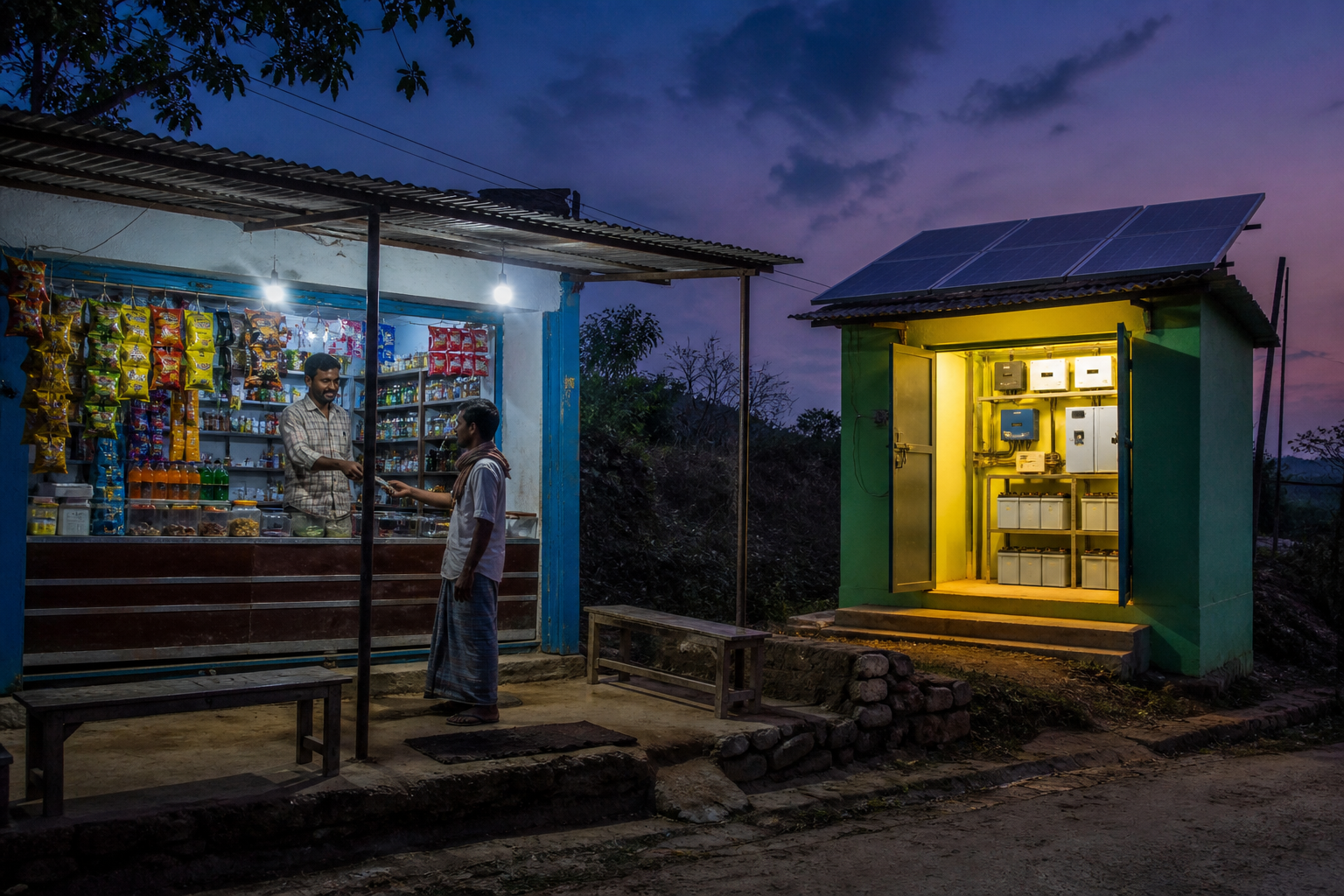
Husk Power Systems is an Indian-origin distributed renewable energy company focused on mini-grids for underserved communities. The strategic problem it tackles is different from a utility-scale solar park. A large solar park asks: “Can I generate cheap power and sell it through a contract?” A mini-grid asks: “Can I create a reliable local power business where demand, collection, maintenance and community trust all work together?”
Situation: Many rural and peri-urban customers may need reliable power for shops, irrigation, telecom, households and small enterprises, but grid reliability and affordability can vary by location. The opportunity is real, but customer loads are small and collections can be operationally intensive.
The move: Husk’s model combines local renewable generation, storage or backup architecture, customer acquisition, metering, collections and service operations. The key is not one technology. The primary driver is local operating discipline: matching generation to actual demand and ensuring customers keep paying because the service is reliable. Supporting drivers include modular assets, demand stimulation among productive users, remote monitoring and field service capability.
Lesson: In distributed renewables, the winning capability is not simply “low-cost solar.” It is the ability to turn electrons into a repeatable service business.
How AI Changes Energy & Renewables Interview Questions With Model Answers
AI is changing both the sector and the way candidates should prepare for it. Keep it concrete, because generic “AI will transform energy” answers sound weak.
Practical student workflow: Load a target company’s annual report, investor presentation and one regulator note into NotebookLM. Ask it to create: “10 energy and renewables interview questions, model answers using only these documents, and red flags in the company’s project economics.” Then verify the numbers manually using annual report reading for sector insight.
Interview Relevance
“India wants to scale renewable energy rapidly. What are the biggest business opportunities and the biggest bottlenecks in this transition?”
If the interviewer asks you to estimate a market, do not panic. Break it into installed base, new capacity additions, utilisation, price per unit and adoption rate. If you need a refresher, revise sector sizing when no number exists.
Common Mistake
The mistake: treating renewables as automatically superior because they are clean and increasingly cost-competitive. Why it costs candidates: it ignores intermittency, grid evacuation, storage, payment risk and regulatory complexity. One-line fix: say, “Renewables win when generation economics are combined with reliable evacuation, bankable offtake and system flexibility.”