
How the Energy & Renewables Value Chain Works
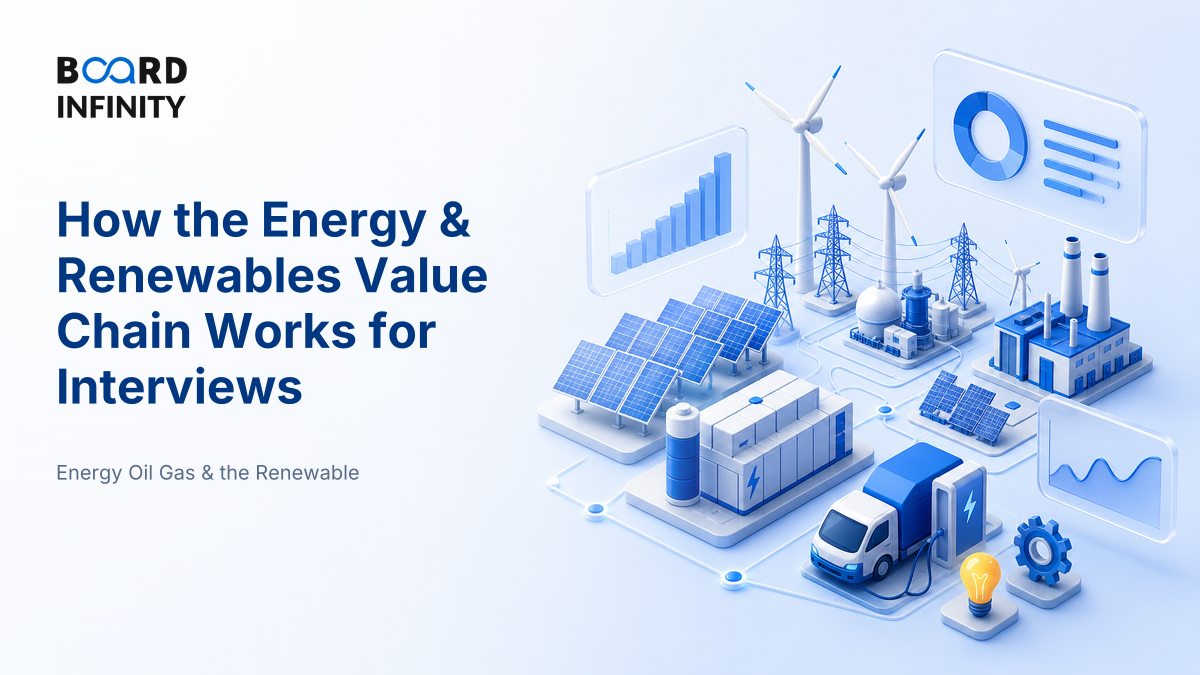
A solar developer can win an auction in the morning and still lose the project years later because a transmission line is delayed, a land parcel is disputed, or the offtaker cannot pay on time. That is the energy business in one scene: the product may be invisible, but the value chain is brutally physical, regulated and capital-heavy.
- The energy value chain converts a primary resource - sun, wind, coal, gas, water, uranium - into delivered energy, invoices and customer outcomes.
- For renewables, the big bottlenecks are not only generation; they are land, permits, grid connectivity, storage, forecasting, offtake and payment security.
- Think in two chains at once: the physical chain of electrons and the commercial chain of contracts, tariffs, subsidies and settlements.
- The core renewable value chain is: resource assessment -> project development -> equipment and EPC -> generation and O&M -> transmission or distribution -> customer and settlement.
- Winning players manage four risks better than peers: resource risk, construction risk, grid risk and offtaker or payment risk.
- In interviews, do not say “renewables are just solar panels and wind turbines.” Explain who captures value at each stage and where the risk sits.
Big Picture: Energy Is a Chain, Not a Plant
The easiest way to understand energy and renewables is to stop looking only at the power plant. A plant creates value only when the resource is secured, the asset is financed and built, the grid can absorb the electricity, and a customer or market pays for it.
The pyramid matters because weakness at a lower layer can destroy value above it. A great solar site without grid evacuation is stranded. A low-cost wind farm without a bankable power purchase agreement is hard to finance. A distribution company with high losses may buy power but struggle to pay on time.
Core Explanation: The Renewable Value Chain in Five Moves
A value chain is the sequence of activities that turns inputs into a product customers value. In energy, that product is not just electricity or fuel. It is reliable, delivered, metered and paid-for energy.
1. Origination: Find the Resource and the Demand
Origination is the starting point where a player identifies a viable energy opportunity. In renewables, this usually means mapping solar irradiation, wind speed, land access, environmental sensitivity, transmission availability and nearby demand.
In conventional energy, upstream origination may mean coal mining, gas exploration or crude oil production. In renewables, the “fuel” is free, but the site is not. The real scarcity is quality land, grid access and predictable output.
2. Development: Turn a Site into a Bankable Project
Development is where most inexperienced candidates underplay the complexity. Before construction starts, the developer must secure land rights, permits, grid connectivity, environmental approvals, a power purchase agreement or market route, and financing.
In India, large renewable procurement has often involved agencies and counterparties such as Solar Energy Corporation of India, state distribution companies and corporate buyers. If you are unsure which public body controls which decision, revise locating the regulator and what it controls before a sector interview.
3. Equipment and EPC: Convert Plans into Assets
This stage includes modules, cells, inverters, trackers, turbines, blades, towers, transformers, cables, batteries and balance-of-system equipment. EPC stands for engineering, procurement and construction: designing the plant, buying components and executing the build.
The strategic question here is: does the company own manufacturing, outsource it, or integrate selectively? A solar IPP may not manufacture panels; a module manufacturer may not own generation assets; a battery company may sit between generation and grid flexibility.
4. Generation and O&M: Produce Energy Reliably
Generation is the conversion of resource into electricity. O&M, or operations and maintenance, keeps the asset available, safe and efficient. In renewables, O&M includes panel cleaning, inverter replacement, blade inspection, vegetation control, forecasting, SCADA monitoring and warranty management.
The value driver is not just installed capacity in MW. It is useful output in MWh at the right time, with low downtime and low curtailment.
5. Transmission, Distribution and Settlement: Deliver and Get Paid
Electricity has to move through the transmission grid, distribution networks, open-access routes or private wires before the customer benefits from it. This is why grids are becoming a central constraint in clean energy transitions; the International Energy Agency calls electricity grids essential to secure energy transitions in its report on Electricity Grids and Secure Energy Transitions.
Settlement is the commercial end of the chain: metering, billing, payment collection, receivables management, renewable energy certificates where applicable, and dispute resolution. For a lender or investor, this is where “energy produced” becomes “cash received.”
Definitions You Can Say in One Breath
- Renewable energy: Energy from natural sources that are replenished faster than they are consumed, as defined by the United Nations.
- Energy value chain: Activities that convert a primary energy resource into delivered energy, cash flows and customer outcomes.
- IPP: An independent power producer that owns generation assets and sells electricity to utilities, markets or customers.
- PPA: A power purchase agreement is a contract defining power price, volume, tenure, delivery and payment obligations.
- Open access: A mechanism allowing eligible consumers to buy power using transmission or distribution networks.
The Metrics That Reveal Where Value Is Created or Lost
In interviews, metrics show that you understand the chain commercially. Use them to diagnose the stage: generation, grid, customer or financing. For deeper company preparation, pair these with reading an annual report for sector insight.
Notice the pattern: an energy company can look strong on installed capacity but weak on curtailment, collections or debt service. That is why sector analysts separate operating performance from cash conversion.
Conventional Energy vs Renewables: Same Chain, Different Risk Profile
The old mental model of energy was fuel-led: secure coal, oil or gas, burn it, move it, sell it. Renewables flip the logic. The fuel is free, but intermittency, land, equipment supply, transmission and storage become more important.
The interview insight: renewables are not automatically “asset-light” just because sunlight and wind are free. They are often capital-intensive, contract-heavy and grid-dependent.
Case Study: Husk Power Systems and the Mini-Grid Value Chain
Husk Power Systems shows how a renewables player can create value by owning more of the chain - from distributed generation to last-mile customer service.
Husk Power Systems, an Indian-origin company, focuses on renewable mini-grids for communities and small businesses that need reliable local power; the company describes its model around decentralized renewable energy services on the Husk Power Systems official site.
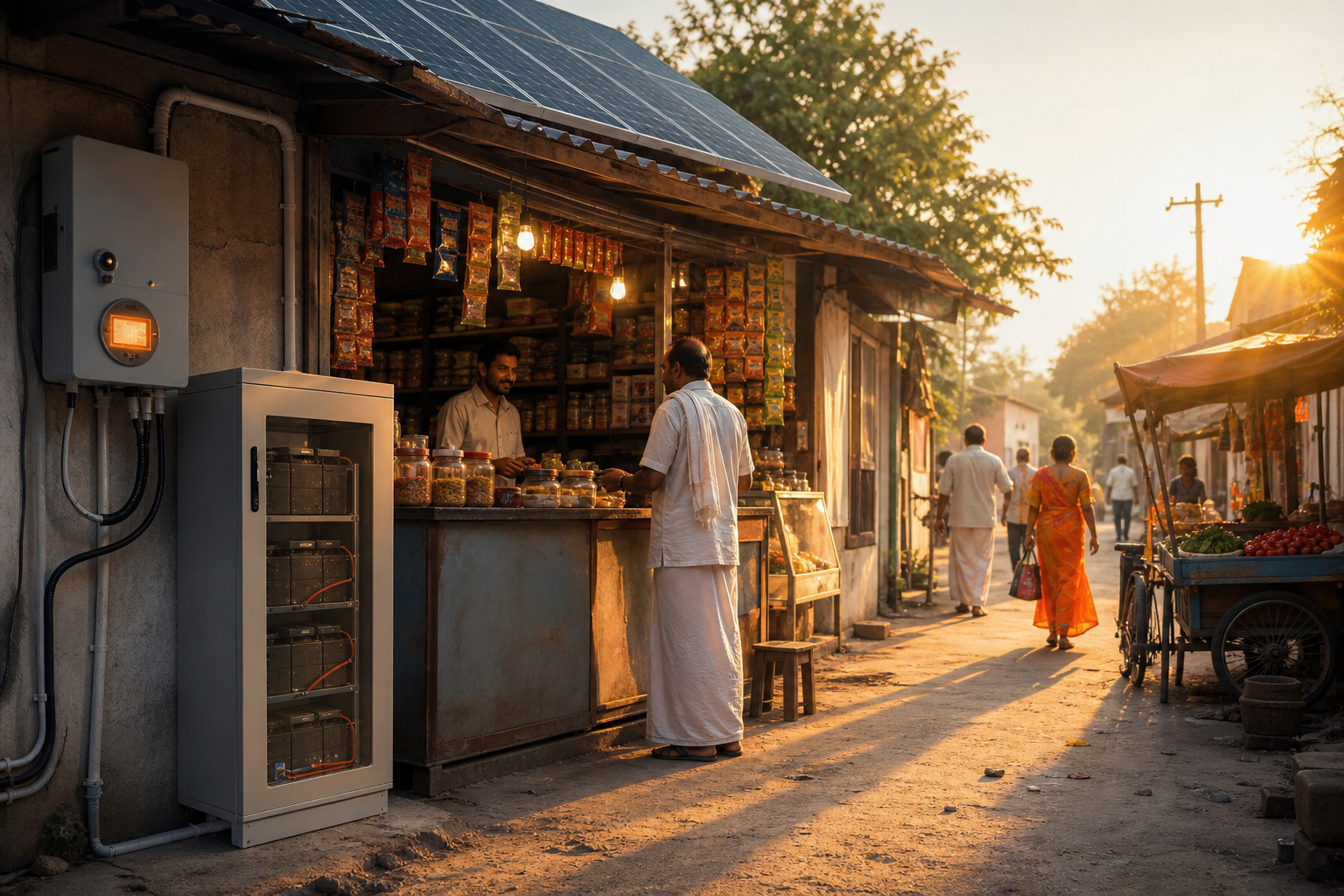
Situation: In weak-grid or underserved areas, the problem is not only generation. Customers need power that is local, reliable, affordable and billable. A distant utility-scale plant does not solve last-mile reliability if distribution is weak.
The move: Husk’s strategic logic is vertical integration at a local scale. Instead of only generating renewable power, it develops sites, installs generation and storage, manages local distribution, meters usage, serves households and small businesses, and uses digital monitoring to keep systems running.
Result and lesson: The primary driver is control over the last mile: Husk is not merely selling electrons; it is solving reliability for a defined community. Supporting drivers include demand aggregation from productive users, modular renewable assets, remote monitoring, local operations and payment discipline. The case proves that in energy, value often sits where technical delivery meets customer collection.
The shallow answer is “Husk generates renewable power.” The complete answer is “Husk participates across generation, distribution, operations and customer settlement, which is why its value chain is different from a pure utility-scale IPP.”
How AI Changes Energy & Renewables Value Chains
AI does not remove the physics of energy. It improves decisions where the chain has uncertainty, large data streams and high downtime cost.
Practical student workflow: Use NotebookLM or Perplexity to build a sector brief. Upload a company annual report, investor presentation, tariff order or regulator page, then ask: “Map this company across the energy value chain, identify its revenue points, and list the top three risks at each stage.” Cross-check every regulatory or financial claim manually; this is exactly where using AI to research a sector without importing its errors becomes important.
Interview Relevance
“Walk me through the energy and renewables value chain. Where does a renewable energy company actually make money, and where can value leak out?”
If the interviewer asks you to compare sectors, use the same value-chain lens across both. For example, compare energy with another sector using a common sector comparison framework: input risk, asset intensity, regulation, customer ownership and cash conversion.
Common Mistake
The biggest mistake is treating renewables as a pure generation story - “solar panel, wind turbine, clean power.” That misses the interview-winning parts: land, permits, grid, storage, offtake, financing and collections. Fix: always map the answer from resource to cash, not from plant to power.