
ATL, BTL and TTL Advertising Explained
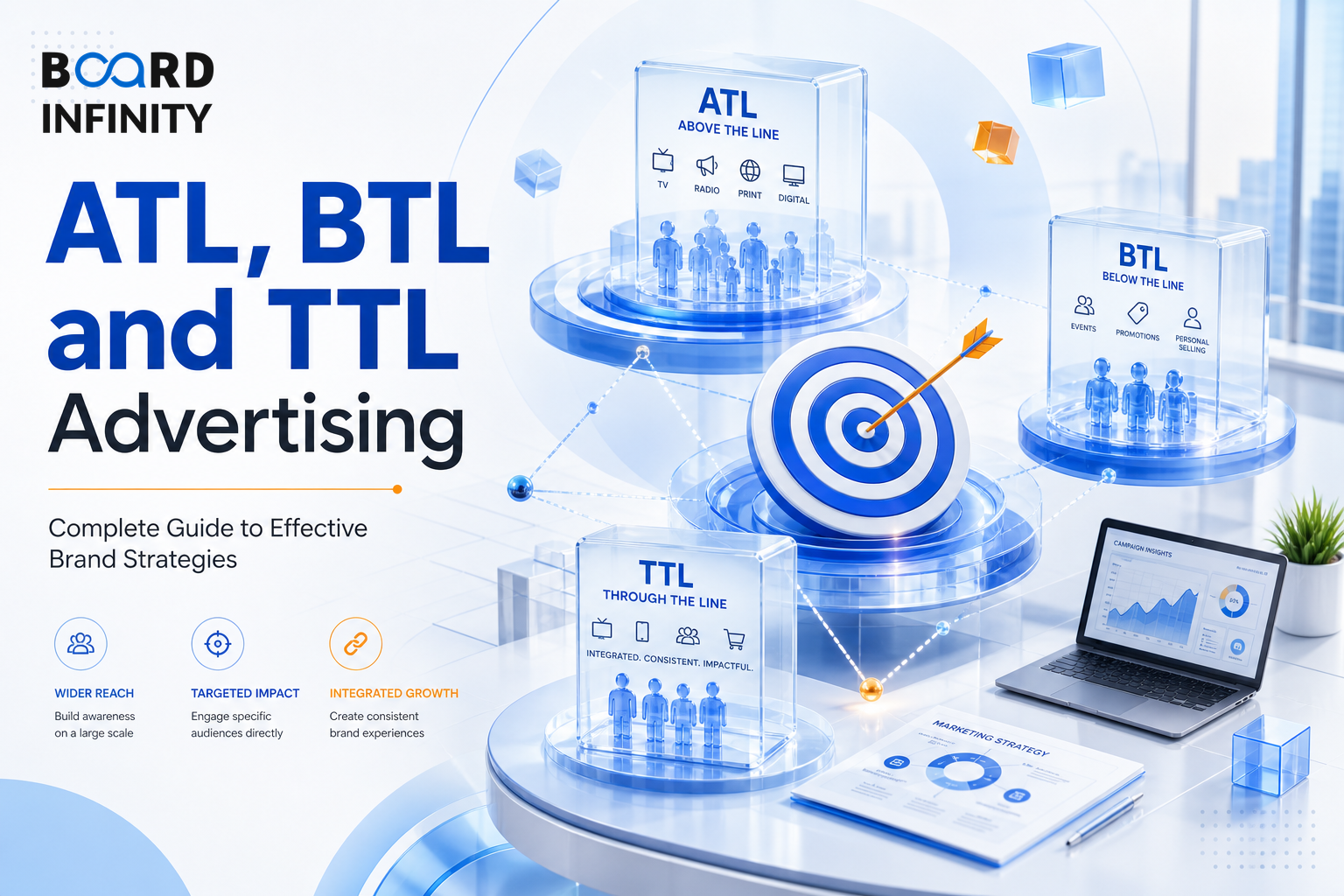
Advertising questions in marketing interviews often test whether you can match the communication channel to the business objective. ATL, BTL and TTL are useful because they separate mass awareness, targeted response and integrated campaign planning. In this lesson, you will learn the core differences, Indian examples, and a practical way to use the framework in case interviews at companies like HUL and Zomato.
- ATL means Above the Line advertising - mass media channels used for broad reach and brand awareness.
- BTL means Below the Line advertising - targeted channels used for specific segments with measurable, direct response.
- TTL means Through the Line advertising - an integrated approach that combines ATL reach with BTL precision.
- Television, print, radio, out-of-home and cinema are classic ATL channels because they can create high visibility at scale.
- Email, events, point-of-sale, trade shows and guerrilla marketing are BTL channels because they reach more specific audiences and can trigger action.
- HUL's Surf Excel "Daag Acche Hain" is a TTL example because it used television commercials, school activations, in-store sampling, digital, user-generated content and PR.
- In interviews, the strongest answer links channel choice to the goal - awareness, trial, lead generation, engagement or an integrated 360-degree campaign.
The Big Picture: Three Levels of Advertising Reach
The simplest way to understand ATL, BTL and TTL is to ask one question: is the brand trying to reach everyone, a sharply defined group, or both through a coordinated plan? This distinction matters because advertising channels differ in reach, cost, targeting and measurability.
What ATL Advertising Means
ATL stands for Above the Line. It refers to mass media channels designed for broad reach and brand awareness building. ATL is typically chosen when the marketer wants many people to know, remember or emotionally connect with a brand.
The role of ATL is not usually narrow conversion. It is about salience - making the brand mentally available when consumers later enter a purchase situation. A TVC, or television commercial, is a common ATL format because it can combine story, music, characters and emotion at scale.
ATL works best when the message benefits from scale and memorability. Cadbury Dairy Milk's emotional ads are a good illustration because the brand uses storytelling to associate the product with moments of feeling and celebration. Airtel's "Har Ek Friend" campaign similarly uses a mass-reach format to build broad recognition around a relatable social theme.
The nuance in ATL is that high reach does not automatically mean high action. Television can deliver the highest reach, but the source also notes expensive production and airtime. In an interview, avoid saying ATL is "better" because it is bigger. Instead, say ATL is appropriate when the brand objective is awareness, visibility or image building.
What BTL Advertising Means
BTL stands for Below the Line. It refers to targeted channels designed for specific segments with measurable, direct response. Compared with ATL, BTL is closer to the point of decision, interaction or lead generation.
Several BTL channels are built around direct engagement. POS, or point-of-sale, means communication inside or near the retail buying environment, such as checkout displays or shelf talkers. B2B, or business-to-business, refers to companies selling to other companies, where trade shows and product demonstrations can help build relationships and generate leads.
BTL is especially useful when the marketer wants to reach a defined audience and observe response more directly. Nykaa personalized emails, for instance, represent a targeted approach because messages can be tailored to identified individuals. Cadbury displays at supermarket checkout are BTL because they influence consumers at the point where purchase decisions are being made.
The main mistake with BTL is to reduce it to "cheap advertising." Some BTL tactics can be cost-effective or unconventional, as in guerrilla marketing, but the defining feature is targeting and measurable response, not merely low spend. A college fest sponsorship, an Auto Expo booth and a personalized email are very different executions, but all are BTL because they engage a specific segment more directly than mass media.
What TTL Advertising Means
TTL stands for Through the Line. It is an integrated approach that combines ATL's broad reach with BTL's targeted precision. TTL is often used when a brand wants both mental availability and consumer action.
A TTL campaign is sometimes described as a 360-degree campaign because it surrounds the consumer across multiple touchpoints. In the source example, HUL's Surf Excel "Daag Acche Hain" used mass media, activations, retail, digital and PR, or public relations. PR means getting visibility through media coverage, reputation building or case-study recognition rather than only paid advertising.
The nuance is that TTL is not just "ATL plus BTL" placed side by side. The campaign idea must stay consistent across channels. If television says one thing, the in-store sampling says another and the social media contest feels unrelated, the campaign may be multi-channel but not truly integrated.
ATL vs BTL vs TTL: Interview Comparison
In case interviews, candidates often know the full forms but struggle to compare them on business logic. A good comparison links each type to objective, audience, channel behavior and measurement.
This table also shows why the three categories are not a strict hierarchy. ATL is not outdated, BTL is not only small-scale, and TTL is not automatically superior. The right choice depends on the marketing problem.
Choosing the Right Approach
A practical interview answer should start from the objective and then choose channels. If the brand problem is low awareness, ATL may be the natural starting point. If the problem is low trial despite awareness, BTL activation at the point of sale may be more relevant. If the brand needs both awareness and trial across the country, TTL becomes stronger.
This checklist is useful because it prevents channel-first answers. Interviewers prefer candidates who say, "Given the objective, I would use this mix," rather than simply listing television, social media and events.
HUL Surf Excel: The Full Framework in One Business
HUL's Surf Excel "Daag Acche Hain" demonstrates the whole framework because it combines broad awareness, targeted activation, digital participation and public recognition into one integrated campaign. The campaign is a strong worked example for interviews because the source clearly connects the campaign design to both awareness and trial.
The takeaway is simple: a shallow answer says "Surf Excel did ads and activations." A complete answer says "Surf Excel used TTL by combining ATL reach with BTL precision, digital participation and PR amplification to drive awareness and trial."
Common Indian Examples to Remember
Examples are powerful in interviews because they make the framework feel practical. The source provides several India-relevant examples across categories, so use them selectively rather than overloading your answer.
Notice that some brands can appear in more than one bucket depending on the channel used. Zomato highway boards fit ATL because they are out-of-home visibility media, while Zomato witty social media appears under guerrilla marketing as a BTL example. This is why you should classify the channel, not just the brand.
Structuring an ATL, BTL and TTL Advertising Explained Interview Answer
"A new FMCG brand wants to build awareness and drive trial in India. How would you decide between ATL, BTL and TTL advertising?"
The fastest way to sound interview-ready is to separate objective from channel. Do not say "I will do ATL" first. Say "If the objective is mass awareness, ATL channels like television or out-of-home make sense; if the objective is trial, I would add BTL activation; if both are needed, I would design TTL."
Conclusion
ATL, BTL and TTL are not just advertising labels - they are a planning framework for matching message, audience and business objective. Use ATL for broad awareness, BTL for targeted response and TTL when an integrated campaign must drive both awareness and trial.
The most frequent error is classifying the brand instead of the channel. Zomato can be ATL through witty highway boards and BTL through witty social media, so always explain the medium, objective and audience before naming the bucket. This mistake costs points because it shows memorisation rather than marketing judgment.
Social Media Platform Deep-Dive for India