
India's FY2026 Digital Advertising Landscape
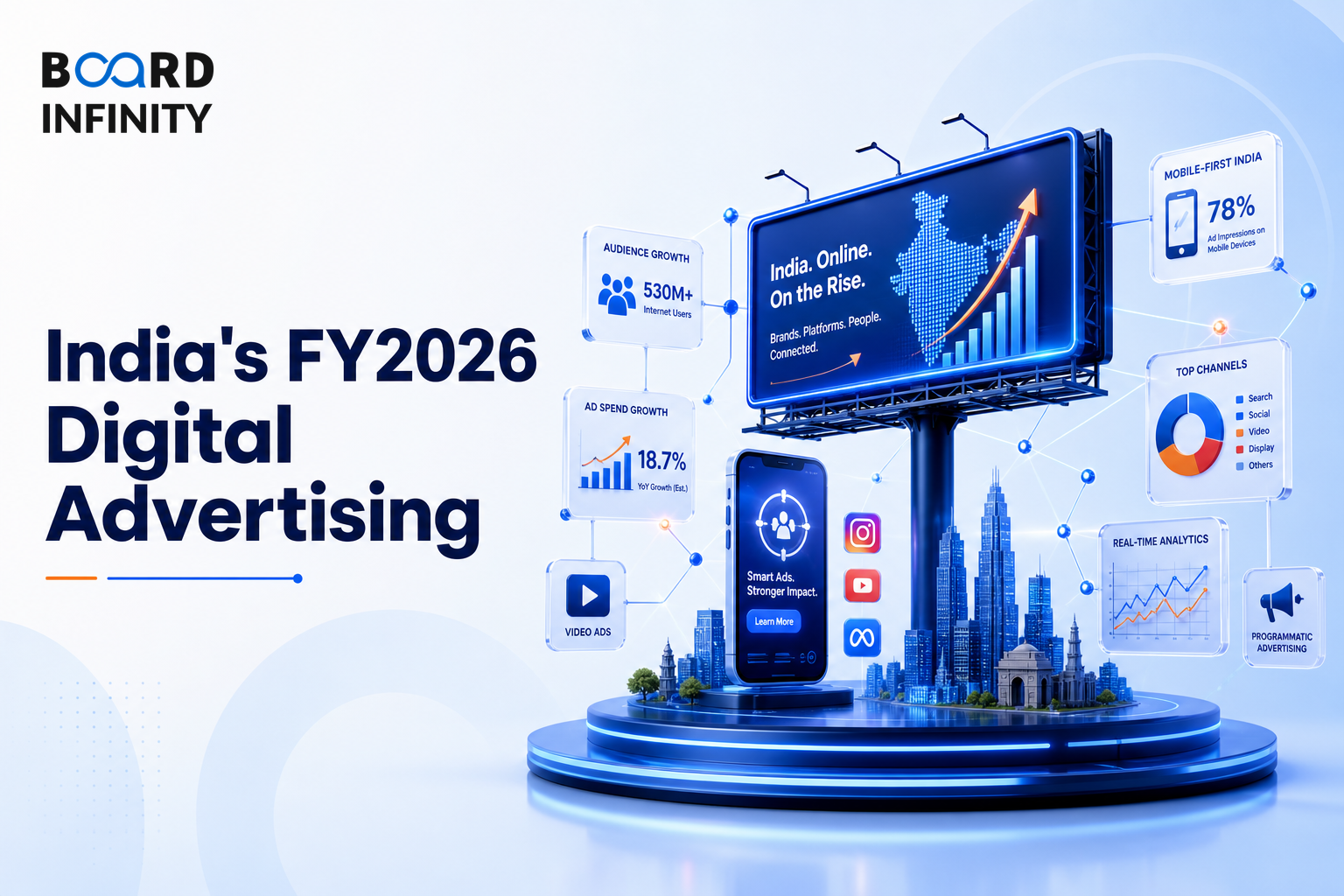
Email Marketing Best Practices showed how brands use owned, measurable communication to drive engagement and conversion. India's FY2026 digital advertising landscape answers the next placement-interview question: where are paid media budgets moving when brands want reach, targeting, and measurable growth at scale? This matters because FY2026 is the first full year after digital advertising overtook television in India during FY2025, making it a natural case-interview theme for marketing, growth, and business roles.
- Digital advertising overtook television for the first time in India during FY2025, with total digital ad spend at ₹49,000 crore, equal to 44% of total ad spend.
- Digital grew at around 20% year-on-year, compared with 8% for television, making the shift a growth-rate story as well as a share-of-wallet story.
- Mobile accounts for 78% of all digital ad spends, so India's digital advertising landscape is primarily mobile-first.
- FMCG and e-commerce together contribute 68% of digital ad revenue, showing that high-frequency consumer categories are central to the market.
- Video contributes 35%+ of digital ad spend and is the fastest-growing format, while OTT and Connected TV are changing how television-like reach is bought.
- Programmatic advertising accounts for 40%+ of display inventory traded via RTB, meaning automated media buying is now a core capability.
- India's digital advertising market was valued at $13.6B in 2024 and is projected to reach $32.3B by 2030 at a 15.3% CAGR.
Read FY2026 as the year when digital stops being treated as an add-on channel and becomes the main planning layer for many advertising conversations. The big picture is not just that digital is larger than television, but that budgets are being shaped by device behavior, content format, automated buying, and category demand.
Why FY2026 Is a Turning Point
FY means financial year, and FY2026 is important because it follows the first year in which digital advertising became India's largest advertising channel. In FY2025, digital accounted for 44% of total ad spend at around ₹49,000 crore, while television accounted for 27% at around ₹30,000 crore.
The turning point is also visible in growth. Digital grew at around 20% year-on-year, usually shortened to YoY, which means growth compared with the previous year. Television grew at 8%, so even where TV remains relevant, the faster budget acceleration is clearly on the digital side.
The FY2026 digital advertising landscape is the market structure created after digital overtook television in India, shaped by channel share, mobile-first consumption, video growth, programmatic buying, category concentration, and long-term market expansion.
The Channel Split: What Changed After Digital Overtook TV
The FY2025 channel split gives the clearest evidence of budget migration. Digital is now the largest channel with 44% share, television is second with 27%, and print still holds 18%, especially because it remains relevant in Tier 2-3 markets according to the source content.
OTT means over-the-top media, or video content delivered through the internet rather than traditional broadcast distribution. CTV means Connected TV, or television screens connected to internet-based content. The source identifies OTT or Connected TV as 5% of total ad spend, worth around ₹5,500 crore, and the fastest-growing segment at 30%+ YoY.
OOH means out-of-home advertising, such as outdoor media. The source notes that OOH has 3% share, around ₹3,300 crore, and is recovering post-COVID, with digital OOH growing. Radio and cinema are grouped under others at 3%, around ₹3,300 crore, and are described as stable with niche use cases.
The interview takeaway is that digital's rise does not mean every other channel disappears. A strong answer should show that television, print, OOH, radio, and cinema still have roles, but the center of growth and budget reallocation has moved toward digital, OTT, Connected TV, and digital OOH.
Mobile, Video and Programmatic: The Operating Signals
Three signals explain how digital advertising is being bought and consumed in India: mobile, video, and programmatic. Mobile has 78% share of all digital ad spends, so digital advertising in India is not just internet-first, it is mobile-first. For marketers, this affects creative length, screen format, landing-page experience, and measurement design.
Video has a 35%+ share of digital and is growing fastest. This matters because video combines attention, storytelling, and measurable distribution inside digital environments. As television shifts toward CTV and OTT, the boundary between classic TV-style brand building and digital performance channels becomes less rigid.
Programmatic advertising is automated buying and selling of ad inventory using technology rather than only manual media buying. RTB means real-time bidding, where ad inventory is bought through automated auctions. The source says 40%+ of display inventory is traded programmatically via RTB, which makes automation a core part of the FY2026 landscape.
Category Concentration: Why FMCG and E-commerce Matter
FMCG means fast-moving consumer goods, or frequently purchased consumer products. E-commerce refers to buying and selling through online platforms. Together, FMCG and e-commerce contribute 68% of digital ad revenue in the source content, making them the most important category signal in this landscape.
This concentration matters because these categories typically need frequent consumer touchpoints, broad reach, and measurable outcomes. Digital channels are useful for these needs because they support large-scale distribution, repeated exposure, audience segmentation, and performance tracking.
In interviews, do not simply say "digital is growing because everyone is online." A sharper answer links category demand to channel economics: when FMCG and e-commerce form 68% of digital ad revenue, the market is being shaped by categories that need both brand salience and measurable conversion-oriented communication.
The 2030 Projection: Why This Is Not a One-Year Spike
The source content says India's digital advertising market was valued at $13.6B in 2024 and is projected to reach $32.3B by 2030 at a 15.3% CAGR. CAGR means compound annual growth rate, which describes the average annual growth rate over a period assuming compounding.
This projection is important because FY2026 should not be read as a temporary disruption. It is the first full year after digital became the largest channel, but the longer-term projection indicates continued expansion through 2030.
Worked Example: Reframing an FY2026 Media Plan
Consider a marketing interview case where a national advertiser is entering FY2026 and must explain how to rethink media allocation after digital overtook television. The aim is not to invent an exact budget, but to use the source metrics to frame a logical decision.
The reusable lesson is to separate market share from media role. Digital has the largest share and strongest momentum, but television, print, OOH, radio, and cinema still appear in the channel split with specific use cases and growth trends.
A Reusable Framework for Case Interviews
Use a six-part structure whenever you are asked to analyse India's FY2026 digital advertising market. First, anchor the answer in the FY2025 watershed. Second, quantify the channel split. Third, explain why mobile, video, and programmatic matter. Fourth, connect the shift to FMCG and e-commerce. Fifth, include the 2030 projection. Sixth, add nuance by explaining that other channels still have roles.
Digital became India's largest advertising channel in FY2025, so FY2026 should be analysed through six lenses: channel share, growth rate, mobile dominance, video acceleration, programmatic buying, and category-led demand.
Structuring a India's FY2026 Digital Advertising Landscape Interview Answer
"Digital has overtaken television in India. How would you explain the FY2026 advertising landscape and where marketing budgets are moving?"
The best answers do not stop at "digital is bigger than TV." They explain why the budget is shifting: faster growth, mobile-first consumption, video momentum, programmatic buying, and category demand from FMCG and e-commerce.
Conclusion
India's FY2026 digital advertising landscape is best understood as the first full-year planning environment after digital became the country's largest ad channel. The final takeaway for interviews is simple: lead with the FY2025 shift, support it with exact metrics, and then explain how mobile, video, programmatic, OTT, and category demand shape where budgets are moving.
The most frequent error is treating the landscape as a one-line fact: "digital overtook TV." That costs points because it ignores the real drivers - 78% mobile share, 35%+ video share, 40%+ programmatic display inventory via RTB, FMCG plus e-commerce at 68% of digital ad revenue, and the $32.3B projection for 2030.
Social Media Platform Deep-Dive for India