
Key Digital Marketing Frameworks, Tools and Platforms in India
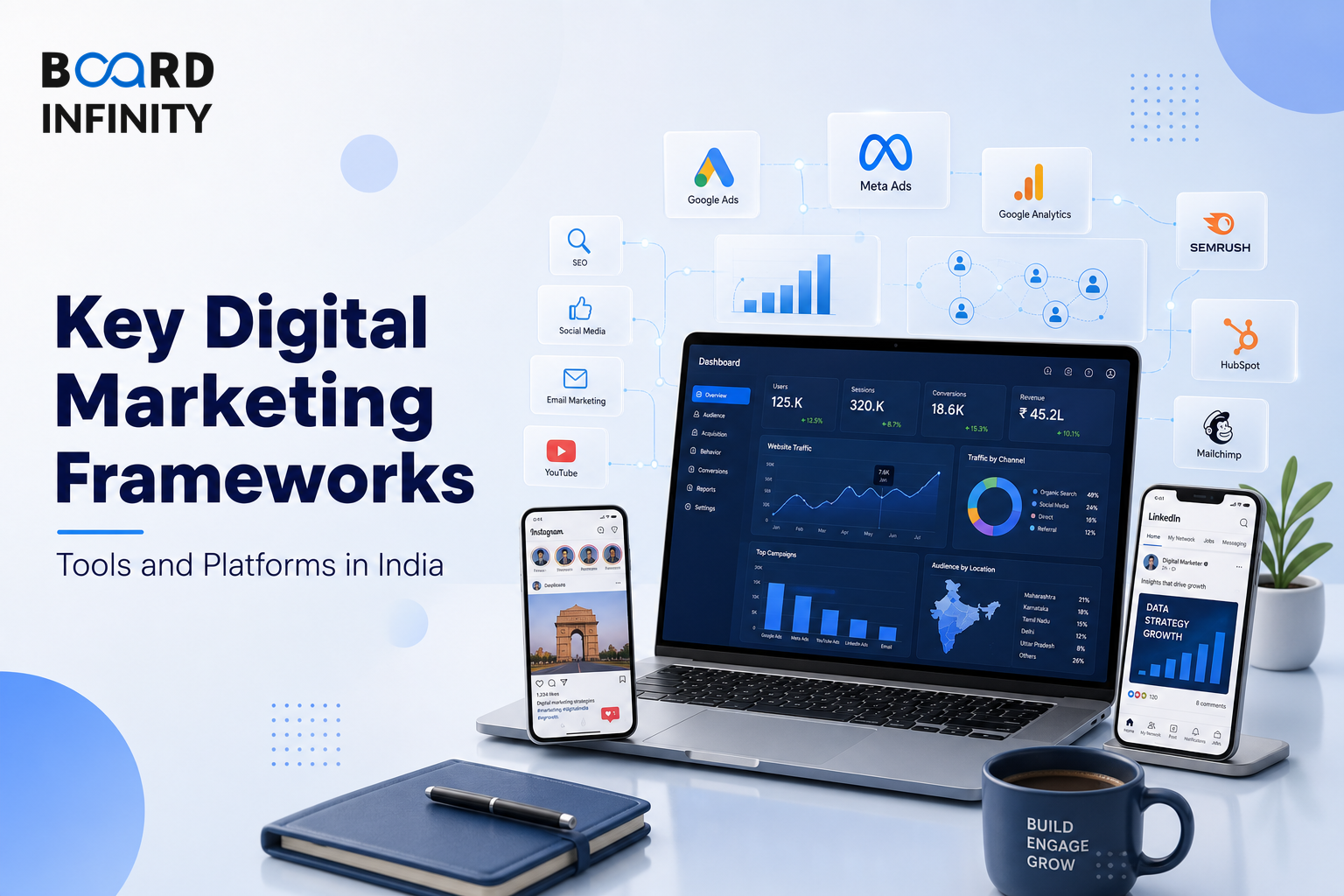
After understanding India's FY2026 Digital Advertising Landscape, the next practical question is: which tools help a marketer plan, execute, track, and improve digital campaigns? This quick-reference stack compares the essential platforms used by digital marketing professionals in India across analytics, SEO, social media, email, CRM, ads, content, and automation. For placement prep, this matters because interviewers often test whether you can connect a marketing objective to the right platform and pricing model instead of just naming popular tools.
- Use a category-purpose-pricing lens: first identify the marketing job, then shortlist tools, then check the typical cost model.
- Google Analytics 4 (GA4) is the analytics base for website traffic analysis, user behavior, conversion tracking, and audience insights, with a free version and a 360 version at ₹1.5L+/month.
- SEO platforms such as SEMrush, Ahrefs, and Ubersuggest support keyword research, competitor analysis, backlink audit, rank tracking, and site audit at ₹8K-20K/month.
- Social media tools such as Hootsuite, Buffer, and Sprout Social support multi-platform scheduling, analytics, social listening, and team collaboration at ₹2K-15K/month.
- Email tools such as Mailchimp, Sendinblue, and ConvertKit support campaigns, automation workflows, A/B testing, and list management, with a free tier available and paid plans at ₹1K-10K/month.
- CRM and automation tools help manage leads, pipelines, customer views, segmentation, notifications, and journey orchestration, with prices ranging from free CRM options to ₹10K-1L+/month for India-focused automation platforms.
Think of the stack as a campaign operating system: analytics tells you what happened, SEO and ads bring in demand, social and content create distribution, email and automation drive repeat engagement, and CRM tracks the customer relationship.
The Practical Framework: Category, Purpose, Pricing
The simplest way to understand digital marketing tools is not by memorising brand names. Use a three-part framework: category, purpose, and pricing. Category tells you where the tool fits in the marketing ecosystem, purpose tells you what work it performs, and pricing tells you whether it is suitable for the scale of the team or campaign.
This framework is useful because many tools overlap in real organisations. For example, a Customer Relationship Management system, or CRM, may include marketing automation features, while a marketing automation platform may also segment users and trigger customer journeys. In interviews and case discussions, the stronger answer is usually not “use the most popular tool,” but “use the tool that matches the campaign objective, data requirement, and budget.”
- GA4 means Google Analytics 4, used for website traffic analysis, user behavior, conversion tracking, and audience insights.
- SEO means Search Engine Optimization, where platforms such as SEMrush, Ahrefs, and Ubersuggest help with keyword research, competitor analysis, backlink audits, rank tracking, and site audits.
- CRM means Customer Relationship Management, used for lead management, pipeline tracking, marketing automation, and a customer 360° view.
- PPC means Pay Per Click, a paid advertising model listed under Google Ads and Meta Ads Manager.
- CPC means Cost Per Click and CPM means Cost Per Mille, both shown as pay-per-result pricing models for ad platforms.
- A/B testing means comparing two campaign variants, listed as a capability in email platforms such as Mailchimp, Sendinblue, and ConvertKit.
Analytics: Google Analytics 4
Analytics is the measurement layer of the digital marketing stack. Google Analytics 4, or GA4, is used for website traffic analysis, user behavior, conversion tracking, and audience insights. It helps a marketer understand whether campaign traffic is arriving, what users are doing, and whether desired actions are being completed.
In a practical stack, GA4 typically comes before optimisation decisions because it gives visibility into performance. If a campaign has traffic but weak conversions, GA4 helps frame the next question: is the issue audience quality, landing page behavior, or conversion tracking? The source pricing makes GA4 accessible because it has a free version, while the 360 version is listed at ₹1.5L+/month.
SEO: SEMrush, Ahrefs, and Ubersuggest
SEO platforms support organic search work. SEMrush, Ahrefs, and Ubersuggest are listed for keyword research, competitor analysis, backlink audit, rank tracking, and site audit. These are the core activities needed to understand what users search for, how competitors are performing, and whether a website has technical or authority-related issues.
The important interview nuance is that SEO tools do not replace strategy. They provide the research and diagnostic layer. A marketer still needs to decide which keywords matter, which competitor gaps are worth targeting, and which site audit issues should be prioritised. The typical pricing range in the source is ₹8K-20K/month, so these tools are often evaluated based on expected usage and depth of SEO work.
Social Media: Hootsuite, Buffer, and Sprout Social
Social media platforms create operational complexity because marketers often handle multiple accounts, posting calendars, reporting needs, and collaboration workflows. Hootsuite, Buffer, and Sprout Social are listed for multi-platform scheduling, analytics, social listening, and team collaboration. That makes them useful when social work moves beyond one-off posting.
The practical value is coordination. Scheduling helps maintain consistency, analytics helps assess performance, social listening helps monitor conversations, and team collaboration helps multiple people work without losing control of approvals. The typical pricing range is ₹2K-15K/month, so the buying decision usually depends on the number of channels, reporting needs, and collaboration depth.
Email: Mailchimp, Sendinblue, and ConvertKit
Email tools are used for direct audience communication. Mailchimp, Sendinblue, and ConvertKit support email campaigns, automation workflows, A/B testing, and list management. This means the tool is not only for sending newsletters; it also helps structure triggered communication and manage audience lists.
The source lists a free tier available and paid pricing at ₹1K-10K/month. For a learner or early-stage team, the free tier can support basic use cases, while paid plans become relevant when automation workflows, testing, and list management needs expand. In a case answer, email becomes especially relevant when the business already has leads or users to re-engage.
CRM: HubSpot, Salesforce, and Zoho CRM
A CRM system is the customer and lead management layer. HubSpot, Salesforce, and Zoho CRM are listed for lead management, pipeline tracking, marketing automation, and customer 360°. The phrase customer 360° means a rounded customer view that helps teams understand interactions and status in one place.
CRM becomes important when marketing generates leads that need follow-up, qualification, and pipeline visibility. HubSpot is listed with a Free CRM, while paid CRM pricing is ₹5K-50K/month. The nuance is that CRM is not only a sales tool; the source explicitly includes marketing automation as part of the CRM purpose, so ownership may overlap across marketing and sales teams.
Ad Platforms: Google Ads and Meta Ads Manager
Ad platforms are the paid acquisition layer. Google Ads and Meta Ads Manager are listed for PPC campaigns, display, video, shopping, app install, and audience targeting. PPC, or Pay Per Click, is one type of paid campaign model, while the pricing is listed as pay per result through CPC or CPM.
CPC, or Cost Per Click, charges based on clicks. CPM, or Cost Per Mille, charges based on impressions. In interviews, this distinction matters because a traffic objective may lean toward click-based thinking, while a reach or awareness objective may be discussed through impressions. The source does not give a fixed monthly fee here because ad platforms are priced by result rather than a standard subscription.
Content: Canva, Figma, and Adobe Creative Cloud
Content tools support the creation and management of marketing assets. Canva, Figma, and Adobe Creative Cloud are listed for graphics, social media creatives, video editing, and brand asset management. These tools sit close to social media, ads, and email because those channels need creatives to run effectively.
The pricing comparison is clear in the source: Canva Pro is ₹500/month, while Adobe is ₹2K+/month. A practical stack may choose based on creative complexity and asset management needs. In a case answer, content tools should not be treated as decoration; they enable the actual creatives used across campaigns.
Marketing Automation: Clevertap, WebEngage, and MoEngage
Marketing automation platforms are used for behavior-based communication and lifecycle engagement. Clevertap, WebEngage, and MoEngage are listed for push notifications, in-app messaging, user segmentation, and journey orchestration. The source specifically notes these as India-focused platforms.
The pricing range is ₹10K-1L+/month, making this category materially more expensive than many basic email or social tools. That cost is easier to justify when a business needs segmentation, app or in-product messaging, and structured journeys rather than simple one-time campaigns. The nuance is that marketing automation should be connected to a clear user journey; otherwise, the tool can become expensive infrastructure without focused usage.
Worked Example: Building a Practical Indian Digital Marketing Stack
This example shows how to convert a tool list into a decision structure. Instead of saying “use GA4, SEMrush, Mailchimp, and HubSpot,” a stronger answer explains why each tool is present and what part of the marketing system it supports.
Reusable Selection Checklist
When comparing tools, use the same checklist across categories. It keeps the answer practical and prevents a candidate from over-indexing on brand recall.
Conclusion
A strong digital marketing stack is not a random collection of famous tools. It is a mapped system where GA4 measures behavior, SEO and ad platforms drive acquisition, social and content tools support distribution, email and automation manage communication, and CRM tracks leads and customers. The final takeaway is simple: choose tools by category, purpose, and pricing before choosing by brand name.
The most frequent error is listing tools without explaining what each one does or how it is priced. This costs points because it sounds like memorisation, not marketing judgement, especially when categories such as CRM, email, and automation can overlap in real teams.
Social Media Platform Deep-Dive for India