
SEO vs SEM - Difference, Use Cases and Interview Answer
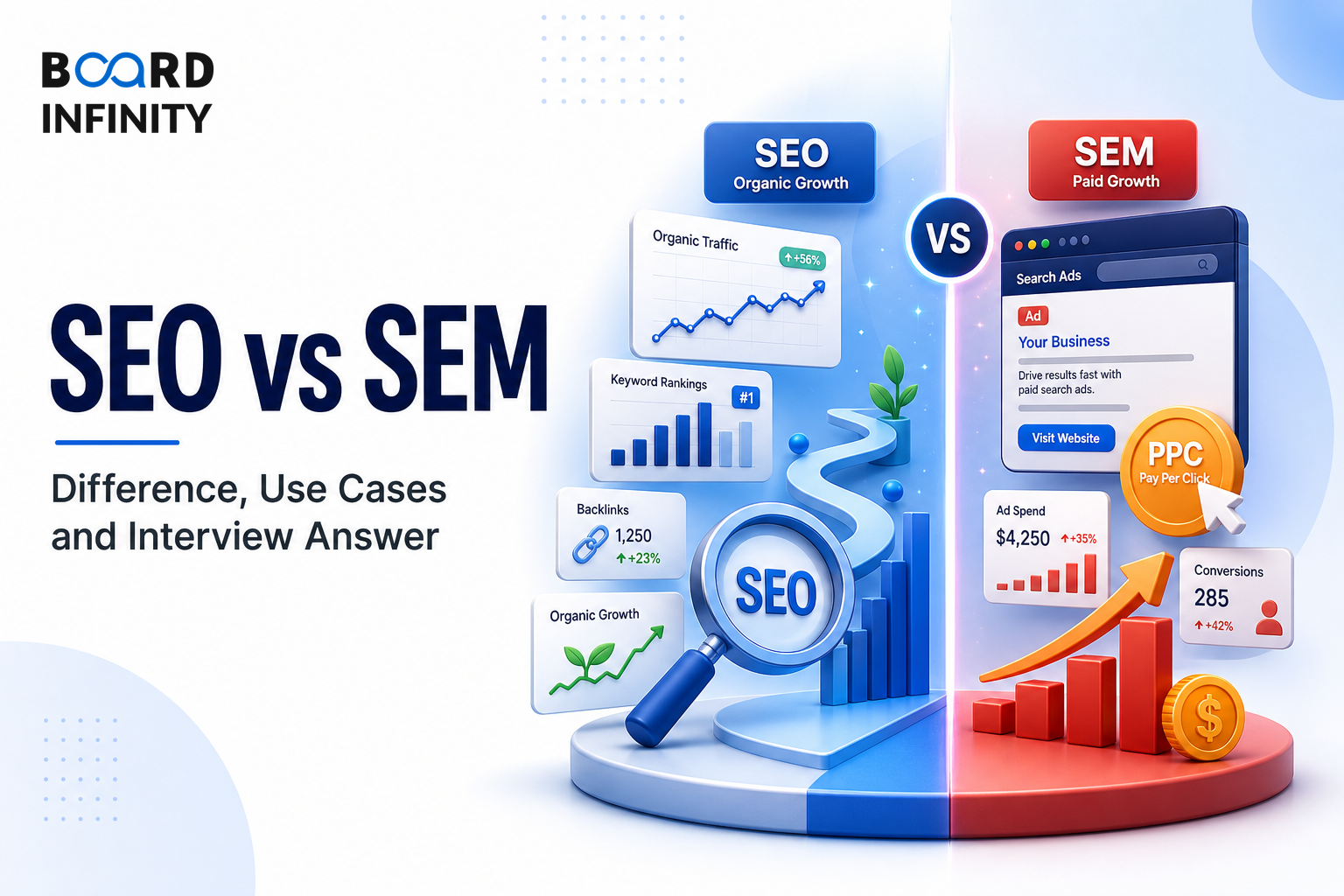
After understanding The Nine Digital Marketing Channels - A Complete Breakdown, the next interview question is usually about choosing between channels, not just naming them. SEO and SEM both sit inside search marketing, but they behave very differently: one compounds over months, while the other can start producing traffic within hours. This matters in interviews because marketers are expected to explain not only what each term means, but also when to use each one based on goals, time horizon, budget and intent.
- SEO stands for Search Engine Optimization - earning organic search visibility through content relevance, authority and technical optimization.
- SEM stands for Search Engine Marketing and is often discussed as PPC, or Pay-Per-Click, where traffic is bought through paid search placements.
- SEO clicks are free, but typically require content and technical investment; the India benchmark given is ₹0 per click, with ₹10-50K/month content investment.
- SEM works through CPC, or Cost Per Click, and CPM, or cost per 1,000 impressions; the India CPC benchmark given is ₹5-50/click, varying by industry and keyword.
- SEO takes 3-12 months for meaningful rankings, while SEM can generate results within hours of campaign launch.
- SEO is better for informational queries, brand building and thought leadership; SEM is better for commercial intent, product launches, promotions and competitive terms.
- The ideal approach is usually both: use SEM for immediate traffic and revenue while building SEO as a long-term organic traffic engine that can reduce dependence on paid search over time.
The Big Picture: Organic Engine vs Paid Lever
The simplest way to frame this topic is: SEO is the long-term compounding organic engine, while SEM is the immediate paid traffic lever. Both help a brand appear in search, but they differ in cost model, speed, sustainability, targeting, trust and testing velocity.
SEO is earned organic search visibility; SEM or PPC is paid search visibility. In interviews, position SEO as the compounding asset and SEM as the fast, controllable acquisition lever.
What SEO Means and Why It Matters
SEO means Search Engine Optimization. It refers to improving organic search visibility through investment in content and technical optimization so that relevant pages can rank for search queries without paying for every click.
The key advantage of SEO is sustainability. The source describes SEO as compounding because it builds a long-term asset. Once meaningful rankings are achieved, organic traffic can continue without a click-by-click media cost, although the channel still requires investment in content and technical optimization.
SEO is not an instant channel. Meaningful rankings typically take 3-12 months, so it is a poor fit if the business needs traffic within hours. But for informational queries, brand building and thought leadership, it is often the stronger fit because organic results are trusted 70% more than ads.
SEO also captures a large share of search behavior. According to the source, 70-80% of total search clicks go to organic. That makes SEO especially important when the goal is long-term visibility across broad topics where content relevance and authority matter.
What SEM Means and Why It Matters
SEM means Search Engine Marketing. In this comparison, SEM is discussed as PPC, or Pay-Per-Click, meaning paid search campaigns where the marketer pays for traffic, usually through CPC or CPM models.
CPC means Cost Per Click - the advertiser pays when a user clicks the ad. CPM means cost per 1,000 impressions - the advertiser pays based on ad views. These models make SEM highly controllable, but also directly dependent on budget.
The biggest advantage of SEM is speed. Paid campaigns can produce results within hours of campaign launch, making SEM useful when a marketer needs immediate traffic, product launch momentum, promotion visibility or coverage on competitive commercial keywords.
SEM also offers precise targeting. The source lists demographics, location, device, time and audience as targeting dimensions. This makes SEM useful when a marketer needs to narrow traffic by who the user is, where they are, what device they use, when they search or what audience segment they belong to.
SEO vs SEM: Detailed Comparison
In an interview, do not stop at "SEO is free and SEM is paid." That answer is directionally correct but incomplete. A stronger comparison explains trade-offs across cost, time, sustainability, trust, click share, targeting, testing, use case and India CPC benchmarks.
This table also shows the core trade-off. SEO is not truly "free" from a business investment perspective because content and technical optimization require resources. SEM is not automatically better because it is fast; it stops immediately when budget is paused.
When to Use SEO
Use SEO when the search problem is broad, educational and long-term. If users are asking informational questions, comparing concepts, learning categories or discovering expertise, SEO is typically the stronger search lever because content relevance and authority can build over time.
SEO fits brand building because organic results carry higher trust and credibility. The source states that organic results are trusted 70% more than ads, which matters when the brand wants to be seen as a reliable answer rather than only a paid placement.
SEO also fits thought leadership. If a company wants to own educational search demand around a topic, content investment can compound into an organic traffic asset. The marketer must be patient, however, because meaningful rankings take 3-12 months.
Choose SEO when the goal is long-term organic visibility for informational queries, brand building or thought leadership, and when the business can wait 3-12 months for meaningful rankings.
When to Use SEM
Use SEM when speed, precision and commercial intent matter more than compounding. Since SEM can generate results within hours of campaign launch, it is useful when traffic and revenue are needed immediately.
SEM is especially relevant for commercial intent queries. Commercial intent means the searcher is closer to a buying or action decision. The source also lists product launches, promotions and competitive terms as strong SEM use cases.
SEM is also stronger for rapid experimentation. SEO changes can take months to test, while SEM allows A/B testing of ads, landing pages and audiences in days. A/B testing means comparing two versions - for example, two ads or two landing pages - to see which performs better.
Choose SEM when the goal is immediate traffic or revenue, especially for commercial intent, product launches, promotions, competitive terms or fast testing of ads, landing pages and audiences.
Why the Best Answer Is Often Both
The source is clear that the ideal approach is both. SEM should be used for immediate traffic and revenue, especially on competitive commercial keywords, while SEO is built as a long-term organic traffic engine.
This is not a contradiction; it is a portfolio approach. SEM covers the short-term need for visibility, targeting and fast learning. SEO gradually builds organic reach and should reduce dependence on paid search over time.
The nuance is that "both" does not mean equal budget, equal effort or equal priority at all times. In many marketing plans, the balance depends on how urgent the revenue goal is, how competitive the keywords are and whether the query is informational or commercial.
Worked Example: Launch Traffic While Building Organic Demand
Consider a marketer planning search traffic for a new offering. The immediate problem is that search visibility is needed quickly, but the business also does not want to depend on paid traffic forever.
This example is interview-ready because it avoids a false binary. The stronger answer is not "SEO is better" or "SEM is better"; it is "use the channel that matches the job, and combine them when the business needs both speed and sustainability."
Reusable Decision Framework
When you are asked to choose between SEO and SEM, use a simple five-part filter. This keeps your answer structured and prevents you from relying only on the free-versus-paid distinction.
Structuring a SEO vs SEM Interview Answer
"What is the difference between SEO and SEM, and when would you use each?"
The number one way candidates get this wrong is by saying "SEO is free and SEM is paid" and stopping there. A stronger answer explains timing, sustainability, trust, click share, targeting, testing speed and business use case.
Conclusion
SEO and SEM are not substitutes in every situation; they are different search levers for different jobs. Use SEO when you want a trusted, compounding organic asset, use SEM when you need immediate and precisely targeted paid traffic, and combine both when the business needs revenue now plus lower paid dependence over time.
The most frequent mistake is treating SEO as completely free and SEM as simply expensive. SEO still needs content and technical investment, while SEM can be highly useful when speed, targeting and commercial intent matter. This mistake costs points because it ignores the business trade-off behind the channel choice.
Social Media Platform Deep-Dive for India