
Email Marketing Best Practices for High-ROI Campaigns
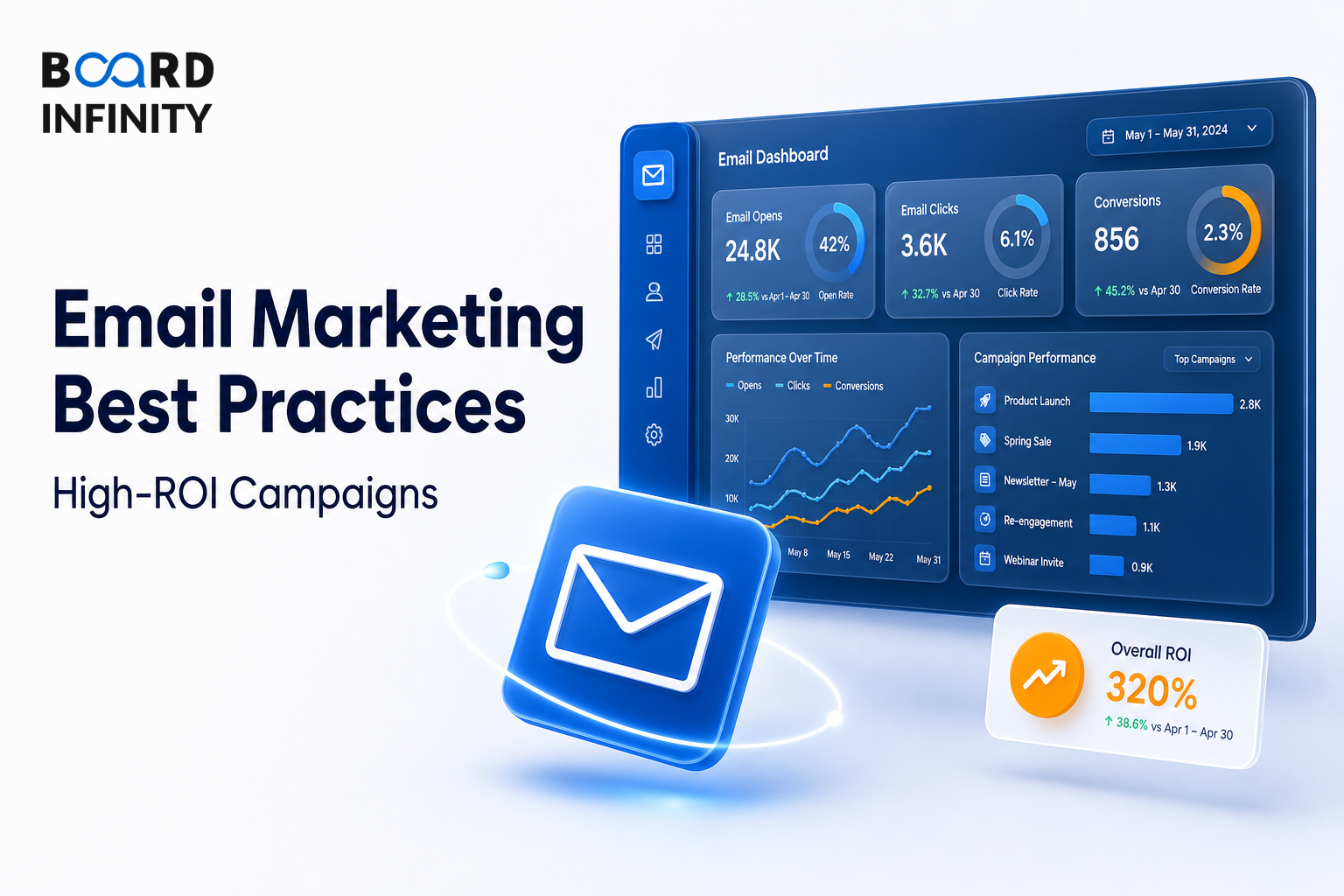
After understanding Influencer Marketing Strategy & ROI Measurement, the natural next question is how brands build a repeatable owned-channel engine instead of depending only on external reach. Email marketing matters because email remains the highest-ROI digital channel, but that ROI is not automatic. In interviews, candidates are expected to show that performance comes from disciplined execution across subject lines, personalization, segmentation, timing, mobile design, automation, list hygiene, and compliance
- Email remains the highest-ROI digital channel, but results depend on execution quality across the full campaign lifecycle.
- Subject lines drive open rate: keep them under 50 characters, personalize using name or behavior, and A/B test because 47% of recipients decide based on subject alone.
- Personalization and segmentation improve relevance: personalized emails deliver 6× higher transaction rates, while segmented campaigns see 14.31% higher open rates than non-segmented campaigns.
- Timing and mobile design are critical in India: test Tuesday to Thursday sends at 10-11 AM or 2-3 PM IST, and design for mobile because 70%+ of emails in India are opened on mobile devices.
- Automation scales lifecycle marketing: welcome series, abandoned cart, re-engagement, post-purchase, and birthday emails generate 320% more revenue than manual campaigns.
- List hygiene and compliance protect performance: remove bounces and inactive subscribers, include unsubscribe links, honor opt-outs within 24 hrs, and follow GDPR/data privacy expectations.
Context: Why Email Still Wins
Email marketing is the use of permission-based email communication to acquire, activate, retain, or re-engage users through structured campaigns. Its advantage is that it can combine reach, personalization, timing, and automation in one channel. Unlike a one-off campaign, effective email marketing typically behaves like a system: the right message goes to the right segment at the right time, in a format the user can easily read and act on.
ROI means return on investment - the business value generated compared with the cost of running the channel. The source states that email remains the highest-ROI digital channel, but the interview point is nuance: high ROI comes from strong fundamentals, not from sending more emails.
Use this big-picture map to structure any email marketing answer before drilling into individual tactics.
Subject Lines: The First Conversion Point
The subject line is the short text a recipient sees before opening an email. In many campaigns, it is the first conversion point because the user decides whether the message is worth attention. The source states that 47% of recipients decide based on subject alone, so a weak subject line can damage performance before the email body is even seen.
Best practice is to keep the subject line under 50 characters, personalize it with name or behavior where relevant, and run an A/B test. An A/B test means comparing two versions of one variable - for example, two subject lines - to see which performs better. In an interview, this shows that you would not rely only on creative instinct; you would test and learn.
A strong subject line is not just short. It should match the user context. If a user has shown a behavior, such as browsing or purchasing, the subject line can reflect that behavior. The nuance is that personalization should improve relevance, not feel forced. Over-personalized or misleading subject lines may get an initial open, but they can reduce trust and hurt future engagement.
Personalization and Segmentation: Relevance at Scale
Personalization means adapting email content to the individual user using dynamic content based on user behavior, purchase history, and preferences. Dynamic content means the email changes based on what is known about the user. The source states that personalized emails deliver 6× higher transaction rates than generic blasts, which is why interview answers should move beyond “send a newsletter” and talk about user relevance.
Segmentation means dividing the audience into meaningful groups so that each group receives more relevant communication. The source recommends segmentation by behavior, such as active or dormant users; lifecycle stage; purchase history; and engagement. Segmented campaigns see 14.31% higher open rates than non-segmented campaigns.
The practical difference is simple: personalization changes the message for a user, while segmentation decides which group gets which message. In many organisations, the two overlap. For example, a dormant segment may receive a re-engagement email, while the content inside that email changes based on purchase history or preferences.
Timing and Mobile Optimization: Remove Friction
IST means Indian Standard Time, the time zone used for India-based scheduling. The source recommends testing email send times and notes that India best practice is Tuesday to Thursday, 10-11 AM or 2-3 PM IST. Right timing can increase open rates by 20%+, but it should still be tested because audience habits can vary by category and lifecycle stage.
Mobile optimization is equally important. The source states that 70%+ of emails in India are opened on mobile devices. That makes responsive design, a single-column layout, and large CTA buttons essential. CTA means call to action - the button or link that asks the user to take the next step, such as viewing a product, completing a purchase, or updating preferences.
The recommended mobile CTA tap target is 44px+. In interview terms, this is not a design detail to skip. If the button is too small, the email may be opened but not acted on, which creates a gap between open rate and downstream performance.
Automation: Turning Campaigns into Lifecycle Journeys
Email automation means setting up triggered or scheduled email flows that run based on user actions or lifecycle events. The source lists welcome series, abandoned cart, re-engagement, post-purchase, and birthday emails as key automation use cases. These flows matter because automated emails generate 320% more revenue than manual campaigns.
A welcome series can introduce a new subscriber to the brand. An abandoned cart flow can remind a user about an incomplete purchase. A re-engagement flow can target dormant contacts. Post-purchase emails can support the next step after buying, and birthday emails can create a personalized moment. The common logic is that the email is not sent randomly; it is linked to user context.
The nuance is that automation should not mean “set and forget.” In a strong interview answer, you should say that automated journeys still need subject-line testing, segmentation, mobile design, list hygiene, and compliance. Automation scales a good strategy, but it can also scale poor execution if the underlying messages are irrelevant.
List Hygiene and Compliance: Protect Deliverability and Trust
List hygiene means keeping the email list clean by removing bounces and inactive subscribers, then deciding whether to re-engage or sunset dormant contacts. A bounce is an email that cannot be delivered. A dormant contact is a subscriber who has stopped engaging. The source states that clean lists improve deliverability, help avoid the spam folder, and reduce costs.
Compliance means following legal and privacy requirements for email communication. The source states that brands should include an unsubscribe link, honor opt-outs within 24 hrs, and follow GDPR/data privacy expectations. GDPR stands for General Data Protection Regulation, a data privacy regulation that is often referenced as a benchmark for responsible handling of personal data.
This matters because email performance is not only about creative copy. If deliverability is poor, even a well-written campaign may not reach the inbox. If unsubscribe requests are ignored, the brand risks losing trust and harming sender reputation. In interviews, list hygiene and compliance are strong differentiators because many candidates focus only on subject lines and forget the system that keeps the channel healthy.
Worked Example: Improving an E-commerce Email Program
This example is useful in interviews because it moves from diagnosis to operating system. The decision is not simply “send more emails”; it is to build lifecycle journeys, personalize content, test timing and subject lines, make the design mobile-first, and protect deliverability through hygiene and compliance.
Reusable Email Marketing Checklist
When evaluating any campaign, use a checklist that moves from user relevance to operational safety. This keeps the answer structured and prevents you from over-indexing on copywriting while ignoring deliverability or compliance.
- Audience: Is the campaign segmented by behavior, lifecycle stage, purchase history, or engagement?
- Message: Is the content personalized using behavior, purchase history, or preferences?
- Subject line: Is it under 50 characters, personalized where relevant, and A/B tested?
- Timing: Have send times been tested, especially Tuesday to Thursday, 10-11 AM or 2-3 PM IST for India?
- Mobile: Is the email responsive, single-column, and built with 44px+ CTA tap targets?
- Automation: Are welcome, abandoned cart, re-engagement, post-purchase, or birthday flows being used where relevant?
- Health: Are bounces and inactive subscribers removed, and are dormant contacts re-engaged or sunset?
- Compliance: Is there an unsubscribe link, are opt-outs honored within 24 hrs, and is data privacy respected?
Structuring a Email Marketing Best Practices Interview Answer
"Email has high ROI, but many campaigns underperform. How would you improve an email marketing program for an Indian consumer brand?"
The strongest answers connect creative decisions to measurable channel health. Do not stop at “write better subject lines”; show how segmentation, automation, mobile design, list hygiene, and compliance work together to protect ROI.
The most frequent error is treating email marketing as a volume game. Sending more generic blasts may look active, but it ignores personalization, segmentation, deliverability, mobile usability, and opt-out compliance - all of which directly affect performance and trust.
Conclusion
Email marketing performs because it combines relevance, timing, usability, automation, and trust in one high-ROI channel. In interviews, the winning answer is to present email as a disciplined system: segment the audience, personalize the message, test execution, automate lifecycle journeys, and protect the list.
Social Media Platform Deep-Dive for India