
The Nine Digital Marketing Channels - A Complete Breakdown
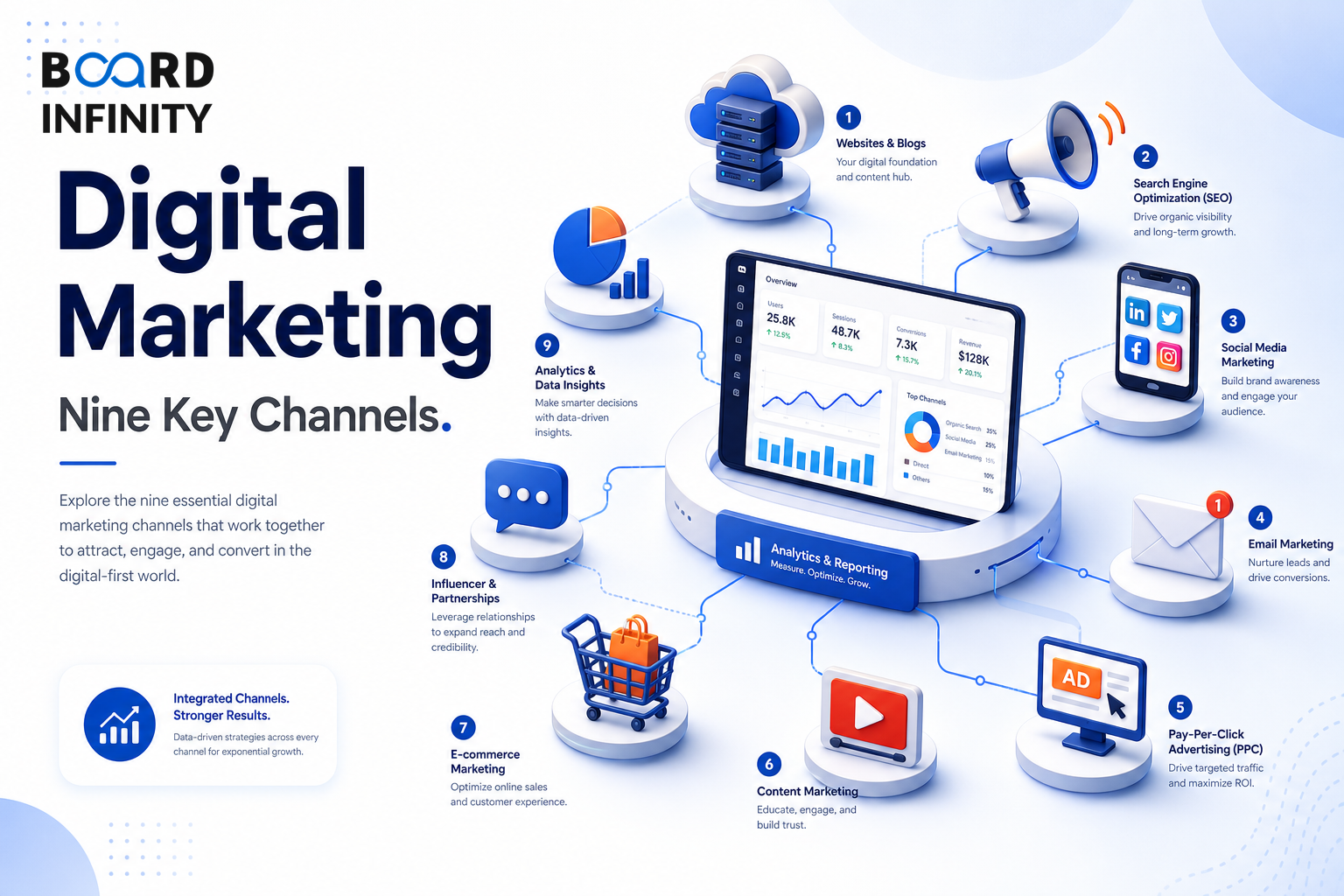
In Integrated Marketing Communication (IMC), brands coordinate messages across touchpoints so that the customer receives one consistent story. The next question is practical: which digital channel should carry which part of that story, and how should performance be measured? This lesson breaks down the nine core digital marketing channels as an interview-ready map, especially for India where Google, Instagram, YouTube, and WhatsApp Business behavior can materially change channel strategy.
- SEO, or Search Engine Optimization, is the long-term organic channel built on on-page SEO, off-page SEO, and technical SEO.
- SEM/PPC, or Search Engine Marketing and Pay Per Click advertising, uses paid search through Google Ads and Bing Ads, with Quality Score affecting cost and ad position.
- Social media marketing builds community and engagement across Instagram, Facebook, LinkedIn, YouTube, and Twitter/X, with India shaped by Reels, Shorts, and regional language content.
- Content marketing uses blogs, videos, whitepapers, webinars, and case studies across the TOFU, MOFU, and BOFU funnel to build trust and drive inbound demand.
- Email and WhatsApp marketing are direct communication channels, but WhatsApp has unusually high India relevance with 500M+ users and 98% open rate.
- Influencer, performance, and programmatic advertising are paid or partner-led channels where measurement discipline matters through engagement rate, ROAS, CPA, CPL, and real-time bidding.
Big Picture - The Channel Map
A digital marketing channel is not just a place to publish content or spend media money. It is a route to acquire, engage, convert, or retain a customer, and each route has a different time horizon, measurement logic, and India-specific platform behavior.
Choose a digital channel by matching the business objective, customer intent, funnel stage, budget model, and measurement metric instead of choosing the platform that is currently popular.
WhatsApp Marketing uses the WhatsApp Business API for customer communication, commerce, and support. In India, the channel is unusually powerful because WhatsApp has 500M+ India users, 98% open rate, and 45-60% click-through rate. JioMart processes 500K+ orders/day via WhatsApp, showing that the channel can move beyond notifications into catalog browsing, in-chat ordering, and commerce.
1. SEO - Search Engine Optimization
Search Engine Optimization (SEO) means improving a website so it ranks organically on search engines. It matters because SEO is a long-term compounding channel: content created today can drive traffic for years, and unlike paid ads, organic traffic has zero marginal cost per click.
SEO has three pillars. On-page SEO includes content quality, keyword optimization, meta tags, internal linking, URL structure, and header hierarchy. Off-page SEO includes backlinks, domain authority, social signals, brand mentions, and guest posting. Technical SEO includes site speed through Core Web Vitals, mobile-friendliness, structured data through Schema.org, XML sitemaps, and canonical tags.
In India, Google holds 95%+ search market share, so SEO strategy typically starts with Google behavior. At the same time, vernacular SEO is growing rapidly with 500M+ Indian language internet users, which means brands cannot assume English content is sufficient for all search demand.
2. SEM / PPC - Search Engine Marketing and Pay Per Click
Search Engine Marketing (SEM) is paid search advertising, primarily through Google Ads and Bing Ads. Pay Per Click (PPC) means advertisers bid on keywords and pay when a user clicks the ad.
The key operating idea is Quality Score: Quality Score = Click-Through Rate × Ad Relevance × Landing Page Experience. A higher Quality Score leads to lower Cost Per Click and better ad positions. The major formats include search ads, shopping ads, display ads, video ads on YouTube, app install ads, and Performance Max campaigns.
Interview answers should not describe SEM as simply “buying traffic.” The better answer explains the economics: track Cost Per Click, Click-Through Rate, Quality Score, Return on Ad Spend, and Impression Share. In India, average Cost Per Click is ₹5-50 depending on industry, and finance, education, and real estate keywords are the most expensive.
3. Social Media Marketing
Social media marketing builds brand presence, community, and engagement on social platforms. It is especially useful when a brand wants to create conversations, visual storytelling, or regular engagement instead of waiting only for search intent.
Meta platforms, including Instagram and Facebook, dominate business-to-consumer marketing through Reels, Stories, Carousels, and Live sessions. Instagram has 400M+ users in India. LinkedIn is the business-to-business powerhouse for thought leadership, professional networking, and lead generation, with 150M+ India members. YouTube is India’s #1 video platform with 500M+ users, and Shorts competes with Reels. Twitter/X is relevant for real-time conversations, brand public relations, crisis management, and newsjacking.
The India nuance is that Instagram Reels and WhatsApp Business dominate consumer engagement, while regional language content is growing 35% YoY. In interviews, this means a social plan for India should not be platform-neutral; it should specify content format, language behavior, and community objective.
4. Content Marketing
Content marketing means creating valuable, relevant content to attract, engage, and retain a target audience. Its formats include blog articles, videos, podcasts, infographics, whitepapers, webinars, newsletters, case studies, and ebooks.
The useful framework is the content funnel. TOFU, or Top of Funnel, uses blogs and social posts for awareness. MOFU, or Middle of Funnel, uses guides and webinars for consideration. BOFU, or Bottom of Funnel, uses case studies and demos for conversion.
Content builds trust, establishes thought leadership, and drives organic traffic, making it the foundation of inbound marketing. Nykaa’s beauty content strategy drives 40%+ organic traffic, while Zerodha’s Varsity is a masterclass in content marketing. For case interviews, the nuance is that content is not only a branding asset; it can also feed SEO, social media, email, and conversion journeys.
5. Email Marketing
Email marketing is direct communication via email. The source describes it as consistently the highest ROI channel in digital marketing, with approximately ₹36 return per ₹1 spent.
The core metrics are Open Rate, with a benchmark of 20-30%, Click-Through Rate at 2-5%, Conversion Rate, Unsubscribe Rate, and List Growth Rate. The main best practices are segmentation, personalization through dynamic content, A/B testing of subject lines and send times, and automation workflows such as welcome series, abandoned cart, and re-engagement.
Deliverability is the hidden technical layer. SPF, DKIM, and DMARC are authentication mechanisms used to improve trust and reduce email delivery issues. Clean lists and avoiding spam triggers also matter. In India, email is highly effective for D2C brands such as Mamaearth and boAt, education such as UpGrad, and financial services such as Groww.
6. Influencer Marketing
Influencer marketing means partnering with individuals who have engaged audiences to promote products authentically. The channel works because audiences may trust creators more than brand-led advertising, especially when the creator-product fit is credible.
The key insight is that micro and nano influencers deliver 3-5× higher engagement rates than mega influencers at 10× lower cost. Measurement includes Earned Media Value, engagement rate, brand lift, tracked conversions, and promo code redemptions. In India, the market size is ₹3,600 Crore in 2024 and is projected at ₹4,500 Crore in 2025 at 25% growth, based on the WPP-Kantar Report. Instagram and YouTube are primary platforms, and ASCI mandates #ad disclosure.
7. Performance Marketing
Performance marketing is data-driven, ROI-focused paid marketing where every rupee is tracked to a measurable outcome. It typically uses channels such as Google Ads, Meta Ads, programmatic display, affiliate marketing, and app install campaigns.
The main key performance indicators are ROAS, or Return on Ad Spend, CPA, or Cost Per Acquisition, CPL, or Cost Per Lead, and LTV:CAC ratio, meaning Lifetime Value to Customer Acquisition Cost ratio. The source gives a healthy LTV:CAC ratio target as 3:1 or better.
Optimization happens through A/B testing creative and audiences, bid strategy optimization, lookalike audiences, retargeting, and conversion API integration. In India, D2C brands spend 30-50% of revenue on performance marketing, so the interview nuance is to discuss sustainability, not just growth. Paid acquisition can scale quickly, but the candidate should connect spend to payback quality through ROAS, CPA, and LTV:CAC.
8. Programmatic Advertising
Programmatic advertising is automated, real-time bidding for digital ad inventory using algorithms and data. RTB, or real-time bidding, means ad inventory is bought and sold dynamically rather than through only manual media buying.
The ecosystem includes a DSP, or Demand-Side Platform, used by buyers; an SSP, or Supply-Side Platform, used by publishers; and a DMP, or Data Management Platform, used for audience data. Targeting can be contextual, behavioral, demographic, retargeting, lookalike, or geofencing.
The advantages are scale, efficiency, precision targeting, real-time optimization, and reduced human error. In India, 42% of digital ad spends, approximately ₹30,081 Cr, were traded programmatically in 2025, growing 19% YoY according to the dentsu-e4m Report 2026. Google DV360 and The Trade Desk are leading DSPs.
9. WhatsApp Marketing
WhatsApp marketing uses the WhatsApp Business API for customer communication, commerce, and support. The source highlights 98% open rate compared with 20% email, 45-60% click-through rate, and 500M+ India users.
Use cases include order confirmations, delivery tracking, payment reminders, product catalogs, customer support chatbots, and broadcast promotions. Commerce use cases include WhatsApp native payments through UPI, catalog browsing, and in-chat ordering.
The India relevance is unusually strong because WhatsApp is both a communication and commerce layer. JioMart processes 500K+ orders/day via WhatsApp, while Meesho built its entire reseller business on WhatsApp groups. The interview nuance is to treat WhatsApp as a conversion, support, and retention channel, not only as a broadcast tool.
Worked Example - Choosing Channels for WhatsApp Commerce
This example shows how to move from channel description to channel strategy. Instead of saying “use WhatsApp because it has high open rates,” the stronger answer connects the business problem to the use cases, the India user base, and a measurable operating outcome.
Comparing Compounding, Paid, Partner, and Direct Channels
This comparison is useful in interviews because it prevents a one-channel answer. In many organisations, ownership may overlap across marketing, growth, product, content, and customer support teams, but the candidate’s job is to show which channel serves which business goal.
Structuring a The Nine Digital Marketing Channels Interview Answer
"If Nykaa or JioMart wants to grow digital demand in India, how would you choose between SEO, paid ads, social media, influencers, email, and WhatsApp?"
The strongest answers do not list channels mechanically. They connect each channel to a funnel stage, metric, and India-specific user behavior, then explain why a mix is better than a single-channel bet.
Conclusion
The nine digital marketing channels form a practical operating map for growth: organic discovery, paid acquisition, social engagement, content-led trust, direct communication, creator-led influence, automated media buying, and WhatsApp-led commerce. For interviews, the final takeaway is simple: choose channels by objective, measurement logic, and platform behavior in India.
The most frequent error is treating all digital marketing channels as interchangeable traffic sources. That costs points because SEO, SEM, social, content, email, influencers, performance marketing, programmatic advertising, and WhatsApp each have different economics, metrics, and India-specific behavior.
Social Media Platform Deep-Dive for India