
Content Marketing Strategy Framework: 7-Step Operating System
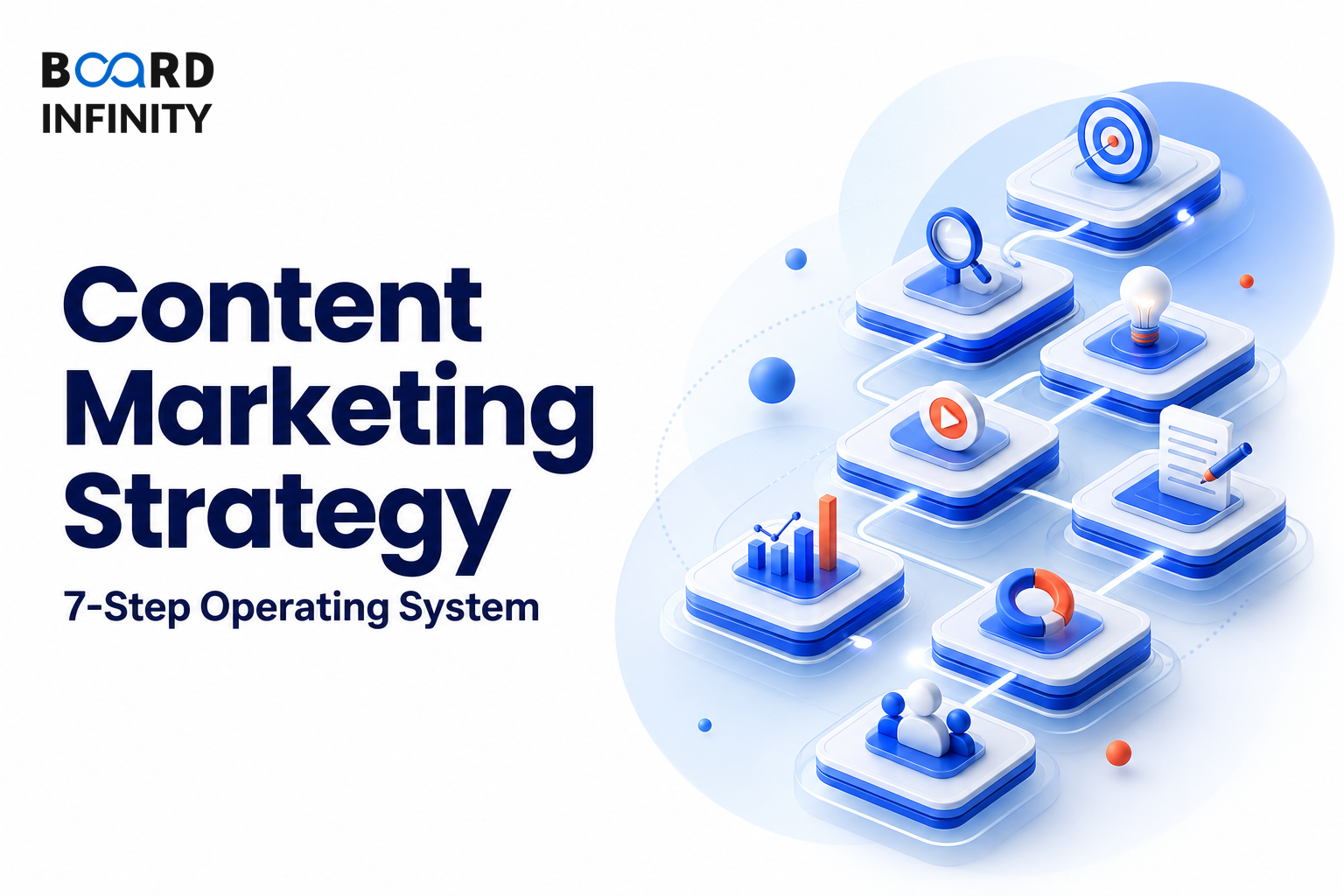
After understanding SEO vs SEM - Search Engine Optimization for organic visibility and Search Engine Marketing for paid search visibility - the next question is how a business keeps creating content that actually supports growth. A content marketing strategy framework answers that by turning content from scattered posts into a repeatable operating system. In interviews, this matters because it shows you can connect audience insight, funnel thinking, distribution, and Return on Investment, or ROI, instead of only suggesting “make more content.”
- A content marketing strategy framework is a 7-step operating system for auditing content, defining personas, mapping funnel stages, researching topics, planning calendars, distributing assets, and optimizing performance.
- The process starts with a content inventory and gap analysis so the team knows what already exists, what performs well, and where opportunities remain.
- Target personas should capture goals, pain points, and content preferences, typically resulting in 3-5 detailed persona documents.
- Content should be mapped to the funnel: TOFU for awareness, MOFU for consideration, and BOFU for decision-stage content.
- Keyword and topic research focuses on high-volume, low-competition keywords grouped into topic clusters and pillar pages.
- Distribution is not an afterthought: one content asset can be repurposed from blog to video to carousel to newsletter.
- ROI takes patience: content marketing costs 62% less than traditional marketing and generates approximately 3× as many leads per dollar spent, but most programs take 6-12 months to show meaningful ROI.
The Big Picture: Content Marketing as an Operating System
A strong content marketing engine is not just a publishing calendar. It is a sequence of decisions that moves from understanding existing assets to reaching the right personas, matching content to funnel stages, distributing intelligently, and measuring what converts.
A content marketing strategy framework is a repeatable 7-step system that converts audience insight and existing content into planned, distributed, and measurable content assets across the marketing funnel.
Why This Framework Matters
Content marketing often fails when teams treat it as a production task rather than a growth system. Publishing more blogs, videos, or newsletters may increase activity, but without personas, funnel mapping, topic research, and performance tracking, the business cannot know whether the content is moving users from awareness to consideration to conversion.
The framework matters because it links content decisions to business outcomes. It begins with what already exists, then defines whom the content is for, where each asset fits in the funnel, how it will be discovered, when it will be published, how it will be distributed, and how performance will be improved.
The ROI, or Return on Investment, lens is especially important. The source states that content marketing costs 62% less than traditional marketing and generates approximately 3× as many leads per dollar spent. However, it also requires patience because most content programs take 6-12 months to show meaningful ROI.
Step 1. Audit Existing Content
The first step is to audit existing content. This means analyzing what content you already have, what performs well, where gaps exist, and where opportunities are visible. The output is a content inventory and gap analysis.
This step prevents a common waste of effort: creating new content without understanding the current library. In many organisations, there may already be blogs, videos, guides, webinars, demos, or case studies, but they may not be organized by performance, funnel stage, or persona relevance.
In practical terms, the audit asks four basic questions: what exists, what works, what is missing, and what can be improved. For an interview answer, this is a strong starting point because it shows discipline before action. You are not jumping to “create content”; you are first diagnosing the content base.
Step 2. Define Target Personas
A target persona is a detailed profile of a buyer or user segment. In this framework, persona documents should include goals, pain points, and content preferences. The expected output is 3-5 detailed persona documents.
This matters because content is useful only when it is relevant to a specific audience. A user looking for awareness content may prefer blogs, social posts, or videos, while someone comparing options may need guides or webinars. Persona definition connects content format and messaging to user intent.
For interviews, define personas before proposing channels. A crisp answer might say: “I would identify 3-5 detailed personas, document their goals, pain points, and content preferences, and then use those personas to decide what content to create and how to distribute it.”
Step 3. Map Content to Funnel Stages
The funnel is a way to describe how a potential customer moves from initial awareness to evaluation and then decision. In this framework, the funnel has three stages: TOFU, MOFU, and BOFU.
- TOFU means Top of the Funnel. It is the awareness stage, where blogs, social content, and videos help people discover a topic or problem.
- MOFU means Middle of the Funnel. It is the consideration stage, where guides and webinars help users evaluate options or learn in more depth.
- BOFU means Bottom of the Funnel. It is the decision stage, where case studies and demos help users move closer to conversion.
The output of this step is a content-funnel matrix. This matrix helps avoid overloading one stage while ignoring another. For example, a team may have many awareness blogs but too few BOFU demos or case studies, creating a gap between interest and conversion.
Step 4. Keyword and Topic Research
Keyword and topic research identifies high-volume, low-competition keywords. A keyword is a search phrase a user may type when looking for information. High-volume means many users search for it, while low-competition means it may be easier to compete for visibility.
The source also highlights grouping keywords into topic clusters and pillar pages. A topic cluster is a set of related content pieces around a broader subject. A pillar page is the central page that organizes or anchors that broader topic.
The output is a keyword list and topic clusters. This step connects naturally to SEO because keyword research helps content become discoverable. However, the framework is broader than SEO because it also includes personas, funnel mapping, publishing discipline, distribution, and optimization.
Step 5. Create an Editorial Calendar
An editorial calendar is the operating plan for content creation and publishing. In this framework, it includes content creation, publication dates, distribution channels, and responsible teams. The output is a monthly editorial calendar.
This step turns strategy into execution. Without a calendar, content ideas remain unprioritized and teams may miss publication consistency. With a calendar, the team knows what is being created, when it will go live, where it will be distributed, and who owns each task.
In interviews, this is where you show project-management thinking. A good answer does not stop at “create content”; it explains how content will be planned, scheduled, assigned, and distributed across channels.
Step 6. Produce and Distribute
Production means creating high-quality content assets. Distribution means taking those assets to the relevant channels. The framework specifically calls out repurposing across formats, such as blog to video to carousel to newsletter.
This is a powerful operating idea because it increases the usefulness of one core asset. A blog can become a video for users who prefer watching, a carousel for social consumption, and a newsletter item for direct audience communication. The output is published content assets.
The nuance is that distribution should be planned, not added at the end. If a team knows the persona’s content preferences and the funnel stage, it can choose the right formats earlier in the process.
Step 7. Measure and Optimize
The final step is to measure and optimize performance. The framework tracks four metrics: traffic, engagement, leads, and conversions. A lead is a potential customer signal, and a conversion is a desired action that indicates progress toward a business outcome.
The operating rule is simple: double down on what works and cut what does not. This means the content engine should become smarter over time. Strong formats, topics, and funnel-stage assets get more attention, while weak ones are reduced or improved.
The output is a monthly performance report. This report is important because content marketing requires patience. Since most programs take 6-12 months to show meaningful ROI, monthly reporting helps teams stay disciplined without expecting instant results.
Worked Example: Building a Content Engine from an Existing Library
Consider a content team that already has scattered blogs, social posts, videos, guides, webinars, case studies, and demos, but no clear view of what performs well or where the gaps are. The team uses the 7-step framework to move from scattered production to a measurable monthly operating rhythm.
The key learning is that content marketing is not a one-off campaign. It is a disciplined system where each month creates more data, better prioritization, and clearer decisions about what to continue or stop.
ROI and Patience: The Business Case for Content Marketing
The source gives a clear ROI equation: content marketing costs 62% less than traditional marketing and generates approximately 3× as many leads per dollar spent. This is the economic reason many businesses invest in content as a growth channel.
However, the same source adds an important caveat: most content programs take 6-12 months to show meaningful ROI. That means content marketing should typically be evaluated as a compounding system, not as an instant lead machine.
Content marketing ROI should be framed as lower cost, higher lead generation per dollar, and a 6-12 month patience window for meaningful results.
Practical Framework You Can Reuse
For case interviews or placement discussions, use the framework as a sequence. It helps you avoid random suggestions and shows that your strategy has diagnosis, audience clarity, funnel logic, execution planning, and optimization.
Structuring a Content Marketing Strategy Framework Interview Answer
"How would you build a content marketing strategy for a brand that wants to generate more leads over the next few months?"
The best interview answers connect content to ROI without promising instant results. Mention the 62% lower cost, approximately 3× leads per dollar spent, and the 6-12 month window for meaningful ROI.
The most frequent error is jumping straight to content ideas without auditing, defining personas, or mapping the funnel. This costs points because it makes the strategy look like a list of activities rather than an ROI-focused operating system.
Conclusion
A strong content marketing strategy framework turns content into a repeatable engine: audit what exists, define who it is for, map it to the funnel, plan topics and calendars, distribute intelligently, and optimize through monthly performance reports. The final takeaway is simple: content marketing works best when creativity is paired with structure, patience, and ROI discipline.
Social Media Platform Deep-Dive for India