
Automotive, Electric Vehicle & Battery Supply Chains
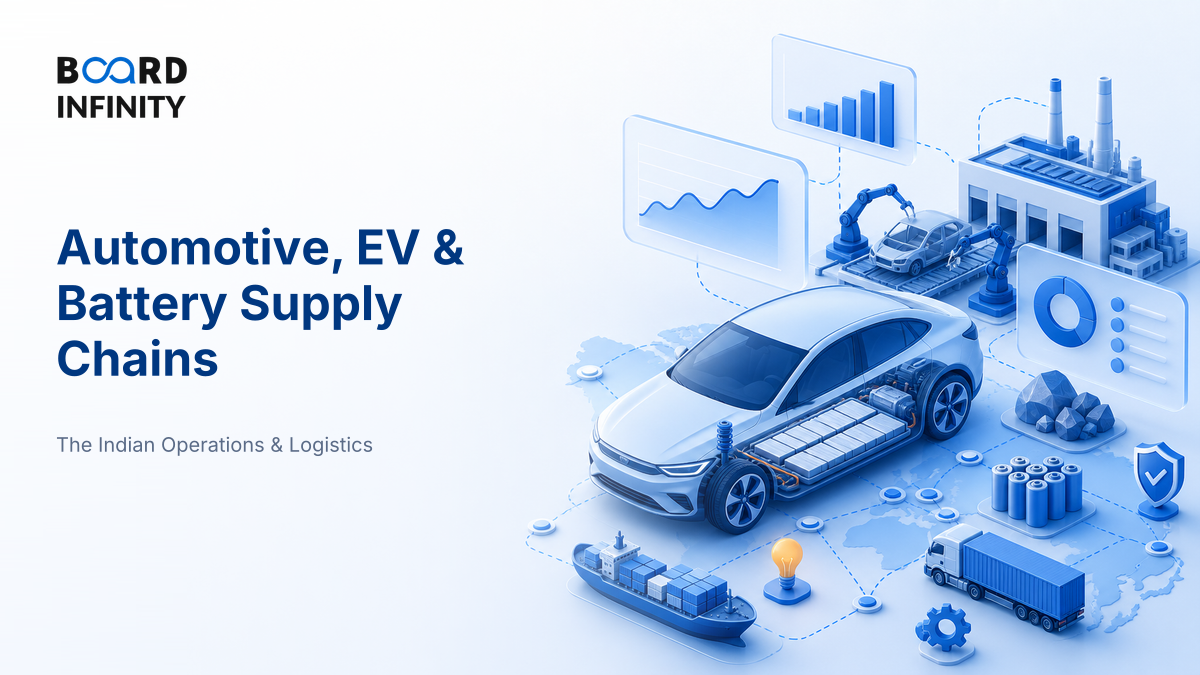
The biggest misconception about EV supply chains is that they are just automobile supply chains with an electric motor added. In reality, the centre of gravity shifts from engines and fuel systems to cells, electronics, software, minerals, thermal safety and charging ecosystems.
- Automotive supply chains are built for high-volume, low-defect, tightly sequenced assembly across thousands of parts.
- EV supply chains reduce many mechanical parts but add battery cells, power electronics, software, charging and thermal-management complexity.
- The battery is the strategic bottleneck: chemistry, cell sourcing, pack design, safety, recycling and warranty economics drive competitiveness.
- OEMs must balance cost, continuity and localisation - cheapest supplier is rarely the best supplier in EVs.
- Key metrics: OTIF, inventory turns, line stoppage hours, supplier PPM, warranty claims and battery yield.
- Interview answer frame: map the chain, identify bottlenecks, evaluate risks, propose operating levers, and close with metrics.
- Common trap: saying “vertical integration solves everything”; it helps only when the capability is strategic and scalable.
Big Picture
An automotive supply chain is a synchronised factory network. An EV and battery supply chain is a synchronised factory network plus an energy-chemistry network. That extra layer changes sourcing power, working capital, safety risk and after-sales economics.
Core Explanation: How the Chain Actually Works
Start with the mental model: automotive supply chains move from forecasted demand to component sourcing to sequenced assembly to distribution and service. EVs add battery chemistry and electronics as new centres of risk.
In an internal-combustion vehicle, the engine, transmission, exhaust and fuel system dominate many engineering and supplier decisions. In an EV, the battery pack, battery management system, motor, inverter, charger, semiconductors and software become mission-critical. That is why an EV supply-chain answer must cover both manufacturing and energy storage.
The Five Building Blocks of Automotive, EV and Battery Supply Chains
1. Demand and Product Planning
Automotive demand is variant-heavy: model, colour, trim, battery size, motor type and region all matter. A wrong forecast does not just create finished-goods inventory - it can strand expensive batteries, semiconductors and imported components.
2. Strategic Sourcing and Supplier Network
OEMs source from tiers. Tier-1 suppliers deliver major systems such as seats, dashboards, braking systems, battery packs or electronics. Tier-2 and Tier-3 suppliers provide sub-components and materials. In EVs, supplier power can be high because qualified cell, chip and electronics vendors are fewer than traditional mechanical-part vendors.
This is where procurement becomes strategic, not clerical. If you need the basics, revise what procurement owns and how it creates value before tackling EV supplier decisions.
3. Manufacturing and Sequencing
Vehicle assembly depends on line balancing, takt discipline, inbound part sequencing and defect prevention. EV assembly may look simpler mechanically, but battery-pack assembly demands process control: insulation, thermal interface, sealing, traceability and end-of-line testing.
4. Logistics, Inventory and Working Capital
Automotive plants run best when components arrive in the right sequence, not merely in bulk. But EV supply chains cannot blindly minimise inventory because critical parts such as cells and semiconductors may have long lead times, volatile availability and high qualification effort.
For policy design, connect this topic with setting inventory policy for a multi-product business - EV components are a classic case where A-class items need different controls from commodity parts.
5. After-Sales, Warranty and Circularity
The supply chain does not end when the vehicle is sold. EV batteries create a service loop: diagnostics, warranty claims, module replacement, second-life use and recycling. A weak after-sales supply chain can destroy margins even when factory output looks strong.
ICE vs EV Supply Chains: What Changes
The Strategic Sourcing Matrix for EV Components
Do not treat all parts equally. A fastener, a battery cell, a semiconductor and a seat cover deserve different supplier strategies. The simple interview move is to classify components by business impact and supply risk.
For strategic EV parts, the right levers are long-term capacity agreements, supplier development, technical collaboration, dual sourcing where feasible, and risk monitoring. For routine parts, the levers are standardisation, catalogue buying and transaction efficiency. This is the logic behind category strategy and the supply positioning matrix.
Metrics to Track in Automotive, EV and Battery Supply Chains
In interviews, metrics separate a serious answer from a generic one. Use a mix of service, cost, quality, resilience and battery-specific measures.
Worked Example: Safety Stock for a Constrained EV Component
Suppose an EV scooter maker uses 1,000 battery management units per week. Lead time from the supplier is 4 weeks. Weekly demand variation is 150 units, and the company wants a service factor of 1.65 for a high service level.
Average lead-time demand = 1,000 x 4 = 4,000 units.
Safety stock = service factor x demand standard deviation x square root of lead time = 1.65 x 150 x √4 = 495 units.
Reorder point = average lead-time demand + safety stock = 4,000 + 495 = 4,495 units.
The lesson: a critical EV part should not be controlled only by average demand. Lead-time risk and demand variability must be built into the reorder point. For deeper AI-led replenishment logic, revise using AI for inventory optimisation and replenishment.
Definitions
- Automotive supply chain: The network that sources, produces, delivers and services vehicles and their components.
- EV supply chain: The automotive supply chain extended to batteries, power electronics, software, charging and circular battery flows.
- Battery supply chain: The chain from battery materials to cells, packs, vehicle use, second life and recycling.
- Tier-1 supplier: A supplier that delivers complete systems or major modules directly to the vehicle manufacturer.
- Battery management system: Electronics and software that monitor and control battery safety, charging, temperature and performance.
Case Study: Ather Energy and India’s Electric Two-Wheeler Supply Chain
Ather Energy shows why EV supply-chain strategy in India is not just about assembling scooters - it is about controlling battery performance, software, supplier quality and service feedback.
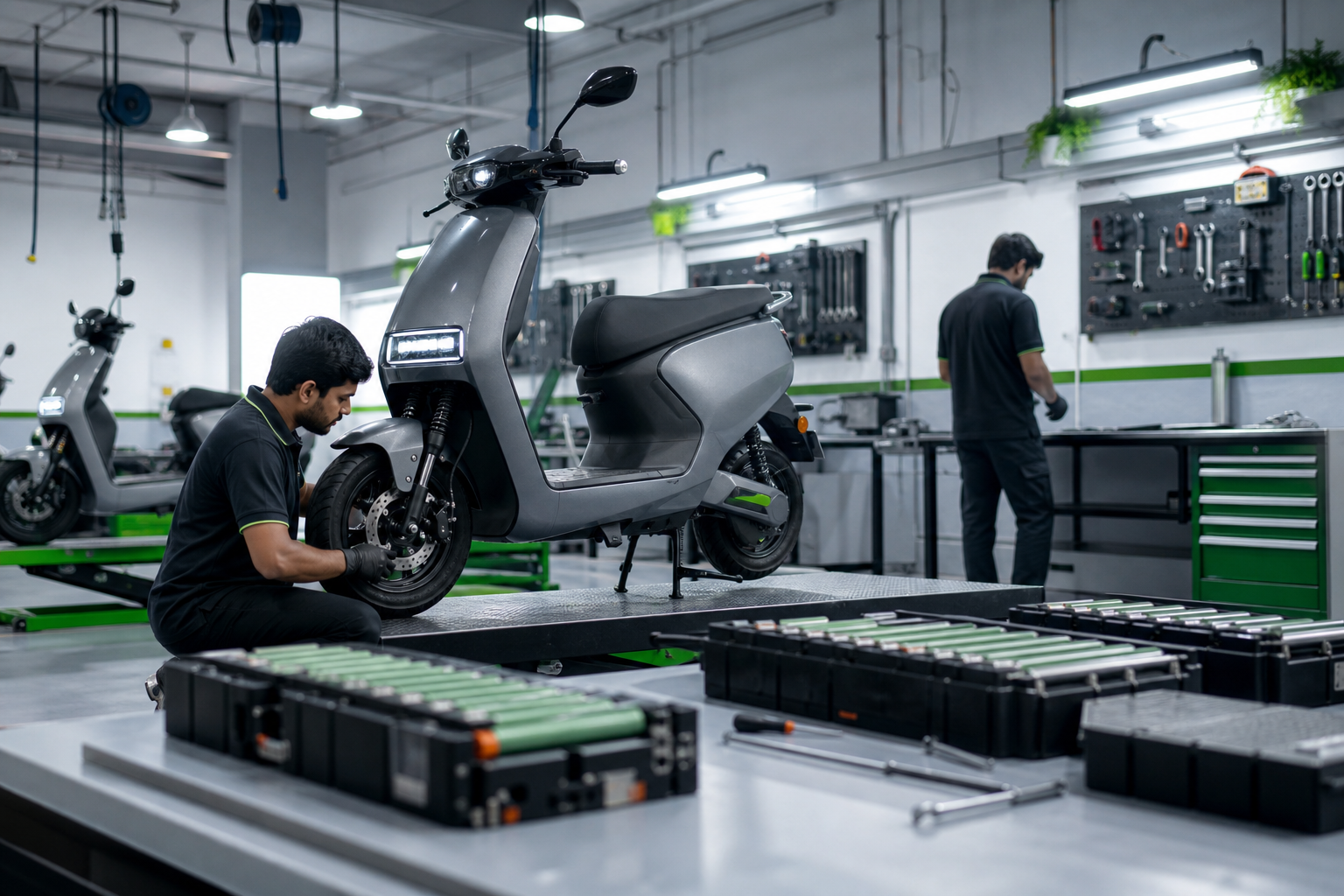
Situation. India’s electric two-wheeler market is demanding: customers expect affordability, range confidence, safety, service access and performance in heat, dust, traffic and monsoon conditions. For a scooter maker, the supply chain must support both manufacturing and the real-world behaviour of the battery on Indian roads.
The move. Ather’s supply-chain logic has centred on treating the battery pack, software and vehicle platform as strategic systems rather than interchangeable bought-out parts. The primary driver is control over the EV performance stack - battery behaviour, vehicle electronics, software updates and diagnostics. Supporting drivers include supplier qualification, manufacturing process discipline, dealer/service feedback, charging ecosystem integration and product design suited to urban Indian usage.
Outcome or lesson. The strategic lesson is not “make everything yourself.” The lesson is sharper: integrate deeply where performance, safety and customer trust depend on system knowledge; partner where scale, cost or specialised manufacturing capability is stronger outside. For an MBA answer, this is a balanced view of vertical integration.
So what: EV winners need a supply chain that is product-aware. The best chain is not merely the lowest-cost chain; it is the chain that protects range, safety, uptime, warranty economics and customer trust.
How AI Changes Automotive, EV and Battery Supply Chains
AI changes this topic in three concrete ways.
- Demand sensing and inventory allocation: ML models can combine bookings, dealer enquiries, seasonality, campaign effects and regional signals to improve variant-level planning.
- Battery quality and predictive diagnostics: AI can detect early patterns in charging behaviour, temperature anomalies and degradation signals, helping teams prevent warranty spikes.
- Supplier and logistics risk monitoring: AI tools can scan supplier delays, quality trends, port disruptions and geopolitical signals to flag risk before the assembly line is hit.
Student workflow: Use ChatGPT or Claude to create an interview prep map. Prompt: “Act as an EV supply-chain consultant. Build a risk map for an Indian electric two-wheeler OEM covering cells, chips, motors, chargers, logistics, warranty and recycling. Give mitigation levers and KPIs for each risk.” Then compare the output with your own logic - do not memorise it blindly.
Interview Relevance
“How is an EV supply chain different from a traditional automotive supply chain, and what should an Indian OEM prioritise?”
If asked for a recommendation, do not jump to “localise everything.” Say: localise where it reduces risk or improves cost at acceptable quality; partner globally where capability, chemistry or scale is not yet economical.
Common Mistake
The mistake: treating EV supply chains as a simple parts-procurement problem. This costs candidates because it ignores battery chemistry, safety, software, warranty and circularity. Fix: always answer with the full loop - source, build, sell, service, learn and recycle.