
Renewable Energy Manufacturing and Solar Supply Chains
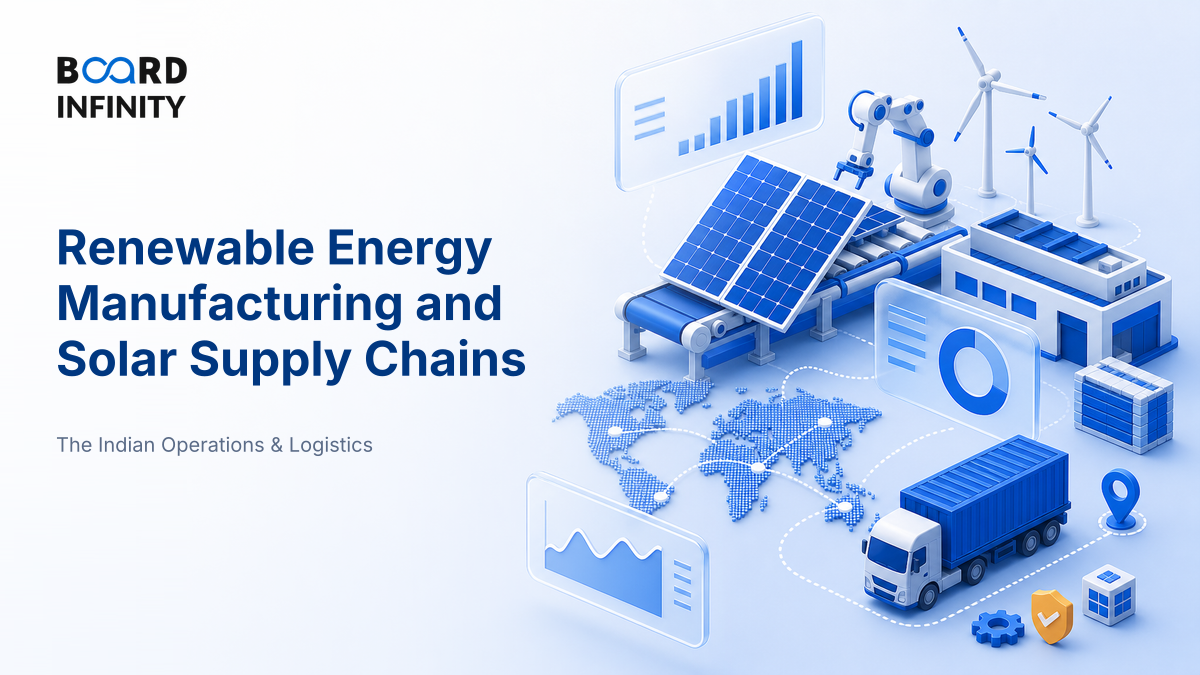
A solar project can have land, financing, grid approval and buyers ready - and still miss commissioning because one upstream input is stuck: a cell line, a wafer shipment, a glass batch or an inverter component. That is the real tension in renewable energy manufacturing: the energy transition is visible on rooftops, but it is won or lost inside supply chains.
- Solar supply chains are layered: raw material to polysilicon, wafers, cells, modules, balance-of-system, EPC installation and after-sales service.
- Manufacturing depth matters: module assembly is easier; cell, wafer and polysilicon integration gives more control but needs higher capex and process capability.
- The core trade-off is cost vs resilience: lowest-cost global sourcing can raise exposure to logistics shocks, policy changes and single-country dependency.
- Interview answers should separate demand, supply, manufacturing and policy risk instead of saying only “solar is growing.”
- Key KPIs: conversion efficiency, manufacturing yield, cost per watt, OTIF, inventory days and warranty claims.
- India’s opportunity is not just demand: the strategic question is how much of the value chain can be manufactured domestically at competitive quality and cost.
- AI is changing the game through forecasting, quality inspection, predictive maintenance and supplier-risk sensing.
Big Picture - Solar Is an Energy Product With a Manufacturing Backbone
Do not think of solar only as a power-generation industry. Think of it as a precision manufacturing and supply-chain system where every layer adds cost, risk and control. The higher you move up the chain, the closer you get to the finished module; the deeper you integrate downward, the more control you gain over bottlenecks.
Core Explanation - How the Solar Supply Chain Actually Works
A solar PV supply chain covers every activity required to convert raw materials into electricity-generating photovoltaic modules and deliver them into operating projects. The chain has three broad zones: upstream materials, midstream manufacturing and downstream deployment.
Upstream includes quartz, metallurgical-grade silicon, polysilicon, glass, silver paste, aluminium frames and other inputs. Midstream includes ingot, wafer, cell and module manufacturing. Downstream includes engineering, procurement and construction, installation, grid connection, monitoring, maintenance and recycling.
The industry’s biggest structural issue is concentration. The International Energy Agency reported that China’s share in all key solar PV manufacturing stages exceeded 80% in its 2022 report on solar PV global supply chains. The strategic implication is simple: solar may be a clean-energy story, but supply assurance is a manufacturing and geopolitics story.
The Four Decisions That Shape a Solar Manufacturing Strategy
Most MBA answers become strong when they move from “renewable energy is growing” to the four decisions a manufacturer or developer must actually make.
If you want to deepen the procurement side, revise supplier selection, scorecards and evaluation, because solar buying decisions depend heavily on quality history, bankability, delivery reliability and warranty strength. For high-value components, should-cost analysis and cost breakdown modelling is the natural next skill.
Key KPIs to Track in Solar Manufacturing and Supply Chains
Interviewers like this topic because it reveals whether you can connect operations metrics to business outcomes. Use metrics that show quality, cost, reliability and working-capital control.
The best candidates do not quote these as isolated ratios. They explain the operating logic: higher yield reduces cost per watt; better supplier OTIF protects project commissioning; lower warranty claims improve bankability and customer trust.
Definitions You Can Say in One Breath
- Renewable energy manufacturing: Industrial production of equipment that converts renewable resources into usable energy.
- Solar PV supply chain: The network converting raw inputs into photovoltaic modules and installed solar power systems.
- Solar cell: The semiconductor unit that converts sunlight into direct-current electricity.
- Solar module: Multiple solar cells laminated and framed into a durable panel for field installation.
- Balance of system: Non-module equipment such as inverters, mounting structures, cables, trackers and protection systems.
- Bankability: Buyer and lender confidence that a solar supplier can deliver reliable long-term performance and honour warranties.
Case Study - First Solar: Supply Chain Strategy Through Technology Choice
First Solar shows how a renewable manufacturer can reduce dependency on the dominant crystalline-silicon chain by choosing a different technology and manufacturing architecture.
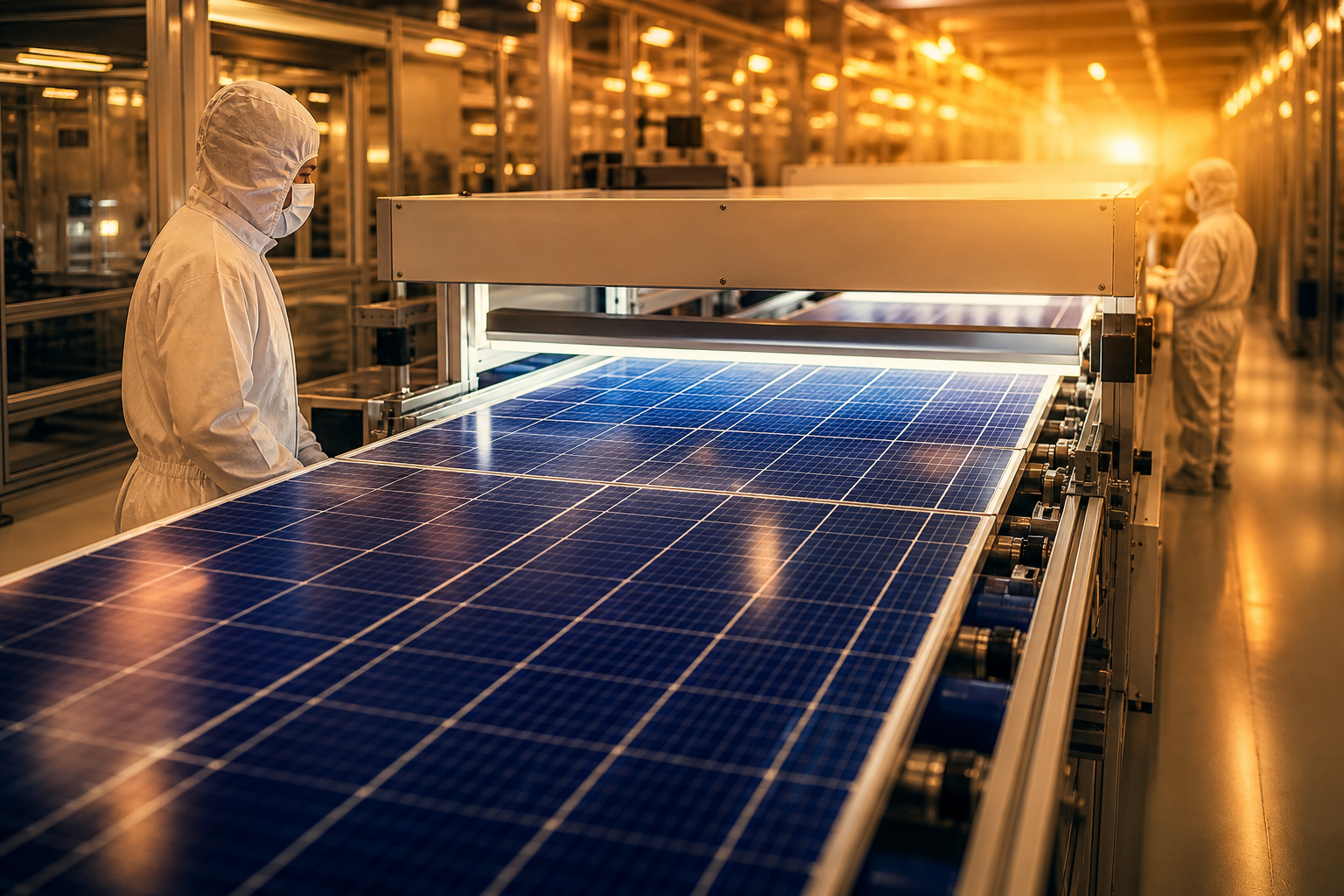
Most solar PV modules globally use crystalline-silicon technology, which depends on the polysilicon-wafer-cell-module chain. First Solar built its strategy around cadmium telluride thin-film modules and a more vertically integrated manufacturing process, a direction the company describes in its public investor materials on First Solar Investor Relations.
Situation: Solar demand was rising, but the mainstream crystalline-silicon chain exposed manufacturers and developers to concentrated upstream capacity, price cycles and policy risk. For buyers of large utility-scale projects, the concern was not only module price; it was whether supply would arrive reliably and perform over decades.
The move: First Solar differentiated on technology and manufacturing depth. Its primary driver was technology-based supply-chain separation: thin-film manufacturing avoids the same wafer-based bottlenecks as crystalline-silicon modules. Supporting drivers included vertical process control, long-term utility-scale customer relationships, quality traceability and manufacturing footprints closer to key demand regions, including India.
Outcome and lesson: The lesson is not “thin film always wins.” The lesson is sharper: in renewable manufacturing, technology architecture can be a supply-chain strategy. A company can compete not only by buying cheaper inputs, but by redesigning dependency itself.
For an Indian MBA answer, the implication is powerful. India’s solar opportunity is not limited to installing more capacity; it also lies in building credible domestic capability in modules, cells, equipment, quality systems and supplier ecosystems. But this requires more than announcing capacity - it requires process yield, qualified suppliers, working capital discipline and long-term buyer confidence.
How AI Changes Renewable Energy Manufacturing and Solar Supply Chains
AI is not a buzzword add-on here. It directly attacks the pain points of solar manufacturing: demand volatility, quality variation, equipment downtime and supplier risk.
A practical student workflow: load a solar manufacturer’s annual report, a recent industry article and your notes into NotebookLM; ask it to generate a supplier-risk map, five likely interview questions and a one-page brief on working-capital pressure. For replenishment logic, connect this with using AI for inventory optimisation and replenishment.
Interview Relevance
“India wants to build domestic solar manufacturing. What supply-chain challenges should a company solve before scaling?”
A strong answer sounds like an operations leader: “I would not scale capacity alone; I would scale qualified supply, process yield, buyer bankability and risk visibility together.”
Common Mistake
Mistake: treating solar as a simple demand-growth story. Candidates say “renewables are growing, so manufacturing will grow” and stop there. Why it costs marks: it ignores upstream concentration, technology choice, yield, quality, policy and working capital. One-line fix: always answer through the chain - materials, manufacturing, suppliers, projects, policy and KPIs.