
BCG Matrix Explained: Stars, Cash Cows, Dogs & Question Marks
After the AIDA Model maps how customers move through the journey, the BCG Matrix answers a different strategy question: where should a company allocate resources across products or business units? It matters in interviews because it turns portfolio analysis into clear decisions: invest, harvest, divest, or selectively build.
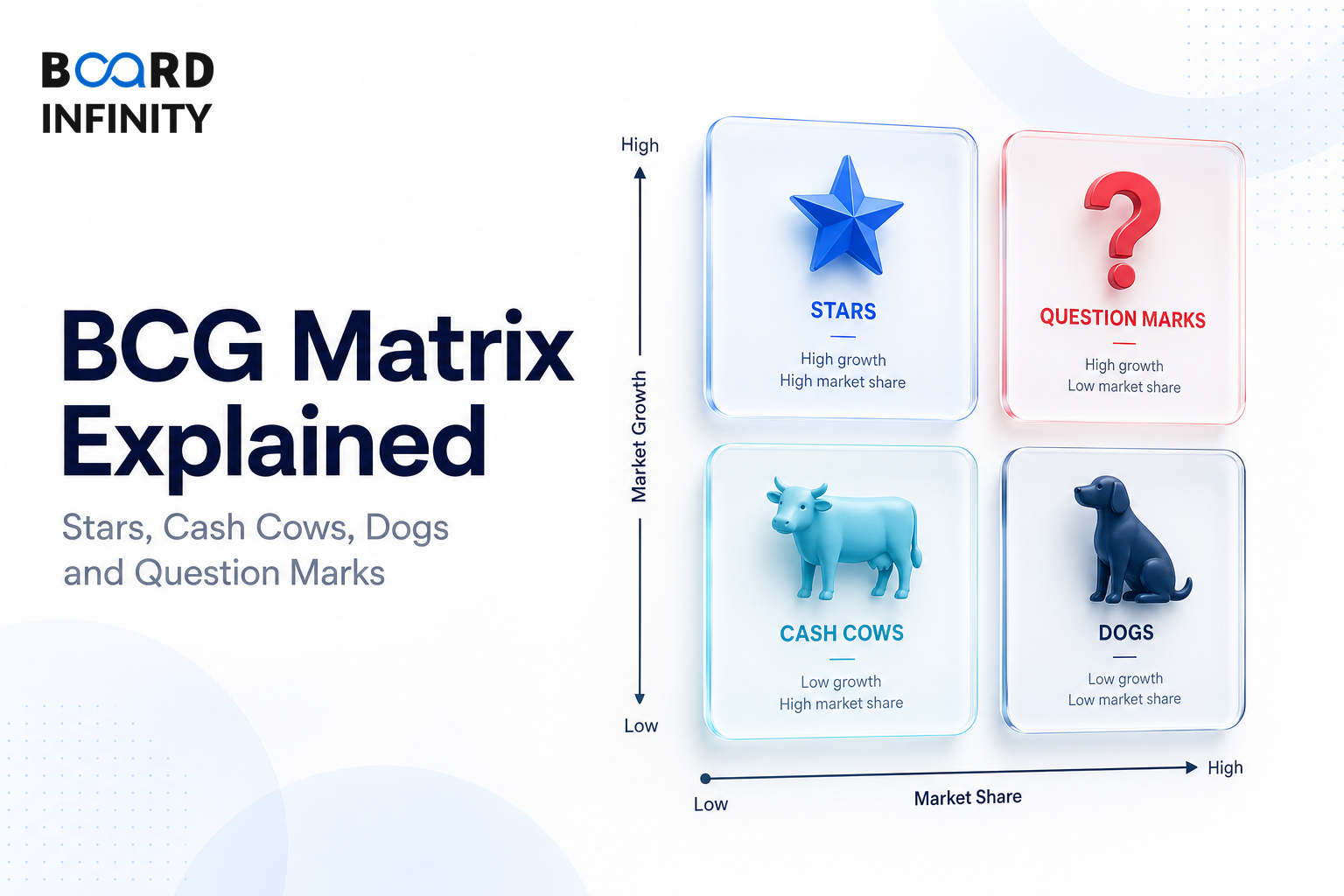
- The Boston Consulting Group (BCG) Growth-Share Matrix classifies a company's business units or products based on two dimensions: market growth rate and relative market share.
- Stars are high growth, high share businesses with moderate cash flow, where the strategy is to invest heavily to maintain leadership.
- Cash Cows are low growth, high share businesses with high cash flow, where the strategy is to maintain position and fund Stars and Question Marks.
- Question Marks are high growth, low share businesses with negative cash flow, where the strategy is to invest selectively to gain share or divest.
- Dogs are low growth, low share businesses with low or negative cash flow, where the strategy is to divest, harvest, or reposition.
- Cash generated by Cash Cows should fund investment in Stars and promising Question Marks, while Dogs should be divested unless they serve a strategic purpose.
Big Picture: Portfolio Analysis Using Growth and Share
The BCG Matrix is used for portfolio analysis and product portfolio or resource allocation cases. It compares market growth rate with relative market share to decide whether a business unit or product should receive more investment, be maintained, be harvested, or be divested.
The Boston Consulting Group (BCG) Growth-Share Matrix classifies a company's business units or products based on two dimensions: market growth rate and relative market share.
Stars
Stars have high growth and high share. Their cash flow is moderate because they require investment, and the strategy is to invest heavily to maintain leadership.
Indian examples include Jio in telecom and Zepto in quick commerce. In an interview answer, Stars signal businesses that are already strong in attractive markets, so the decision is not to harvest too early but to maintain leadership.
Cash Cows
Cash Cows have low growth and high share. Their cash flow is high, and the strategy is to maintain position and fund Stars and Question Marks.
Indian examples include Dairy Milk in chocolates and Surf Excel in detergents. The strategic logic is that Cash Cows generate cash that can support investment elsewhere in the portfolio.
Question Marks
Question Marks have high growth and low share. Their cash flow is negative because they require investment, and the strategy is to invest selectively to gain share or divest.
Indian examples include Tata Neu app and Flipkart's grocery vertical. The decision is selective because a Question Mark may be built into a Star, but it may also need to be divested if it cannot gain share.
Dogs
Dogs have low growth and low share. Their cash flow is low or negative, and the strategy is to divest, harvest, or reposition.
Indian examples include declining print media brands and feature phones. Dogs should be divested unless they serve a strategic purpose, such as completing a product line.
Strategic Implications
Cash generated by Cash Cows should fund investment in Stars to maintain leadership and promising Question Marks to build into Stars. Dogs should be divested unless they serve a strategic purpose, such as completing a product line.
This is the core of the BCG Matrix as a portfolio decision tool: it is not just a classification exercise, but a way to connect cash generation with investment priorities.
Structuring a BCG Matrix Explained Interview Answer
"Explain the BCG Matrix with Indian examples."
Do not stop at listing the quadrants. The strongest answer links each quadrant to a decision: invest heavily, maintain and fund, invest selectively or divest, and divest, harvest, or reposition.
The most frequent error is treating the BCG Matrix as only a labelling tool: Stars, Cash Cows, Question Marks, and Dogs. That costs points because the strategic implication is the core: Cash Cows should fund Stars and promising Question Marks, while Dogs should be divested unless they serve a strategic purpose.
Conclusion
The BCG Matrix is a portfolio strategy tool for deciding where to invest, harvest, divest, or selectively build. Its value comes from linking market growth and relative market share to resource allocation decisions across a company's products or business units.