
Product Life Cycle: The 4 Stages Explained
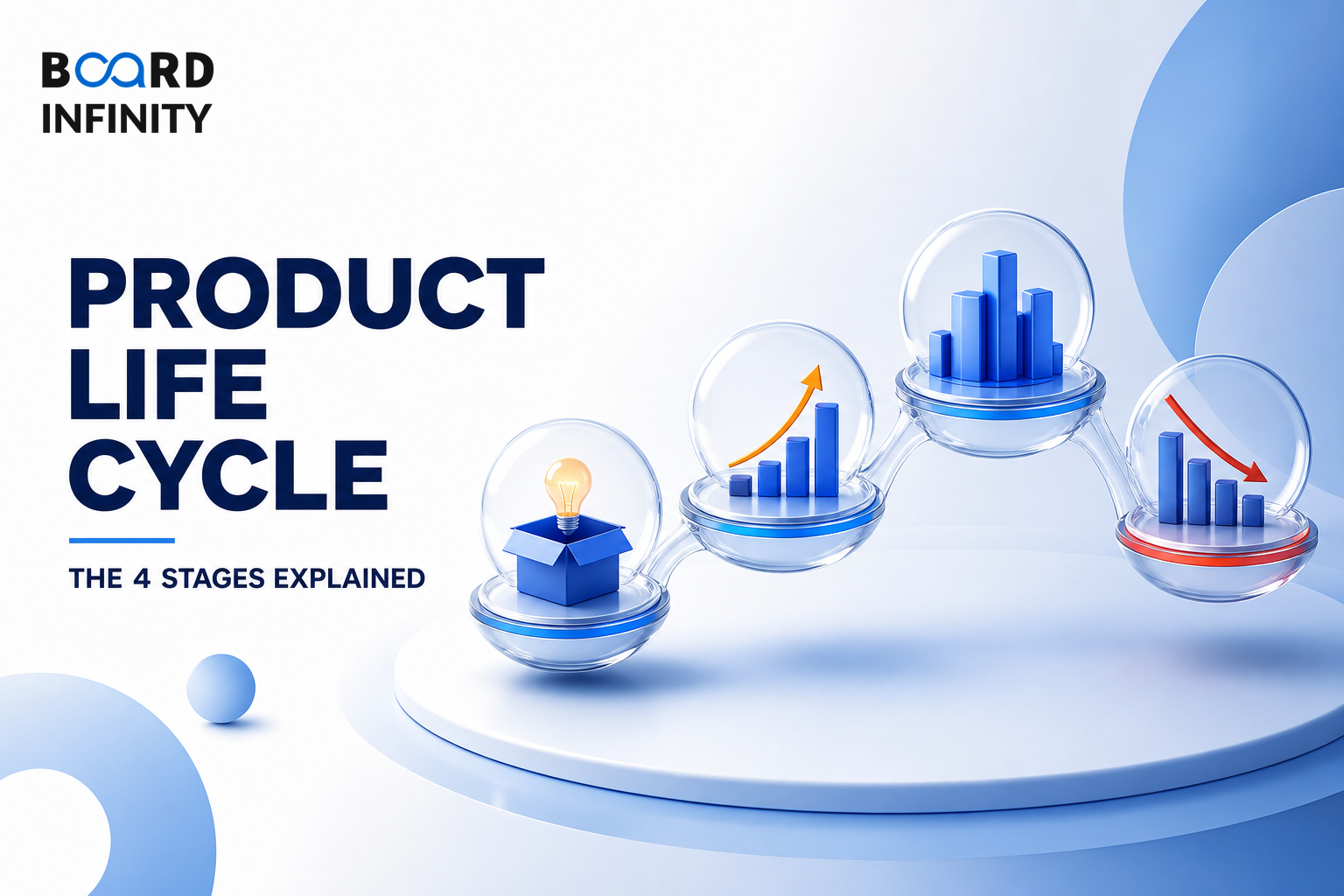
Keller's Brand Equity Model, also called the CBBE Pyramid, explains how a brand builds from Salience to Resonance. Product Life Cycle, or PLC, answers a different interview question: every product passes through distinct life stages, each requiring different marketing strategies. Understanding PLC helps marketers anticipate changes and adjust tactics proactively, especially when diagnosing whether pricing, promotion, product, or distribution strategy should change before performance shifts become obvious.
- Every product passes through distinct life stages, each requiring different marketing strategies.
- The four PLC stages are Introduction, Growth, Maturity, and Decline.
- Introduction has low sales, high costs per customer, negative profits, and innovators as customers.
- Growth has rapidly rising sales, declining costs per customer, rising profits, and early adopters as customers.
- Maturity has peak, then plateau sales, lowest costs per customer, high but plateauing profits, and mass market customers.
- Decline has falling sales, low costs per customer, falling profits, and laggards as customers.
- PLC is descriptive, not predictive - hard to know which stage you are in until after the fact.
Product Life Cycle as a Big Picture Framework
Product Lifecycle Curve maps Sales / Revenue over Time: Introduction, Growth, Maturity, Decline. The framework is useful because each stage has a different pattern of sales, costs, profits, customers, competitors, and marketing strategy.
How Product Performance Changes Across the PLC
The first diagnosis in PLC is to identify how the product is behaving on sales, costs, profits, and customer adoption. This helps decide whether the product needs awareness-building, share capture, differentiation, loyalty, revitalisation, harvesting, or exit.
Marketing Strategy at Each PLC Stage
Once the stage is diagnosed, the strategy should change across product, price, promotion, and distribution. This is the practical use of PLC in marketing cases: the same product should not be managed the same way in Introduction, Growth, Maturity, and Decline.
PLC Limitations
PLC is helpful, but it should not be treated as a perfect forecasting tool. Its limitations matter in interviews because they prevent overconfident answers.
Indian Examples of Product Life Cycle Stages
PLC becomes easier to apply when products are mapped to their current market stage. Indian examples include Feature phones in Decline, Electric Vehicles in Growth, Quick Commerce - Zepto/Blinkit in Early Growth, UPI Payments in Late Growth/Early Maturity, and DTH TV in Early Decline.
Quick Commerce - Zepto/Blinkit is in Early Growth, while UPI Payments is in Late Growth/Early Maturity. The strategic so what is that Zepto/Blinkit should be read through a growth lens, while UPI Payments should be diagnosed closer to maturity signals like peak, then plateau sales and maximum coverage & efficiency.
Structuring a Product Life Cycle Interview Answer
"What is the product life cycle (PLC)? Marketing strategy at each stage?"
The PLC is essentially a blueprint for how your marketing strategy must evolve. Do not describe the stages only - link each stage to sales, profit, customers, product strategy, price strategy, promotion strategy, and distribution.
The most frequent error is treating PLC as predictive instead of descriptive. This costs points because it is hard to know which stage you are in until after the fact, and not all products follow this pattern - some skip stages.
Conclusion
Product Life Cycle helps marketers diagnose whether a product is in Introduction, Growth, Maturity, or Decline, and then adjust product, price, promotion, and distribution strategy accordingly. Use it as a practical stage-based strategy tool, while remembering its core limitation: it describes patterns, but does not perfectly predict them.