
The 4Ps and 7Ps Marketing Mix: From Positioning to Execution
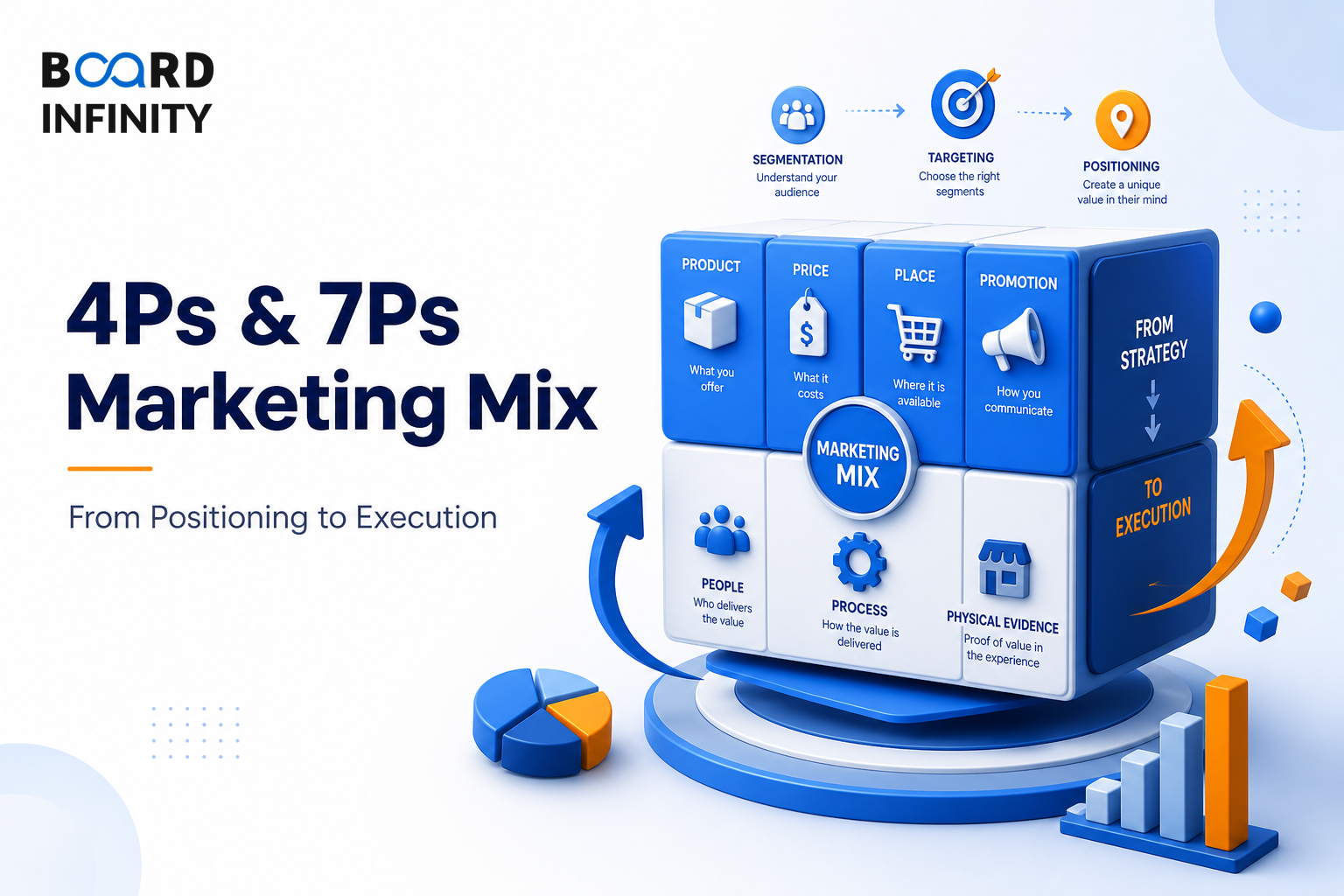
The STP Framework - Segmentation, Targeting and Positioning - helps a firm decide which customers to serve and what meaning it wants to own in their minds. The marketing mix answers the next interview question: once positioning is chosen, what exactly should the company do in the market? This lesson explains how the 4Ps and 7Ps convert strategy into customer-facing decisions across product, price, place, promotion and service delivery.
- The marketing mix is the set of tactical tools a firm uses to produce the desired response from its target market.
- The original 4Ps are Product, Price, Place and Promotion, introduced by McCarthy in 1960.
- The 7Ps extend the framework for services by adding People, Process and Physical Evidence, introduced by Booms and Bitner in 1981.
- Product can be analysed through Kotler's 5 Product Levels: core, generic, expected, augmented and potential product.
- Price is the only P that generates revenue; all other Ps are costs.
- Place covers distribution strategy and channel levels, from direct selling to multi-layer rural FMCG distribution.
- In interviews, strong answers connect the mix to the chosen target market and positioning, instead of listing the Ps mechanically.
The Big Picture: From Positioning to Marketing Mix
The marketing mix sits between strategic intent and market execution. Positioning defines what the brand wants to stand for; the Ps make that positioning visible through the product offered, the price charged, the channels used, the communication chosen and, for services, the delivery experience.
The marketing mix is the set of tactical tools a firm uses to produce the desired response from its target market.
Coca-Cola is used as an example of intensive distribution because it is available in every kirana store across India. The strategic point is that when convenience is key, Place must support the positioning by making the product easy to find and buy.
What the 4Ps Really Do
The 4Ps - Product, Price, Place and Promotion - were originally presented by McCarthy in 1960. They are useful because they force a candidate to move from a broad positioning statement to concrete, controllable decisions.
In many organisations, ownership of these levers may overlap across product, sales, marketing and distribution teams. However, for case interviews, the important point is to show that these levers must work together. A premium product with mass discounting, or a convenience product with limited availability, can create a mismatch between positioning and execution.
Product: Kotler's 5 Product Levels
Product is not just the physical item or basic service. Kotler's 5 Product Levels show that buyers experience a product at multiple layers, from the fundamental benefit to possible future enhancements.
This is especially useful in interviews because it prevents shallow answers such as “improve features.” Instead, you can identify whether the issue lies in the core benefit, expected attributes, augmentation or future differentiation.
AC means Air Conditioning, OTA means Over-the-Air updates, AR means Augmented Reality and AI means Artificial Intelligence. In a case answer, these terms matter only when they clarify how the product creates value. For example, a smartphone is not only a device for calls; at higher levels, it may include an ecosystem such as iCloud or potential integration with AR glasses and an AI assistant.
Price: The Revenue Lever
Price has a special role in the marketing mix because it is the only P that generates revenue; all others are costs. Product development, distribution and promotion typically require spending, while price is where the firm captures value from the market.
In an interview, avoid treating price as a random number or a discount lever. The better answer is to ask what the target customer values, how the product is positioned and whether the price supports the desired response. Depending on the business model, a higher price may reinforce a premium position, while a lower price may support accessibility or volume.
Price is the only P that generates revenue; all other Ps are costs.
Place: Distribution Strategy and Channel Levels
Place, or distribution, determines how products reach the end consumer. This is where positioning becomes operational: a product built for convenience must be widely available, while a product built for exclusivity may deliberately limit outlets.
The three strategies differ mainly in reach and control. Intensive distribution maximises availability, selective distribution balances access with brand control, and exclusive distribution creates tighter control over the customer experience.
D2C means Direct-to-Consumer, where the manufacturer sells directly to the buyer. FMCG means Fast-Moving Consumer Goods, typically products that move through high-volume retail channels. The practical interview nuance is that more channel layers can improve reach, especially in contexts such as rural FMCG distribution, but they can also make execution more complex.
Promotion: Communicating the Offer
Promotion covers the communication tools used to influence the target market. The source identifies advertising, sales promotion, personal selling, PR, direct marketing and digital marketing as part of this P.
PR means Public Relations, or managing public communication and reputation. In a case answer, Promotion should not be reduced to “run ads.” A stronger answer asks what message should be communicated, which channel fits the target market and whether the communication reinforces the same positioning as the product, price and place choices.
Why Services Need the 7Ps
The 7Ps extend the 4Ps for services by adding People, Process and Physical Evidence, as described by Booms and Bitner in 1981. Services need these extra levers because the customer experience is shaped not only by what is offered, but also by who delivers it, how consistently it is delivered and what tangible cues signal quality.
People matter because service quality is often delivered through staff behaviour. Process matters because customers notice friction, delays and inconsistency. Physical Evidence matters because services can feel intangible, so visible and sensory cues such as interiors, branded cups, aroma and WiFi help signal quality.
Worked Example: Coca-Cola and Intensive Distribution
This example shows how to use the marketing mix as a bridge from positioning to execution rather than as a checklist.
The strategic “so what” is simple: Place is not a back-end logistics detail. It is a customer-facing decision that must match the positioning and buying behaviour of the target market.
Comparing 4Ps and 7Ps
The 4Ps are sufficient for analysing many product-led cases. The 7Ps become more useful when the customer's experience depends heavily on service delivery, employee behaviour, process design or tangible quality cues.
How to Use the Marketing Mix in a Case
A good case answer starts with the business objective and target market, then chooses the Ps most relevant to the problem. You do not need to force every P into every answer with equal weight. In many cases, one or two levers will be the real bottleneck.
Structuring a The 4Ps and 7Ps Marketing Mix Interview Answer
"After choosing a target segment and positioning, how would you convert the strategy into marketing execution using the 4Ps or 7Ps?"
The best candidates do not recite the Ps. They explain which P is most important for the situation and why that lever best converts positioning into execution.
Conclusion
The 4Ps and 7Ps are most powerful when used as a bridge between positioning and action. If you can show how each tactical lever shapes the customer's response, you will sound structured, practical and interview-ready.
The most frequent error is treating the marketing mix as a memory list rather than a decision framework. This costs points because it misses the central logic: the Ps must work together to produce the desired response from the chosen target market!