
GE-McKinsey Nine-Box Matrix: Portfolio Prioritization Guide
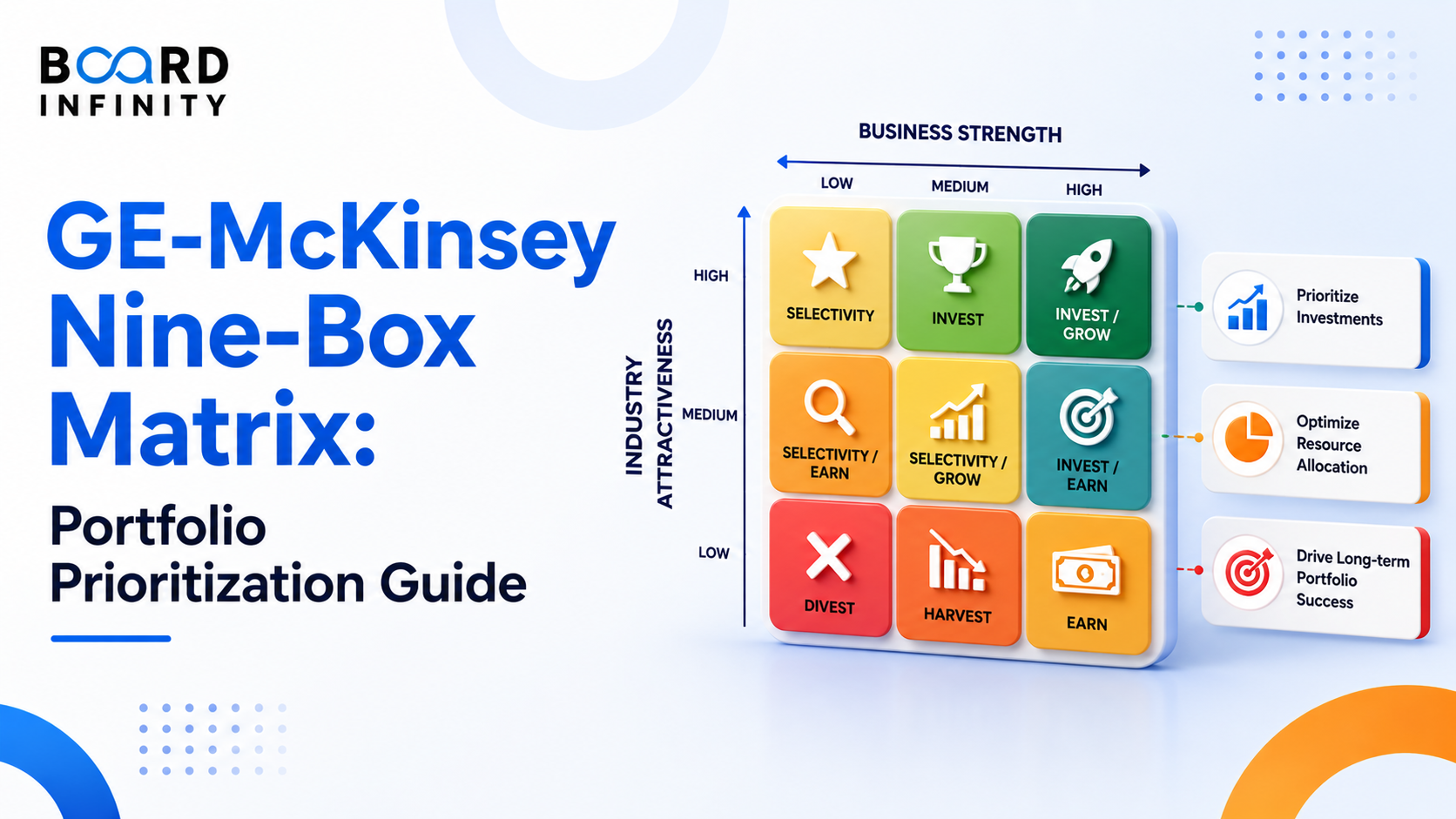
The Product Life Cycle (PLC) Explained showed how a product changes across its life stages; the GE-McKinsey Nine-Box Matrix answers a broader portfolio question: which businesses deserve resources, which should be managed selectively, and which should be harvested or exited. It matters in interviews because it forces you to compare opportunities on two composite dimensions, not on a single headline metric. You will learn how to read the nine boxes, what factors sit behind each axis, and how to convert the matrix into invest, select, harvest, or divest decisions.
- The GE-McKinsey Matrix is a more sophisticated alternative to the BCG Matrix for portfolio prioritization.
- It uses two composite dimensions: Industry Attractiveness and Business Unit Strength.
- Each dimension is rated High, Medium, or Low, creating a nine-box decision grid.
- Industry Attractiveness is assessed using factors such as market size, growth rate, profitability, competitive intensity, technological requirements, environmental impact, and regulatory environment.
- Business Unit Strength is assessed using factors such as market share, brand strength, production capacity, relative profit margins, technological capability, and management quality.
- The main actions are INVEST / GROW, SELECTIVITY / EARNINGS, and HARVEST / DIVEST.
- The strongest portfolio moves usually come from linking the cell position to a clear resource decision, not from merely labeling the business.
The Big Picture: Portfolio Decisions in Nine Boxes
The matrix works by plotting every business unit against two ratings: how attractive the industry is and how strong the business unit is within that industry. The output is not just a classification exercise; it is a resource allocation view that links each box to an action.
What the GE-McKinsey Matrix Is
The GE-McKinsey Matrix is a portfolio prioritization tool used to compare multiple business units and decide where resources should be allocated. It is described as a more sophisticated alternative to the BCG Matrix because it does not rely on a single simple measure for each axis; instead, it uses composite ratings.
A composite dimension means the score is built from several factors rather than one isolated number. For example, Industry Attractiveness is not just about growth rate; it also includes market size, profitability, competitive intensity, technological requirements, environmental impact, and regulatory environment. Similarly, Business Unit Strength is not just market share; it includes brand strength, production capacity, relative profit margins, technological capability, and management quality.
This is why the tool is useful in case interviews. A candidate can avoid jumping straight to “invest” or “exit” and instead show structured thinking: first assess the market, then assess the company position, then choose the portfolio action.
Industry Attractiveness: Is the Market Worth Playing In?
Industry Attractiveness measures how appealing the industry is as a place to compete. In the GE-McKinsey Matrix, it is rated as High, Medium, or Low based on multiple factors rather than one signal.
The important nuance is that Industry Attractiveness is not the same as current sales. A market can be large but difficult because competitive intensity is high, or attractive in growth but demanding because technological requirements are significant. In many interview answers, the best approach is to list the factors, explain which ones matter most for the case, and then assign a High, Medium, or Low rating.
Business Unit Strength: Can the Business Win There?
Business Unit Strength measures how well the business unit is positioned to compete in that industry. It is also rated High, Medium, or Low using a group of internal and relative factors.
This axis prevents a common error: assuming an attractive market automatically deserves investment. A business may operate in a high-attractiveness industry but still be weak because it lacks market share, brand strength, production capacity, technological capability, or management quality. In that case, the matrix does not blindly recommend full investment; it can suggest specialization or a niche strategy.
How the Matrix Converts Ratings into Decisions
Once both axes are rated, the business unit falls into one of nine boxes. Each box points to a different strategic posture: INVEST / GROW, SELECTIVITY / EARNINGS, or HARVEST / DIVEST.
The top-left area of the matrix is where businesses typically deserve more attention because the market is attractive and the business unit has the strength to compete. The bottom-right area is where continued investment becomes harder to justify because the industry is less attractive and the unit is weak. The middle cells require judgment; they are not automatic “yes” or “no” decisions.
How to Build and Use the Matrix
A clean GE-McKinsey answer follows a process: define the units, rate the industry, rate the business unit, locate the box, and then recommend a decision. This keeps the recommendation linked to evidence rather than intuition.
The sequence matters because the same action can have different logic in different boxes. For example, a strong business in a medium-attractiveness industry can receive selective investment, while a medium business in a high-attractiveness industry may be built selectively. Both are investment-oriented, but the emphasis is different.
Worked Example: Reading a Portfolio Decision
The following worked example is an interview-style reading of the matrix. It uses only the rating logic of the framework: situation, problem, framework, decision, outcome, and learning.
The main lesson is that the matrix separates market quality from company capability. If the same unit were weak despite high attractiveness, the recommendation would shift to SELECTIVITY / EARNINGS - Specialize or niche, not automatic full investment.
GE-McKinsey Matrix vs the Simpler BCG Reference Point
The source idea behind using the GE-McKinsey Matrix as an interview framework is that it improves on a simpler portfolio view by using composite dimensions. Rather than forcing a decision from narrow indicators, it allows a broader discussion of market context and business unit capability.
In an interview, the comparison should not become a theory lecture. Use it to justify why you are choosing the GE-McKinsey Matrix: the case likely needs a richer assessment of both the industry and the business unit before committing resources.
Practical Nuances Candidates Should Mention
The matrix is powerful, but it still depends on the quality of the ratings. If the inputs are vague, the output will look structured but remain weak. A strong answer explains the factors used for each axis and then states the rating clearly.
- Do not treat High, Medium, and Low as decoration. The rating must drive the cell and the cell must drive the action.
- Do not over-invest in every attractive market. If Business Unit Strength is weak, the matrix may recommend specialization or a niche approach.
- Do not ignore medium cells. Medium positions often require selective investment, earnings management, refocusing, limiting investment, or minimizing investment.
- Do not collapse the two axes into one score. Industry Attractiveness and Business Unit Strength answer different questions.
Structuring a GE Interview Answer
"Our client has multiple business units and limited capital. How would you decide where to invest, where to manage for earnings, and where to divest?"
The number one way candidates get this wrong is by jumping to the action before rating both axes. In a strong answer, the recommendation comes after you have explained why the industry is attractive or unattractive and why the business unit is strong, medium, or weak.
Conclusion
The GE-McKinsey Nine-Box Matrix is a practical portfolio tool for turning market attractiveness and business unit strength into resource decisions. Its value comes from disciplined comparison: rate both axes, place the business in the correct box, and then choose whether to invest, grow, manage selectively, harvest, or divest.
The most frequent mistake is treating the matrix as a labeling chart instead of a decision tool. If you stop at “High attractiveness, Medium strength” without translating it into INVEST / GROW - Build selectively, you lose the strategic point of the framework!