
Ansoff Matrix - Four Growth Strategies Explained
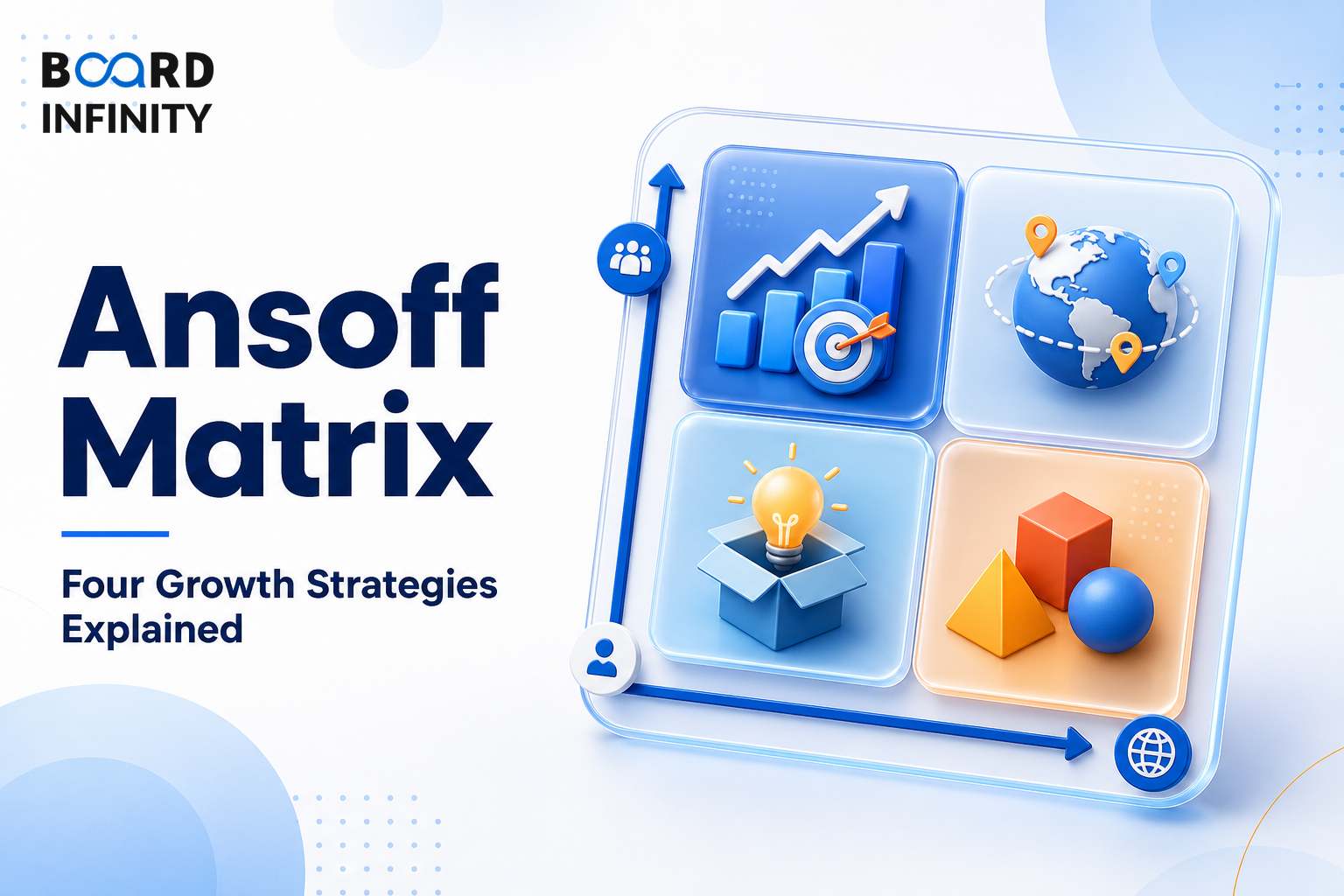
xThe BCG Growth-Share Matrix helps a firm manage its product portfolio, but it does not directly answer the next strategic question: where should growth come from? The Ansoff Matrix answers that by mapping growth options across existing and new products, and existing and new markets. In interviews, this matters because it gives you a clean way to compare strategic moves by risk rather than listing growth ideas randomly.
- The Ansoff Matrix, developed by Igor Ansoff, helps firms evaluate growth options using product-market combinations.
- It has four strategies: market penetration, market development, product development, and diversification.
- Risk increases as a firm moves away from existing products and existing markets.
- Market penetration is the lowest-risk option because the firm sells existing products in existing markets.
- Diversification is the highest-risk option because the firm enters new markets with new products.
- Aashirvaad illustrates penetration, market development, and product development through distribution, geographic expansion, and new product launches.
- ITC is a textbook example because it has used all four growth strategies across cigarettes, Aashirvaad, Sunfeast, Bingo, hotels, paperboards, IT services, and agri-business.
At a glance, the Ansoff Matrix is a two-by-two product-market map. The simplest way to read it is to start from the familiar bottom of risk - existing products and existing markets - and then move outward.
What the Ansoff Matrix Means
The Ansoff Matrix is a strategic growth framework based on two questions: is the product existing or new, and is the market existing or new? A market means the customer group, geography, or segment being served; for example, Aashirvaad expanding to Southern states and export markets is treated as market development in the source. A product means the offering being sold; for example, Aashirvaad launching atta noodles and ready mixes is product development.
The framework matters because growth options do not carry the same level of uncertainty. Expanding shelf space for an existing product is typically easier to reason about than building a new business in a new domain. That is why the matrix is especially useful in case interviews, where candidates must show how they compare strategic options, not just name them.
The Ansoff Matrix evaluates growth by combining two choices: existing versus new products, and existing versus new markets. Risk increases as the firm moves away from existing products and existing markets.
Market Penetration
Market penetration means growing share in the current market with current products. In the Ansoff Matrix, it is the lowest-risk growth strategy because the firm is not changing either the product or the market. The business already understands the product, the customer base, and the operating context.
The source example is Aashirvaad increasing distribution and shelf space. The product remains the same, and the target market remains existing; the growth lever is better availability and stronger presence where the product is already relevant.
In an interview, this is often the first strategy to test because it is closest to the company’s current capabilities. You can talk about whether the firm can improve reach, visibility, or share before recommending more uncertain moves. The nuance is that penetration may be lower risk, but it is not automatically enough; if the current market is limited or the firm has already built strong presence, the interviewer may expect you to explore other quadrants.
Market Development
Market development means taking existing products to new markets or new segments. The product is not new, but the customer context changes. The firm may face different buying behavior, distribution requirements, or competitive conditions depending on the new market.
The source example is Aashirvaad expanding to Southern states and export markets. This is not product development because the growth move is not about creating a new product; it is about taking current products into additional geographies or markets.
For interviews, market development is useful when the product has proven acceptance in one market and the question is whether the same offering can travel. The risk is typically higher than market penetration because the firm is moving away from the known market. A common nuance is to avoid treating every geographic expansion as diversification; if the product is existing and only the market changes, it is market development.
Product Development
Product development means creating new products for existing customers. The market remains familiar, but the offering changes. This strategy relies on the firm’s understanding of its current customer base while adding new products to meet additional needs.
The source example is Aashirvaad launching atta noodles and ready mixes. Aashirvaad is not simply selling more of the same product; it is introducing new offerings for customers it already understands.
In a case answer, product development is a strong option when the company has access to an existing customer base and wants to deepen the relationship through adjacent products. The nuance is that product development should not be confused with penetration. If the product itself changes, it belongs in product development even if the customers are familiar.
Diversification
Diversification means entering new markets with new products. It is the highest-risk option in the Ansoff Matrix because the firm is moving away from both familiar products and familiar markets.
The source example is ITC diversifying from tobacco to hotels, IT, Fast-Moving Consumer Goods, and agri-business. Fast-Moving Consumer Goods, or FMCG, refers to frequently purchased consumer products; in the source, ITC’s FMCG presence is represented through examples such as Aashirvaad, Sunfeast, and Bingo.
In interviews, diversification should be recommended carefully. It can be strategically important, but the matrix signals that it carries the highest uncertainty because both the product and the market are new. A strong answer explains why a firm should move this far from its existing base rather than stopping at penetration, market development, or product development.
How Risk Changes Across the Matrix
The biggest idea in the Ansoff Matrix is the risk gradient. Growth options become more uncertain as the company moves away from what it already sells and whom it already serves. This does not mean lower-risk options are always better; it means the candidate should explicitly acknowledge how much is changing.
This risk view is what makes the framework more than a naming exercise. A candidate who only lists the four boxes gives a textbook answer. A candidate who compares how much each option changes the product-market position gives a strategic answer.
ITC: The Full Framework in One Business
ITC is a useful integrated case because the source describes it as a textbook Ansoff example that has executed all four strategies. It shows how the same company can pursue different growth paths at different points, depending on whether it is extending current products, entering new markets, building new products, or moving into entirely new domains.
The takeaway is that a complete answer does not force a company into only one quadrant. A shallow answer says ITC diversified; a stronger answer shows that ITC has used penetration, market development, product development, and diversification across different growth moves.
Worked Example: Choosing a Growth Path for Aashirvaad
Consider Aashirvaad as a brand looking for growth. The Ansoff Matrix helps separate options that may sound similar but are strategically different: selling more of existing products, entering new regions, or launching new offerings for existing customers.
This worked example is useful because it prevents a common interview error: calling every new initiative diversification. Aashirvaad increasing shelf space, entering Southern states, and launching atta noodles are three different Ansoff moves.
Structuring a Ansoff Matrix Interview Answer
"How would you use the Ansoff Matrix to evaluate growth options for a company like ITC or Aashirvaad?"
The best answers classify the growth move before giving an opinion. If you first identify whether the product and market are existing or new, your recommendation becomes structured rather than intuitive.
The most frequent error is treating diversification as a synonym for any expansion. That costs points because the Ansoff Matrix is specifically about product-market combinations: Aashirvaad expanding to Southern states is market development, while ITC moving from tobacco into hotels, IT, FMCG, and agri-business is diversification.
Conclusion
The Ansoff Matrix is a simple but powerful way to compare growth options by asking what is changing: the product, the market, or both. Use it to move from low-risk market penetration to high-risk diversification, and anchor your interview answer in named examples like Aashirvaad and ITC.