
STP Framework: Segmentation, Targeting and Positioning
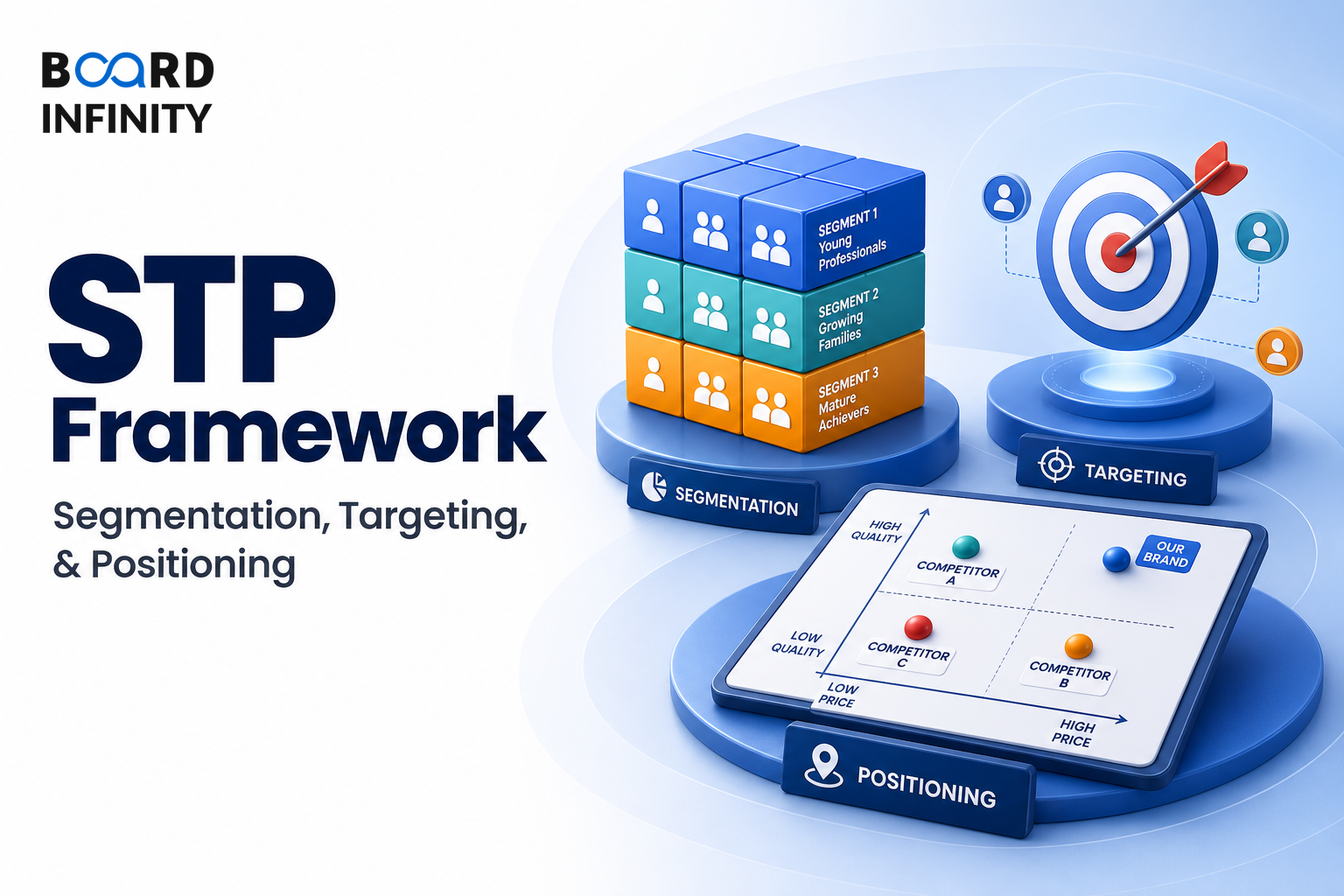
STP is the mandatory starting point for any marketing case because it answers three questions before execution begins: who exists in the market, whom should the brand serve, and what should the brand stand for. Interviewers expect you to segment first, target second and position third before jumping to the 4Ps. If you skip this sequence, your marketing plan sounds like a list of tactics instead of a strategy.
- STP is the foundational strategic framework in marketing and every marketing strategy begins with it.
- Segmentation divides a broad market into subgroups with common needs, characteristics or behaviors.
- Common segmentation bases include geographic, demographic, psychographic, behavioral and firmographic segmentation.
- Targeting means selecting the segment or segments to serve after checking whether they are measurable, accessible, substantial, differentiable and actionable.
- Positioning is about owning a clear space in the consumer's mind using points of parity and points of difference.
- In interviews, always justify your segmentation basis and targeting choice before moving to the 4Ps.
Why STP Comes Before the 4Ps
STP helps brands identify the right customers, focus resources efficiently and craft compelling value propositions. The 4Ps are only useful after the brand knows which customers it is serving and what promise it wants to make to them.
In a case interview, this sequence protects your answer from becoming too execution-heavy. Instead of starting with advertising, pricing or distribution, you first show that the marketing mix is built on a specific target customer and a defensible position.
1. Segmentation - Dividing the Market
Segmentation is the process of dividing a broad market into distinct subgroups of consumers who share common needs, characteristics or behaviors. A strong segmentation is not just a demographic label. It should reveal meaningful differences in customer needs or response to the marketing mix.
For consumer marketing cases, geographic, demographic, psychographic and behavioral segmentation are the most commonly used lenses. For B2B cases, firmographic segmentation becomes important because companies differ by industry, size, revenue, location and technology stack.
The key interview move is to state why a segmentation basis is relevant. For example, if consumers respond differently because of city tier, geographic segmentation is useful. If the need differs by lifestyle or values, psychographic segmentation is more powerful than a simple age-income cut.
2. Targeting - Choosing the Segment
Once segments are identified, the firm must decide which ones to serve. This is where a marketing case becomes strategic because the answer is no longer about describing the market. It is about choosing where the company should concentrate resources.
The source framework gives four targeting strategies. Undifferentiated targeting uses the same offering for the entire market and fits large markets or commodity products, as seen in Coca-Cola's universal Open Happiness campaigns. Differentiated targeting uses different offerings for different segments, such as Toyota with Yaris, Camry and Lexus. Concentrated targeting focuses on one specific segment, as Rolls Royce does for ultra-high-net-worth individuals. Micromarketing tailors the offering to individual customers, such as Dell's custom PC configurations and Netflix recommendations.
These five attractiveness criteria are essential in interviews because they force you to defend the target instead of merely naming it. A segment can sound attractive but still fail if it cannot be reached efficiently or if it is too small to be profitable.
A good answer also links the targeting strategy to company context. If resources are limited and expertise is deep, concentrated targeting can make sense. If the firm has resources to serve multiple segments, differentiated targeting may be stronger. If technology enables customer-level tailoring and the customer value is high, micromarketing becomes relevant.
3. Positioning - Owning a Space in the Consumer's Mind
Positioning defines what the brand should mean to the chosen target. It is not just a tagline. It is the mental space the brand wants to own relative to competitors.
The framework separates positioning into points of parity and points of difference. Points of parity are the must-haves needed to be considered a legitimate player in the category. For a smartphone, a camera, touchscreen and app store are points of parity. Without these, consumers will not even consider the brand.
Points of difference are the unique attributes that distinguish a brand from competitors. They must be desirable to consumers, deliverable by the company and differentiating from competitors. Volvo is associated with safety, while Apple is associated with design and simplicity.
"For [target market] who [need/want], [brand] is the [category] that [point of difference] because [reason to believe]."
Perceptual mapping is another useful positioning tool. It plots competing brands on two key dimensions, such as price vs quality or performance vs style, to identify positioning gaps and opportunities. In an interview, this helps you move from a generic brand promise to a sharper competitive position.
Apple is a clean example of psychographic segmentation and positioning. It targets innovation-seekers who value design and simplicity, and its point of difference is also design plus simplicity. The strategic so what is that Apple's segmentation and positioning reinforce each other instead of operating as separate choices.
Structuring a STP Framework Interview Answer
"How would you use STP before designing the marketing mix for a consumer brand?"
The strongest candidates do not list all possible segments. They choose the segmentation basis that actually explains different customer needs, then justify the target using attractiveness criteria before recommending communication or channels.
The most frequent error is jumping directly to communication without establishing STP. This costs points because promotion is only one part of the marketing mix, while the interviewer expects you to first segment the market, choose the target and define the position.