
PESTLE Analysis Explained for Marketing Strategy
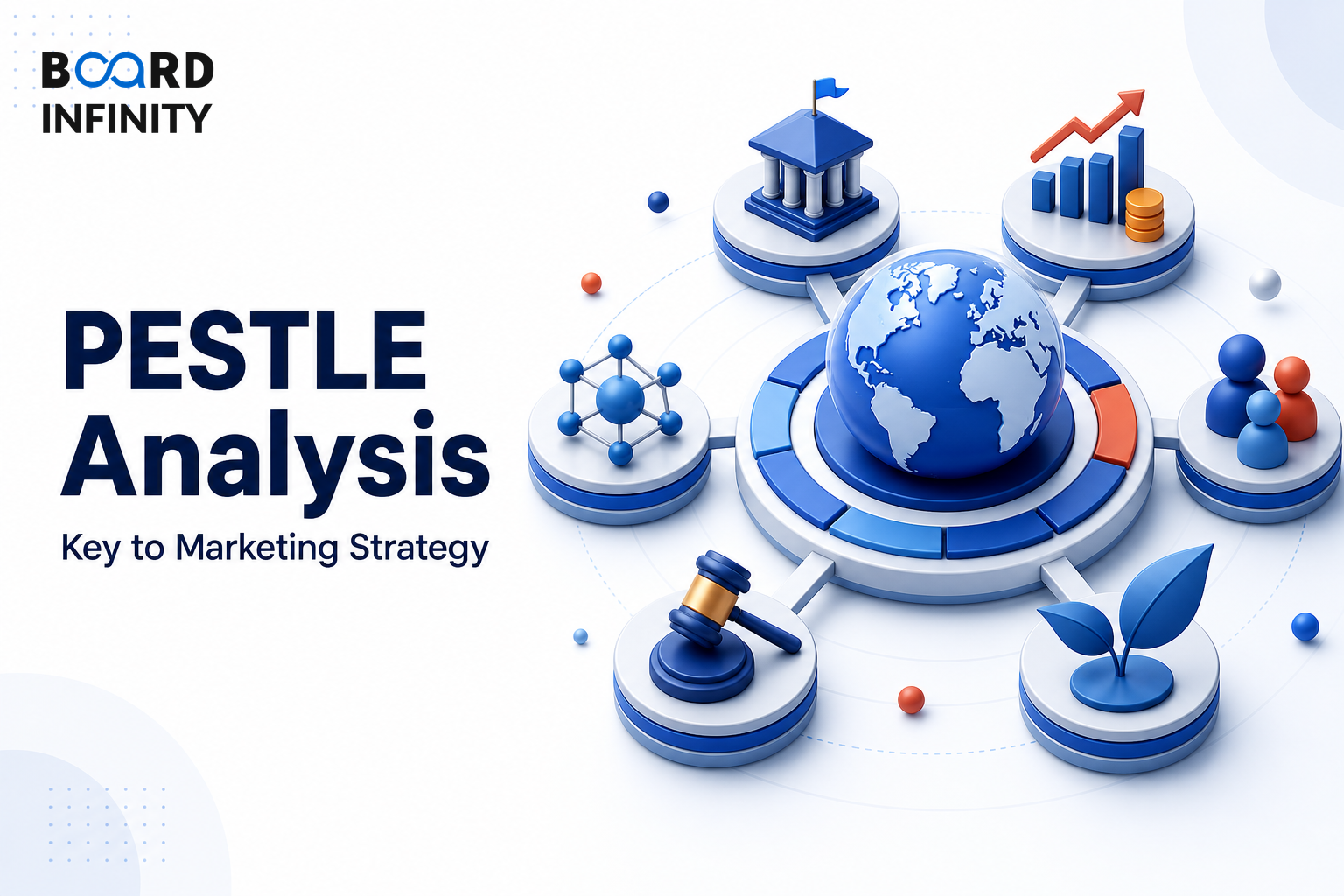
Porter's Five Forces for Marketers looks at industry competition - suppliers, buyers, substitutes, new entrants and rivalry. PESTLE analysis zooms out further and asks a different question: what is changing in the wider external environment before a marketer chooses a strategy? In interviews, especially for FMCG contexts, it helps you show that you can think beyond the brand and category to political, economic, social, technological, legal and environmental forces.
- PESTLE stands for Political, Economic, Social, Technological, Legal and Environmental factors.
- It is a macro-environmental analysis framework, meaning it scans external forces that affect a business but are typically outside direct company control.
- For India FMCG, examples include GST implementation, FDI policy in retail, rural income growth, health and wellness trends, 5G rollout, ASCI guidelines, FSSAI food labeling rules and the single-use plastic ban.
- Marketers use PESTLE before strategy decisions to identify external risks, opportunities and constraints.
- PESTLE works best when each factor is translated into a marketing implication, not just listed as a trend.
- In interviews, a strong answer links PESTLE insights to choices such as positioning, packaging, communication, channel focus or risk mitigation.
At a high level, PESTLE is a six-lens scan of the outside world. The table below shows the full framework before we go deeper into each factor.
What PESTLE Analysis Means
PESTLE analysis is a macro-environmental analysis framework that examines six categories of external factors affecting a business: Political, Economic, Social, Technological, Legal and Environmental. A macro-environment is the broader external context in which a company operates, such as regulation, consumer income, cultural shifts and sustainability pressure.
For marketers, PESTLE matters because marketing strategy is not built in isolation. A campaign, product proposition or channel plan may look attractive internally, but it can still fail if it ignores taxation changes, consumer spending patterns, advertising standards, packaging restrictions or cultural shifts.
The practical use is simple: scan the environment, identify what is changing, judge whether each change creates a risk or opportunity, and convert it into a marketing implication. In an interview, this prevents a generic answer and shows structured business thinking.
How PESTLE Differs from Porter's Five Forces
Both frameworks analyse the external environment, but they operate at different levels. Porter's Five Forces is mainly about the competitive structure of an industry, while PESTLE is about the broader external forces that shape business decisions before competition is even analysed.
A strong candidate can use both together. PESTLE tells you what is changing in the wider environment; Porter's Five Forces helps you understand how those changes may affect competition inside the category.
Political Factors
Political factors include government policies, taxation, trade restrictions and political stability. In India FMCG, the source examples are GST implementation consolidating state-level taxes and FDI policy in retail.
GST means Goods and Services Tax, a tax system that consolidated state-level taxes. FDI means Foreign Direct Investment, where investment comes from an entity based in another country, such as policy governing foreign investment in retail.
For a marketer, political factors matter because they can influence market access, retail structure, cost assumptions and the feasibility of distribution choices. The interview mistake is to stop at saying "government policy matters"; a better answer explains how a policy change affects marketing decisions such as channel planning or pricing sensitivity.
In an India FMCG case, GST implementation and FDI policy in retail are not just policy facts. They can become prompts to discuss distribution, taxation impact and how retail structure may influence market entry or expansion decisions.
Economic Factors
Economic factors include GDP growth, inflation, exchange rates, consumer spending and interest rates. GDP means Gross Domestic Product, a broad measure of economic output. In the source context, post-COVID recovery boosting discretionary spending and rural income growth are key examples.
Economic factors are especially important in FMCG because consumer spending affects what people buy, how often they buy and whether they move toward premium, value or discretionary categories. Inflation and interest rates may also influence household budgets and business cost assumptions.
In interviews, use economic factors to discuss demand conditions. For example, post-COVID recovery boosting discretionary spending can support a conversation about categories where consumers may be more willing to spend, while rural income growth can support a rural market opportunity discussion.
Social Factors
Social factors cover demographics, cultural trends, health consciousness and urbanization. In India FMCG, the source example is the rise of the health and wellness trend driving demand for organic and natural products.
This factor is central to marketing because it is directly connected to consumer needs, preferences and perceptions. If consumers become more health conscious, product claims, packaging cues, portfolio choices and communication themes may need to change.
The nuance is that a social trend should not automatically be treated as a universal opportunity. A marketer should ask which consumer segment is affected, whether the trend changes willingness to pay, and whether the brand can credibly participate in that space.
Technological Factors
Technological factors include innovation, automation, digital transformation, R&D and AI/ML. R&D means Research and Development. AI means Artificial Intelligence and ML means Machine Learning, both referring to systems that can support data-led decisions and process improvement.
The source examples are 5G rollout enabling richer digital experiences and AI in supply chain optimization. For marketers, 5G can affect the richness of digital consumer experiences, while AI in supply chain optimization can influence availability, responsiveness and execution quality.
In an interview, do not treat technology as only advertising technology. It can affect both the front end of marketing, such as digital experiences, and the back end, such as supply chain optimization that supports product availability.
Legal Factors
Legal factors include employment laws, consumer protection, IP and advertising standards. IP means Intellectual Property, such as protected brand assets or product-related rights. The source examples are ASCI guidelines on misleading ads and FSSAI regulations on food labeling.
ASCI means Advertising Standards Council of India, which is relevant when discussing misleading advertising. FSSAI means Food Safety and Standards Authority of India, which is relevant for food labeling regulations.
For marketers, legal factors matter because claims, labels and communication must be compliant. A positioning idea that sounds persuasive can become risky if it conflicts with advertising standards or food labeling requirements.
Environmental Factors
Environmental factors include sustainability, climate, ESG, green regulations and CSR. ESG means Environmental, Social and Governance, a lens used to evaluate responsible business practices. CSR means Corporate Social Responsibility, which refers to a company's responsibility toward society and the environment.
In India FMCG, the source examples are the single-use plastic ban affecting packaging and carbon footprint disclosure pressure. These factors can influence packaging decisions, sustainability communication and operational priorities.
The marketing implication is not only reputational. Environmental rules and disclosure pressure can change product packaging choices and the way a brand communicates sustainability to consumers.
Turning PESTLE into a Marketing Decision
A PESTLE analysis becomes useful only when it moves from external observation to business implication. The following process is a reusable answer structure for cases and interviews.
This structure is useful because it keeps the answer action-oriented. Interviewers are usually not testing whether you can remember six words; they are testing whether you can convert external context into a sound marketing recommendation.
Worked Example: India FMCG Health and Wellness Launch
Consider a candidate evaluating an India FMCG opportunity in organic and natural products. The situation is a market where the health and wellness trend is rising, but the brand still needs to check macro risks before deciding its marketing approach.
The key learning is that PESTLE is not a creativity blocker. It is a discipline that helps marketers avoid blind spots before investing in communication, packaging or market expansion choices.
Structuring a PESTLE Analysis Explained Interview Answer
"How would you use PESTLE analysis to evaluate an FMCG marketing opportunity in India?"
The best answers do not mechanically recite six headings. They identify which two or three factors matter most for the decision and explain why those factors change the marketing plan.
The most frequent error is treating PESTLE as a checklist of external facts without linking them to decisions. This costs points because an interviewer wants to see marketing judgment - for example, how ASCI guidelines affect communication, how FSSAI regulations affect labeling, or how the single-use plastic ban affects packaging.
Conclusion
PESTLE analysis helps marketers scan the wider external environment before committing to strategy. Use it to move from macro signals to practical choices, especially when assessing risks and opportunities in India FMCG cases.