
AIDA Model: Mapping the Buyer Journey from Awareness to Action
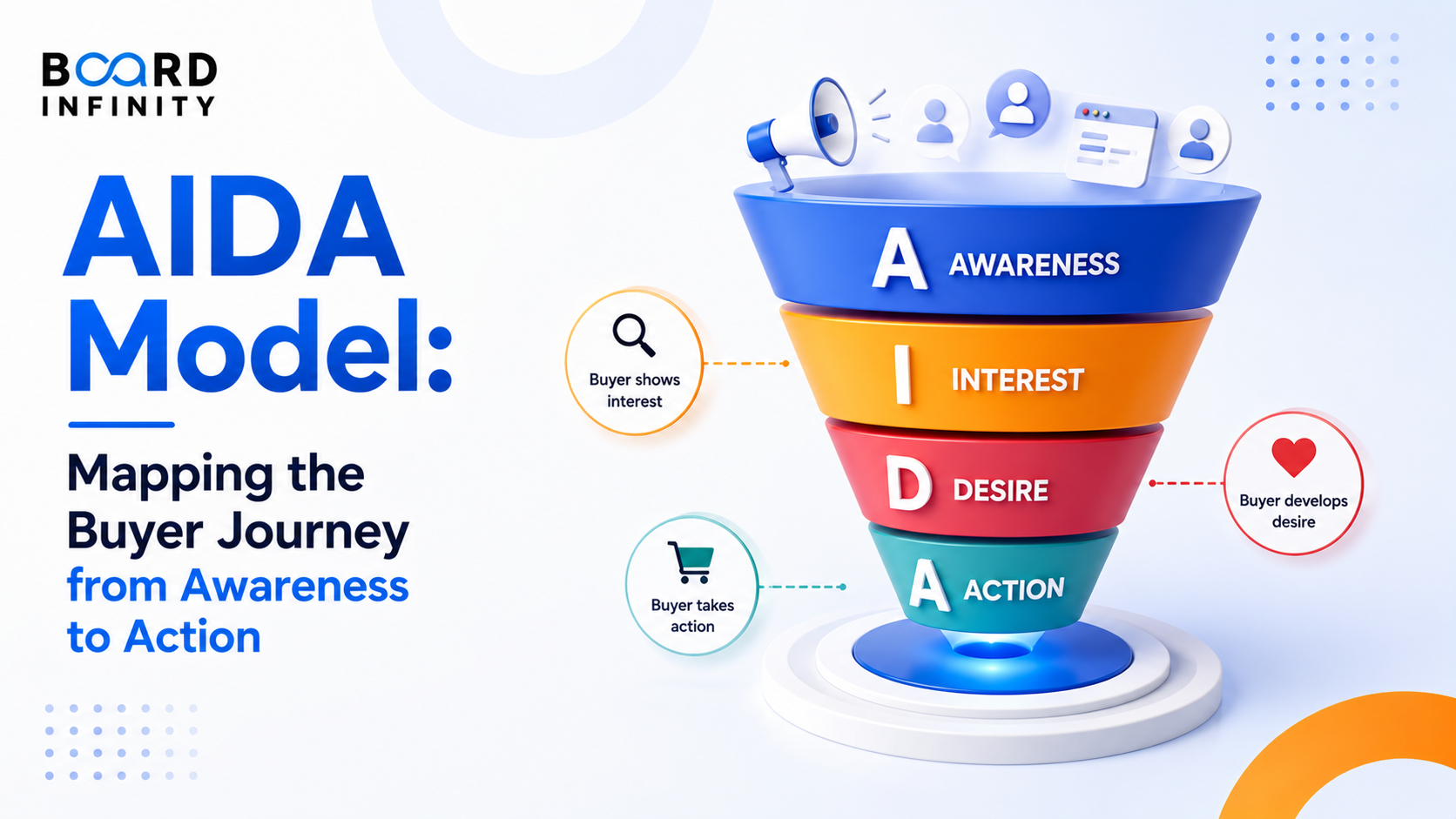
After the 4Ps and 7Ps Marketing Mix, the natural next question is: how do those marketing choices actually move a customer toward purchase? The AIDA model answers this by converting marketing communication into a simple buyer-journey funnel. It matters in interviews because it helps you structure tactics stage by stage instead of giving random ideas like discounts, ads, or app notifications without explaining where they fit.
- AIDA stands for Attention, Interest, Desire, and Action - the four stages a consumer passes through during the purchasing decision process.
- It is one of the oldest and most widely used frameworks in advertising because it links communication objectives to buyer behaviour.
- Attention is about grabbing notice and breaking through noise, such as a Swiggy app notification saying "Hungry? Order now!"
- Interest builds engagement with relevant information, such as "50% off your favorite restaurant tonight!"
- Desire creates emotional want and urgency using food images, reviews, limited-time offers, and fear of missing out.
- Action drives conversion through a clear call to action, easy checkout, and one-tap ordering.
- Some marketers extend AIDA to AIDAS by adding Satisfaction, which focuses on repeat purchase, positive reviews, and referrals.
The Big Picture: AIDA as a Marketing Communication Funnel
AIDA is useful because it gives every marketing message a job. Instead of treating all communication as a direct sales pitch, the model separates the journey into stages: first make the consumer notice, then make the offer relevant, then make the consumer want it, and finally make it easy to act.
The AIDA model describes the four stages a consumer passes through during the purchasing decision process: Attention, Interest, Desire, and Action.
In a funnel view, the same consumer may need different triggers at different moments. For Swiggy, a notification can create attention, an offer can create interest, food photography and ratings can create desire, and a saved address with saved payment can make action easier.
AIDA Stages, Objectives, Tactics, and Swiggy Example
The strongest way to apply AIDA is to map each stage to a specific communication objective and tactic. This prevents a common interview weakness: jumping straight to "give a discount" without first explaining whether the problem is awareness, engagement, desire, or conversion.
Swiggy can use AIDA to move a user from noticing a food-ordering message to completing an order. A push notification such as "Hungry? Order now!" captures attention, an offer like "50% off your favorite restaurant tonight!" builds interest, high-quality food photography with ratings creates desire, and an "Order Now" button with saved address and payment supports action. The strategic point is that each message has a different role in the purchase journey.
Stage 1: Attention
Attention is the first stage of AIDA. The objective is to grab notice and break through noise, because the consumer cannot consider, desire, or purchase something they have not noticed.
In marketing communication, attention is typically created through bold visuals, surprising headlines, or push notifications. For Swiggy, the source example is an app notification that says "Hungry? Order now!" The message is short, direct, and timed around a hunger cue, which makes it appropriate for the beginning of the funnel.
In interviews, treat Attention as a diagnosis stage. If the problem is that users are not noticing the offering, the answer should focus on visibility and message salience rather than checkout design. A strong answer would say: "At the Attention stage, Swiggy should first ensure the user notices the food-ordering prompt through a clear push notification before expecting the user to evaluate restaurants or offers."
The nuance is that Attention is not the same as persuasion. A notification may get noticed, but that alone does not create trust, emotional want, or purchase intent. It simply opens the door for the next stage.
Stage 2: Interest
Interest is the stage where the consumer starts engaging with relevant information. Once attention has been captured, the brand must answer the implicit question: "Why should I care?"
The source tactics for Interest include personalized content, social proof, and compelling copy. In the Swiggy example, "50% off your favorite restaurant tonight!" is more than a generic discount message. It combines relevance with an offer by referring to the consumer's favorite restaurant and creating a reason to explore the option.
Interest matters because it transforms a broad interruption into a personally relevant message. A user who sees "Hungry? Order now!" may notice the prompt, but a user who sees a relevant offer from a favorite restaurant has a clearer reason to continue.
For interview use, this stage is where you should connect communication to relevance. Do not simply say "run ads" or "send notifications." Explain what information the customer needs to stay engaged - for example, a meaningful offer, recognizable restaurant, social proof, or copy that makes the proposition easy to understand.
Stage 3: Desire
Desire is the stage where interest becomes emotional want. The objective is to create urgency and make the customer feel that the purchase is attractive now.
The source identifies food images, reviews, limited-time offers, and FOMO as common tactics. FOMO means fear of missing out - the feeling that delaying action may lead to losing a good offer or experience. In the Swiggy example, high-quality food photography with ratings supports desire by making the food visually appealing while also adding reassurance through reviews and ratings.
Desire is especially important in categories where the final decision is influenced by emotion, convenience, or appetite. In a food-ordering journey, the consumer may already be hungry, but desire is intensified when the app shows appetizing food images and credible ratings.
The nuance is that Desire should not be confused with Interest. Interest makes the consumer pay attention to the offer; Desire makes the consumer want the outcome. In an interview answer, you can show maturity by separating the information trigger from the emotional trigger.
Stage 4: Action
Action is the final AIDA stage, where the objective is to drive the conversion. Conversion means the desired customer response, such as placing an order in the Swiggy journey.
The source tactics for Action are a clear CTA, easy checkout, and one-tap ordering. CTA means call to action - the instruction that tells the user what to do next. In the Swiggy example, the CTA is the "Order Now" button, supported by saved address and payment.
This stage is where friction becomes critical. A customer may notice the message, like the offer, and want the food, but if the checkout is difficult, the journey can still break. That is why the AIDA model does not stop at persuasion; it also forces the marketer to think about the mechanics of conversion.
In interviews, Action is where you move from communication to execution. A strong response links the creative message to the user experience: "After creating desire through food photos and ratings, Swiggy should reduce final friction with an Order Now button, saved address, and saved payment."
Extended Model: AIDAS
Some marketers extend AIDA to AIDAS by adding a fifth stage: Satisfaction. Satisfaction means ensuring the customer is happy after purchase so that the brand can drive repeat purchase, positive reviews, and referrals.
The source notes that Satisfaction is especially critical for subscription and D2C businesses. D2C means direct-to-consumer, where a brand sells directly to customers rather than only through intermediaries. In these businesses, repeat purchase and referrals can be central to growth, so the journey does not end at the first action.
The nuance is that AIDAS does not replace AIDA. It extends the funnel beyond the first conversion. In many interview answers, especially for a food-ordering journey, AIDA is enough to structure the communication path, while AIDAS becomes useful if the question asks about repeat behaviour, referrals, or post-purchase experience.
Worked Example: Applying AIDA to a Swiggy Food-Ordering Journey
This worked example shows why AIDA is interview-friendly: it turns a broad problem into a sequence of decisions. Instead of saying "Swiggy should send discounts," you can explain what the user needs at each stage and why a specific tactic fits that stage.
How to Use AIDA as a Reusable Answer Template
For placement and case interviews, AIDA works best as a communication funnel. Start by identifying the target customer and the desired action, then move backward through the stages to decide what message or experience is needed at each point.
A useful answer structure is: "The objective is to drive action. I would use AIDA to structure the journey: first capture attention, then build interest through relevance, create desire through emotional and social proof cues, and finally reduce friction at action." This keeps the answer crisp while showing strategic sequencing.
Structuring a AIDA Model Interview Answer
"How would you use the AIDA model to improve Swiggy's food-ordering journey from awareness to order completion?"
The best answers do not list the four stages mechanically. They diagnose what the customer needs at each stage and connect every tactic to that need.
The most frequent error is treating AIDA as four synonyms for promotion. That costs points because the model is a sequence: attention is about being noticed, interest is about relevance, desire is about want and urgency, and action is about conversion friction.
Conclusion
The AIDA model is a simple but powerful way to translate marketing communication into a buyer journey. For interviews, its value lies in stage-wise clarity: know what the customer needs at Attention, Interest, Desire, and Action, then choose tactics that move the customer forward one step at a time.