
Product Life Cycle (PLC) Explained
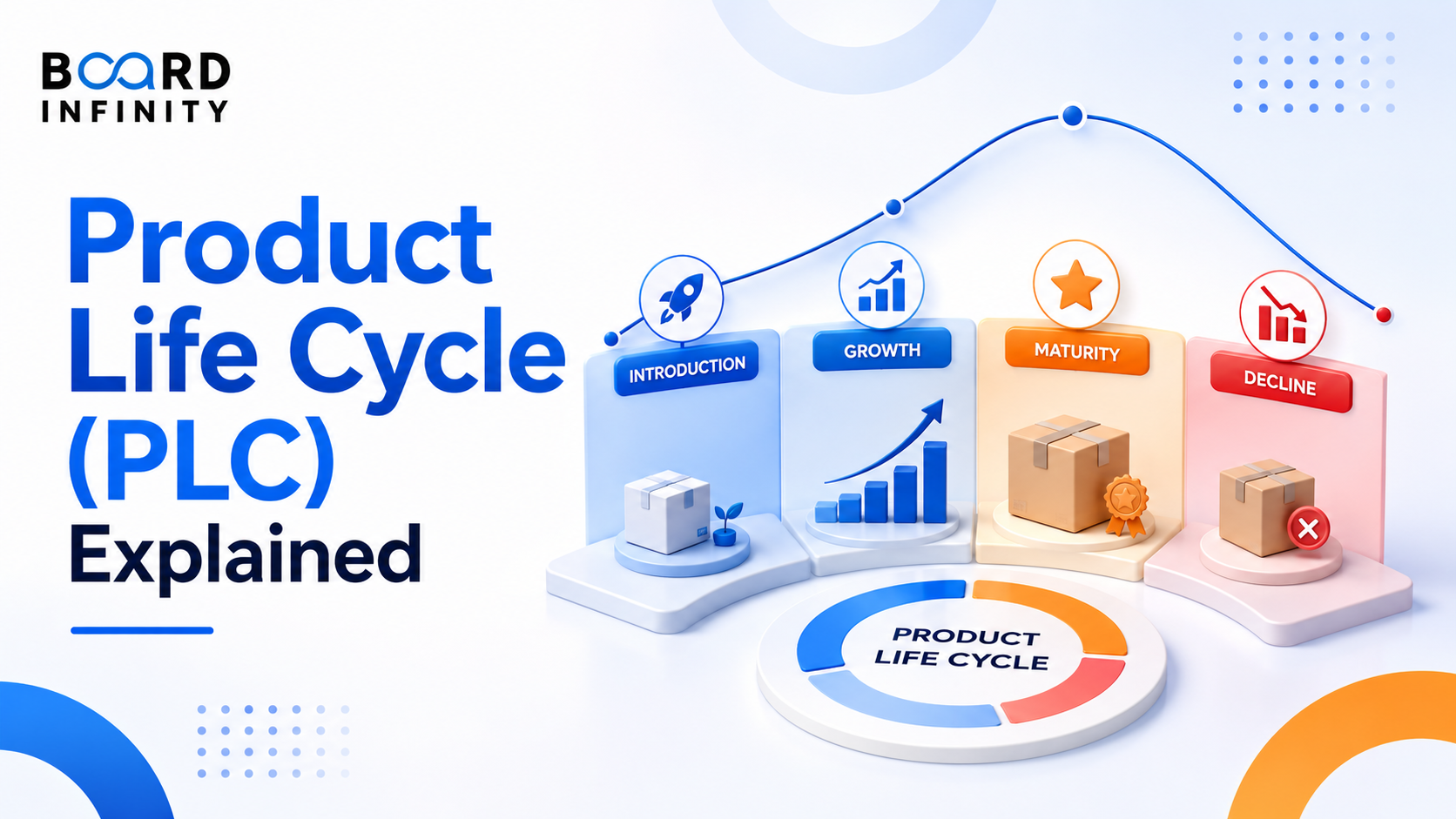
Customer-Based Brand Equity (CBBE) explains how brands build meaning and loyalty in customers minds. Product Life Cycle (PLC) answers the next practical question: as a product ages, how should marketers change product, price, promotion and distribution decisions? This matters in interviews because PLC turns a vague market situation into a stage-by-stage diagnosis of sales, profits, customers and competition.
- Product Life Cycle (PLC) is the idea that every product typically passes through distinct life stages, each needing different marketing strategies.
- The four core stages are Introduction, Growth, Maturity and Decline.
- PLC is useful because sales, costs per customer, profits, customer type and competitor intensity change across the curve.
- In Introduction, marketers usually build awareness, educate the market and use selective distribution.
- In Growth, sales rise rapidly, competitors grow and marketers focus on brand preference, wider distribution and share gain.
- In Maturity, sales peak or plateau, the mass market dominates and brands stress differentiation, efficiency and competitive pricing.
- PLC is descriptive, not predictive, so it should guide decisions but not be treated as a perfect forecast.
PLC as a Stage-Based Decision Tool
The big picture is simple: PLC maps a product against time and asks what is happening to sales, revenue, profits, customers and competitors. Once the stage is diagnosed, the marketer adjusts the marketing mix - product, price, promotion and distribution - instead of using the same strategy throughout the product journey.
Product Life Cycle (PLC) is a framework that describes how a product typically moves through Introduction, Growth, Maturity and Decline, with each stage requiring different marketing strategies.
The source identifies Quick Commerce - Zepto and Blinkit - as being in Early Growth. That means a PLC-led answer should focus on rapidly rising sales, a growing number of competitors, declining costs per customer and the need to build brand preference. The strategic so what is that the marketer should not behave as if the category is mature; the priority is to expand coverage and win share while the market is still growing.
How PLC Changes Marketing Strategy
PLC is most useful when it changes decisions. A marketer should not use the same product, price, promotion or distribution strategy for a product with low sales and negative profits as for a product with peak sales and mass-market adoption.
In many organisations, PLC is used with the marketing mix. The marketing mix means the controllable levers a brand can adjust - product, price, promotion and distribution. PLC tells the marketer which lever to emphasise at each stage.
Introduction Stage
In the Introduction stage, sales are low, costs per customer are high and profits are negative. Customers are mainly innovators, who form 2.5% of customers in the PLC view given in the source. Competitors are few or none, so the immediate challenge is not usually price warfare; it is market creation.
The product strategy is to offer a basic product. Pricing may use cost-plus or skimming, depending on the business situation. Promotion should build awareness and educate the market, while distribution is selective through limited outlets.
For interviews, the key point is that the Introduction stage is not judged only by low sales. Low sales must be read with high costs per customer, negative profits, few competitors and innovator customers. A common nuance is that heavy promotion here does not necessarily mean discounting; the source emphasises awareness and education.
Growth Stage
In the Growth stage, sales are rapidly rising, costs per customer are declining and profits are rising. Customers move toward early adopters, who form 13.5%, while the number of competitors grows. This is why the strategy shifts from only explaining the product to winning preference.
The product strategy is to add features, variants and quality improvements. Price strategy can move toward penetration pricing for share. Promotion should build brand preference, and distribution becomes intensive as coverage expands.
Electric Vehicles are identified in the source as being in Growth, while Quick Commerce - Zepto and Blinkit - is identified as Early Growth. In a case answer, that means the marketer should talk about share gain, wider availability, brand preference and competitive entry rather than treating the market as already saturated.
Maturity Stage
In the Maturity stage, sales reach a peak and then plateau. Costs per customer are the lowest, and profits are high but plateauing. The customer base is the mass market, which is 68%, and competitors are stable with consolidation.
The strategy changes because the market is no longer expanding at the same pace. Product strategy becomes diversification across brands and models, while weak items are pruned. Price strategy is to match or beat competition, promotion stresses differentiation and distribution focuses on maximum coverage and efficiency.
Unified Payments Interface (UPI) payments are identified in the source as Late Growth or Early Maturity. This is a useful interview example because it shows that real categories may sit between stages. A strong answer should acknowledge the overlap instead of forcing every market into a single clean box.
Decline Stage
In the Decline stage, sales are falling and profits are falling. Costs per customer are low, but the market is shrinking. Customers are laggards at 16%, competitors are declining and the strategic question becomes whether to phase out, harvest or selectively maintain the product.
The product strategy is to phase out weak items. Price may be cut or a premium may be harvested, depending on what remains valuable. Promotion is reduced to a minimal level, and distribution uses selective phase-out of weak channels.
The source identifies Feature phones as Decline and Direct-to-Home (DTH) TV as Early Decline. In a case interview, these examples help show that decline does not always mean immediate exit. Depending on the business model, a company may still manage channels selectively and reduce spend instead of abruptly stopping all activity.
Worked Example - Zepto and Blinkit in Early Growth
This example is valuable because it avoids a common case-interview error: naming a stage and stopping there. A complete answer must move from stage diagnosis to marketing action, and the action should change across product, price, promotion and distribution.
PLC Limitations and Nuances
PLC is a practical tool, but it is not a perfect prediction engine. The source gives four important limitations that candidates should mention when asked to critique the framework.
- Not all products follow the same pattern: some products may skip stages.
- Stage duration varies dramatically: fashion trends and kitchen appliances can have very different stage lengths.
- PLC is descriptive, not predictive: it can be hard to know which stage a product is in until after the fact.
- Marketing actions can change the curve: a successful relaunch can extend or restart the cycle.
This nuance is especially important in interviews. PLC should guide the answer, but the candidate should still use market evidence before declaring a stage.
Structuring a Product Life Cycle (PLC) Explained Interview Answer
"Quick Commerce players such as Zepto and Blinkit are in Early Growth. How would you change the marketing strategy using the Product Life Cycle framework?"
The strongest answers do not just list the four stages. They prove the stage using evidence, then convert that diagnosis into specific decisions on product, price, promotion and distribution.
Conclusion
Product Life Cycle is a simple but powerful way to decide how marketing should change as a product moves from low sales and market education to growth, maturity and possible decline. Use it as a decision tool: diagnose the stage, adjust the marketing mix and always mention its limitations.
The most frequent mistake is treating PLC as a memorised curve instead of a decision framework. That costs points because interviewers want to see how stage signals - sales, profits, customers and competition - change the marketing strategy.