
Circular Economy: Reuse, Refurbishment & Recycling Loops
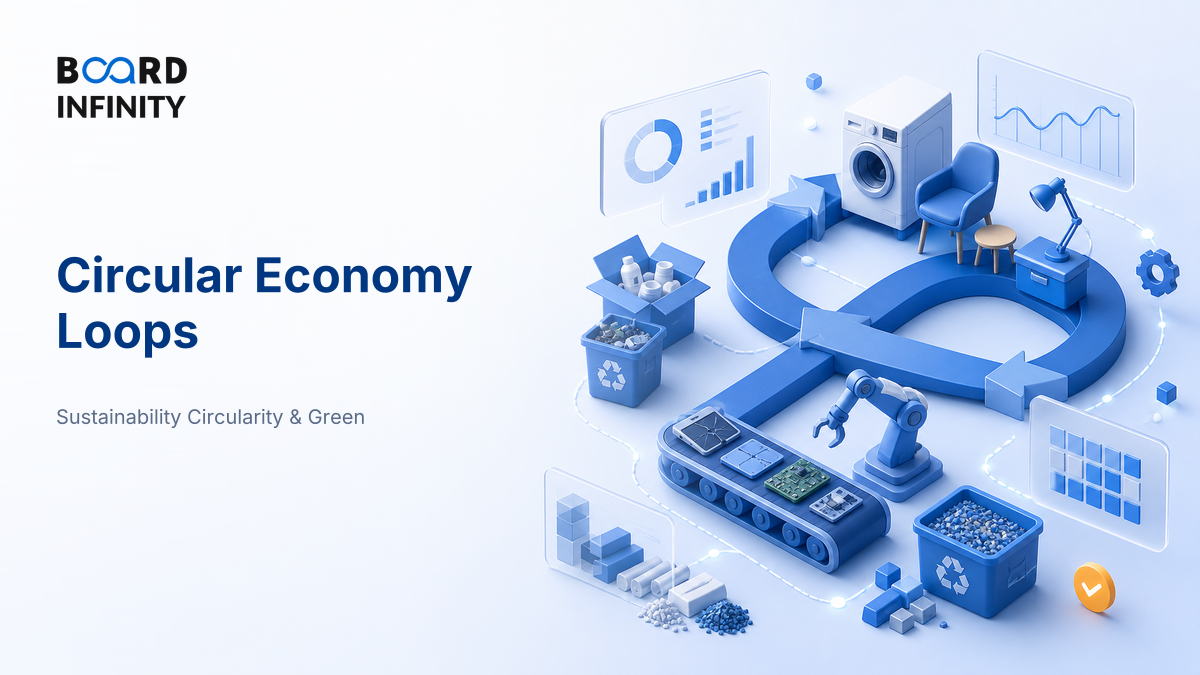
The biggest myth about circular economy is that it simply means “recycle more.” In reality, recycling is often the last resort - the real money and environmental value usually sit earlier, in keeping products in use through reuse, repair and refurbishment.
- Circular economy keeps products, components and materials at their highest value for as long as possible.
- Reuse is the tightest loop - the same product is used again with minimal processing.
- Refurbishment restores a used product to a usable, warrantable condition through inspection, repair and testing.
- Recycling recovers material value after product value is mostly lost; it is useful, but usually lower-value than reuse or refurbishment.
- The winning sequence is: design for circularity, collect the product back, sort and grade it, route it to the best loop, then measure economics and leakage.
- Interview answers should always connect circularity to business value - lower material risk, new revenue pools, compliance, customer trust and lower waste.
- The trap: treating circular economy as CSR. The fix: explain the operating model and unit economics behind each loop.
Big Picture: Circularity Is About Preserving Value, Not Just Managing Waste
A linear economy says “take, make, use, waste.” A circular economy asks a sharper question: after a customer is done with a product, what is the highest-value next use for it?
Think of circularity as a set of loops. The smaller the loop, the more value is retained. Selling the same chair again usually preserves more value than melting it. Repairing a phone usually preserves more value than shredding it for metals.
Core Explanation: The Three Loops You Must Not Confuse
The circular economy has many tools - sharing, repair, remanufacturing, composting, recycling - but for interviews, three loops matter most: reuse, refurbishment and recycling.
The hierarchy is simple: keep the product whole if possible, keep the component useful if the product cannot be saved, recover the material only when product and component value are gone.
The Five-Step Operating Model for Circular Economy Loops
A circular model fails when companies announce a recycling promise but do not build the operating system behind it. Use this five-step structure in cases and interviews.
This is where circular economy becomes a supply chain problem. The reverse flow must be designed as carefully as the forward flow. If collection is unreliable, refurbishing capacity sits idle. If grading is poor, good products get recycled too early and bad products enter resale channels. If spare parts are unavailable, refurbishment becomes slow and expensive.
For the operations side, circularity often depends on spare-parts availability and replenishment decisions; the natural next step is using AI for inventory optimisation and replenishment. For the supplier side, circular programs also require take-back terms, repair standards and service-level clauses, which connect directly to contracting, incentives and service agreements.
Key Metrics: How to Prove a Circular Loop Is Working
There is no universal “good” circularity number across phones, packaging, tyres and apparel. A strong number is category-specific, improving over time, and commercially sustainable. Use these six metrics instead of vague claims.
Worked Example: Choosing Between Refurbishment and Recycling
Suppose a retailer collects 1,000 used tablets in a buyback program. After inspection, 600 can be refurbished, 250 can be harvested for parts, and 150 must be recycled.
The managerial point: recycling all 1,000 units would be simpler, but it would destroy the value still present in 600 usable products and 250 parts donors.
Definitions You Can Say in One Breath
The Ellen MacArthur Foundation defines a circular economy as “a system where materials never become waste and nature is regenerated.”
- Reuse: Using a product again for the same purpose with minimal processing.
- Refurbishment: Restoring a used product through inspection, repair and testing so it can be used again.
- Recycling: Processing waste into materials that can be used to make new products.
- Reverse logistics: Moving products from customers back to sellers, service centres, refurbishers or recyclers.
- Closed-loop system: A system where recovered materials or products flow back into the same company or product chain.
- Open-loop system: A system where recovered materials are used in a different product chain.
Case Study: Cashify and the Circular Smartphone Loop in India
Cashify shows how circular economy becomes a business model when buyback, diagnostics, refurbishment and resale are connected in one operating loop.

India’s smartphone market creates a natural circularity problem: millions of customers upgrade devices, but the old phone still contains working components, resale value and recoverable material. The challenge is not just “collect used phones.” The challenge is to price them fairly, verify condition, refurbish economically, and resell with enough trust that a second customer is willing to buy.
Cashify built its model around this reverse flow. A customer can sell an old phone, the device is evaluated, routed for resale, repair, parts use or recycling, and the next customer gets access to a more affordable device. The primary driver is standardised grading and pricing. Supporting drivers include a customer-facing buyback channel, repair capability, resale distribution, device diagnostics and data on model-level demand.
The lesson is powerful for interviews: circular economy is not a recycling department. It is a revenue model, a quality system, a logistics model and a trust-building exercise. Cashify’s circularity works chiefly because it reduces friction in the reverse flow, supported by diagnostics, repair capability and resale demand.
How AI Changes Circular Economy: Reuse, Refurbishment and Recycling Loops
AI is making circular economy more operational, not just more aspirational. Three changes matter in 2026.
- AI-assisted grading: Computer vision and diagnostic models can help classify returned products by condition, damage and resale potential, especially in phones, electronics and apparel.
- Smarter routing decisions: Machine learning can estimate whether a returned unit should be reused, refurbished, harvested for parts or recycled based on margin, demand, failure risk and processing cost.
- Demand and parts forecasting: Refurbishment depends on the right spare parts at the right service location. AI helps forecast which parts will be needed, reducing both stockouts and dead inventory.
Student workflow: Load a company’s sustainability report, annual report and product return policy into NotebookLM. Ask it to extract the circular loops, list the evidence for reuse, refurbishment and recycling, and generate five interview questions on unit economics, reverse logistics and compliance risk.
Interview Relevance
“A consumer electronics company wants to become more circular. How would you design a reuse, refurbishment and recycling model, and how would you measure whether it works?”
Use the phrase “highest-value loop.” It signals that you understand circularity as a business design problem, not a waste-disposal slogan.
Common Mistake
Mistake: Saying “we will recycle everything” as the circular strategy. This costs candidates because it ignores value hierarchy, reverse logistics and unit economics. One-line fix: Always evaluate reuse first, refurbishment second, and recycling only when product or component value cannot be preserved.